HOME | Contact | Place Orders
1 cent | 5 cent | 10 cent | 25 cent
50 cent | Dollars | Newfoundland | Tokens
World coins
 |
 |
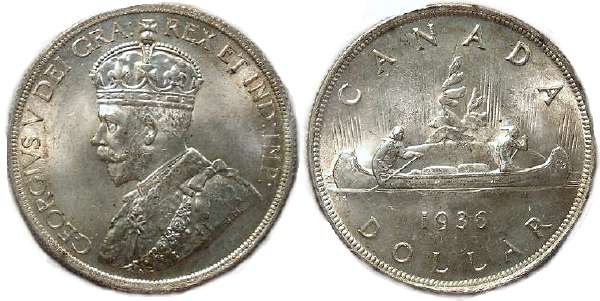
IMAGE OF 1936 TYPE ONLY
GEORGE VI
|
1937 DOLLAR 1937 dollars are found with single and double HP's and while not much more expensive the 2 x HP is much scarcer.
|
1938 DOLLAR 1938 dollars right out of the original bank rolls are often slightly scruffy looking, and often have weak rims. The rims are due to strike, but the scruffy surfaces suggest little care takes in mint handling procedures prior to them being shipped to the banks to be rolled. As this is normal for them, and grade is relative to what is normal, 1938 dollars grading MS-63 and MS-64 will not look quite as nice as on later dates, and examples in MS-64 are scarce and MS-65 are very rare.
|
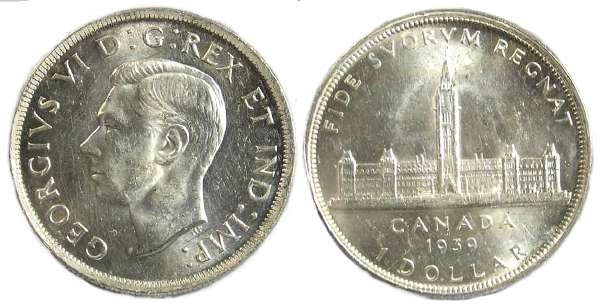
1939 DOLLAR The dollar for 1939 is again by Emaneul Hahn showing the Parliament buildings in Ottawa with FIDE SVORVM REGNAT Latin for HE REIGNS BY THE FAITH OF HIS PEOPLE, commemorating the royal visit of George VI and Queen Elizabeth to Canada.
|
No silver dollar were issued during world war II from 1940 to 1944, but starting in 1945 they were issued every year until 1967.
1945 DOLLAR Many 1945 dollars have a slightly doubling on the 5 and are known as the 5/5 variety. These were once thought to be scarcer but it has become obvious they are relatively common and might not be any scarcer than the regular 5. They no longer command any premium and personally I will not sort them out, listing them here only if mentioned on a certification holder.
|
1946 DOLLAR
|
1947 DOLLAR 1947 dollar comes with two different shaped 7's. The Blunt 7's tail points almost straight down, slightly to the left. The Pointed 7's tail has a distinct curve pointing down and slightly to the right. A somewhat scarcer variety is the Point Dot variety which has the pointed 7 with a small dot to the right of the point. The dot on these coins is in nearly the exact spot where the maple leaf occurs the next year, and some people believe it was put there to mark where to put the maple leaf, but this seem unlikely. Others believe the dot is die deterioration, however many of the 1947 Specimen sets have a point dot dollar in them, and there should not be any die deterioration on Specimen coins. What does appear to be the case, is that the 1947 point dot circulation strikes are the result of a specimen die put to use for business strikes.
|
India received its independence on August 14, 1947 requiring that IND IMP (India's Emperor) be removed from all British Commonwealth coins dated 1948 or newer. A problem similar to that in 1937 when Edward the VIII abdicated, the new obverse designs for coins all over the British Commonwealth had to be prepared at the Royal Mint in England. Those for Canada were not ready at the beginning of 1948 and coins were needed, so early in 1948 coins were struck dated 1947 so that the IND IMP design could still be used but a small maple leaf was placed after the date  indicating minted in 1948.
1947 MAPLE LEAF DOLLAR All 1947 maple dollars are of the blunt 7 variety.
|
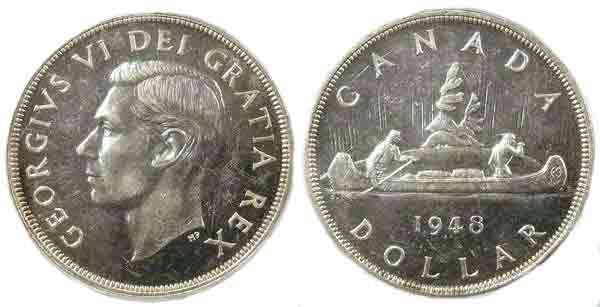
The new obverse design, again by T. H. Paget, arrived late in 1948 and was used until 1952. The inscription now reads GEORGE VI DIE GRATIA REX (Latin for George 6th, by God's Grace King) with deeper hairlines making the coins look sharper in mint state than earlier dates. This affects how the coins look in all lower grades and one cannot use the same grading standard for 1948 to 1952 dollars as for 1937 to 1947 dollars. They would have to wear to VF-30 before the hair looks a muted as it does on uncirculated examples of earlier dates.
1948 DOLLAR With a mintage of about 18,600, the 1948 dollar is the rarest Canadian circulating silver dollar. Recognized as rarities by 1950, most surviving examples saw little if any circulation and while the scarcest date they are easier to find in top quality than are 1945 and 1947 and are only more expensive than those dates because of their popularity.
|
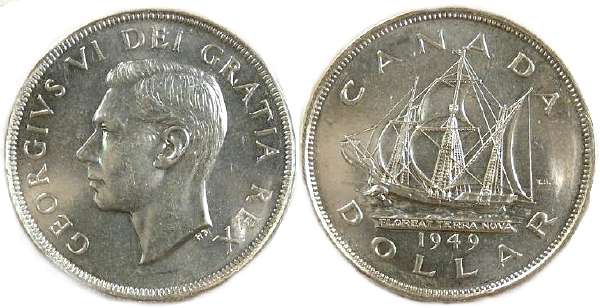
1949 DOLLAR In 1949 to commemorate Newfoundland's entry into confederation as the 10th province, silver dollars were issued depicting John Cabot's ship the Matthew in which he first visited Newfoundland in 1497. These coins commonly show up in high quality for two reasons. First, they were interesting attractive coins which many people saved rather than spent. Second, unlike most other Canadian dollars which were mint shipped to the bank in bags, these were shipped in paper tubes which stopped them from bang together in the bags. 1949 dollars are the least expensive Canadian silver dollar in MS-65 and the only date commonly found in MS-66. Because of the high demand for them the mint struck just over 40,000 1949 dollars in early 1950. I am not aware of any other year for which minting continued into the following year.
|
In 1950 the regular voyageur reverse design was resumed. During the early and mid-1950's, silver dollar dies were often re-polished to extend their use, weakening or removing some of the water lines in front of the canoe, resulting in varieties some of which are in the standard references and thus collected, and some are not.
1950 DOLLAR The 1950 dollar comes three varieties which can be difficult to differentiate as they are due to die wear and die polishing which can happen with gradual loss of detail. This is more a problem with the regular and short water line varieties where some coins are difficult to assign to one of these groups with certainty, but others are very clear. I define these has as much by the Island tip in front of the canoe as by the actual water lines:
|
1951 DOLLAR The 1951 dollar comes in the same varieties as 1950 but are more difficult to differentiate because there are more degrees of water line length. Looking at how the island attaches to the canoe (strongly or weakly) helps. The Arnprior is still pretty clear with only 1 1/2 water lines present and the lower one much shorter than the upper. 1951 dollars are found in Proof-like and are very nice coins. I am not yet certain but I believe most or all 1951 PL dollars are of the short water line variety and normally on ICCS examples the variety will not be designated.
|
1952 DOLLAR The 1952 dollar comes in regular and short waterline as with the 1950 and 1951 dollars, but on the examples with heavier die polishing the water lines were completely removed so there is a no water line variety rather than a 1 1/2 water line Arnprior type. Examples of the no waterline variety often exhibit moderate to heavy die polish lines in the fields which can reduce the look of lustre even on high grade examples. Recently I acquired a PCGS Specimen examples listed by them as just water line but which is very clearly a short waterline example.
|
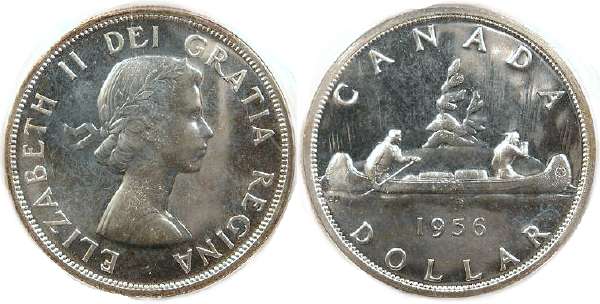
You may note that there are many dates of the 1953 to 1967 dollars which we often not have available. This does not mean they are rare or scarce when in fact for many are so common that at today's high silver prices ordinary ones even in mint condition are only worth their silver content and do not have a higher collector value. Only scarcer varieties (as noted below) or for higher than usual quality examples get listed here. If you can into our store I often have the silver values ones available in a scrap silver bin where we sell them for the price of the silver plus GST (I do not sell those by mail).
1953 NSS DOLLAR The early 1953 dies had the shoulder fold weakly cut so the shoulder fold was usual not present, although might show weakly on some well struck examples. The Queen's shoulder appeared bare which many people thought to be inappropriate. Known as the No Shoulder Strap (NSS) or No Shoulder Fold (NSF) variety, the easiest way to confirm these is by the strong serifs at the top and bottom of the I's in II and DEI on the obverse. These occasionally show up with short water lines.
|
1953 SS DOLLAR Later in 1953 the dies were re-designed with a deeper shoulder fold which usually is visible on the coins. Known as the Shoulder Strap (SS) or Shoulder Fold (SF) variety, the easiest way to be certain of this variety is because the serifs at the top and bottom of the I's on the obverse are small to the point the I's nearly appear straight. These also exist with short waterlines.
|
1954 DOLLAR
|
The term Arnprior was first applied to 1955 silver dollars with only one and a half water lines in front of the canoe, with no trace of a third waterline visible. Some references state that there are 2 1/2 water lines but are confusing the bottom of the island with a water line. These were first noticed among 2000 1955 dollars struck by special order for a business in Arnprior Ontario which handed them out as Christmas bonuses. A used reverse die had been polished, a process that removing some of the waterlines leaving only 1 1/2 visible. That die was used with two different obverse dies, one with a small crack between the T and I of GRATIA, the other a fresher die without any die cracks. Arnprior dollars with the die crack are the more desirable and command higher prices.
It is commonly believed all 1955 dollars with that obverse die crack will be of the Arnprior variety, but that is incorrect. I have seen a number 3 water line 1955 dollars with the die crack weak but visible both in Proof-like sets, and circulation strikes. Proof-like Arnprior dollars exist but only without the die break.
1955 DOLLAR As per the details above, the 1955 dollar comes in several recognized varieties and a few not or only recently recognized. Regular water line, 1 1/2 water line (Arnprior) without die break and 1 1/2 water line Arnprior with die break. 1955 Arnprior dollars in Proof-like never have the die break. A variety not listed in the standard references has short waterlines with traces of a third waterline visible. It is peculiar short waterline dollars are listed for 1950 through 1954, but they are not for 1955. Another variety only recently added to the CCN trend sheet is called the FU MANCHU, where the voyageur has what looks like a small pointed beard but is actually a die clash.
|
While silver dollars were never a widely circulating denomination in Canada, by 1955 their circulation had nearly stopped examples from 1956 to 1967 will normally be in mint (MS) condition or very close to it. Examples grading below AU-50 are very unusual and typically are coins carried as lucky coins, without actually circulating. The one exception to this appears to have been the city of Regina in Saskatchewan where a friend of mine lived in the 1960's and tells me it was the one place both silver dollars and half dollars were commonly circulating into the mid 1960's.
1956 DOLLAR
|
1957 DOLLAR Unlike other dates in this series, 1957 dollars do not occur with a strong cameo effect and those rated as cameo will only be a weak cameo effect. Only recently has ICCS began to certify any 1957 dollars as being cameo.
|
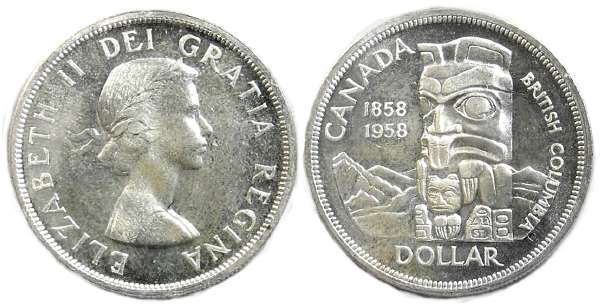
1958 DOLLAR The 1958 100th anniversary of British Colombia becoming a British Territory was celebrated with a silver dollar depicting a beaver Totem Pole of the BC coastal natives. I have heard it said this is a Death Totem and many native North Americans refuse these coins, but as far as I can see there is no truth in this. The beaver represents a strong sense of family and home, the power of working towards goals and achievements, and an understanding of the power in nature and working in harmony with it.
|
1959 DOLLAR
|
1960 DOLLAR
|
1961 DOLLAR
|
1962 DOLLAR There is a minor variety with a small triangular die clash over the Native American's shoulder that looks a little like an arrowhead.
|
1963 DOLLAR
|
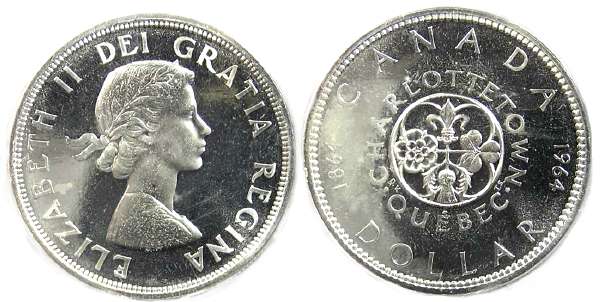
1964 DOLLAR In 1964 silver dollars were issued to commemorate the 100th anniversary of the Charlottetown Conference where, in 1864, the negotiations were started that led to Canadian Confederation as a distinct country. Some 1964 dollars are missing the dot between T and S of the designers initials. 1964 dollars exist as specimen strikes from official specimen sets, and with deep cameo, very good strikes, and without the fine dimpling on the shoulder as seen on Proof-like strikes. These are fairly rare, and without question the most beautiful of 1964 dollars. Examples certified by ICCS will be described as SPECIMEN and those by PCGS as PROOF, but both are describing the same thing. I suspect specimen is correct but they certainly look like Proof's.
|
In 1965 Queen Elizabeth's portrait was updated to a more mature look wearing a tiara. This portrait remained in use until 1989.
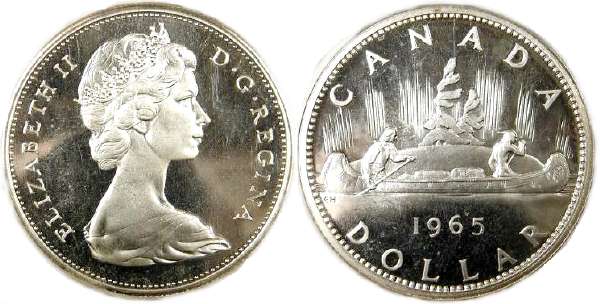
1965 DOLLAR There are 5 varieties of the 1965 dollar, depending on the size of the beads around the head, and if the 5 has a blunt or pointed end at the bottom of the curled. 1965 dollars exist as specimen strikes from official specimen sets, and with deep cameo, very good strikes, and without the fine dimpling on the shoulder as seen on Proof-like strikes. These are fairly rare, and without question the most beautiful of 1964 dollars. Examples certified by ICCS will be described as SPECIMEN and those by PCGS as PROOF, but both are describing the same thing. I suspect specimen is correct but they certainly look like Proof's.
|
1966 DOLLAR 1966 dollars come with either large and small beads on the obverse. Large bead examples are very common and all but the nicest examples are only worth their silver content. Small bead examples are extremely rare. To tell the difference, look at the A in REGINA. On common one it points at the left edge of a bead, while on the rare small bead it points between two beads. All 1966 small bead dollars have a Proof-like mirror finish so if your coin has a typical slightly matte MS finish you don't need to look at that A. With a Proof-like but not found in PL sets, ICCS grades them as MS but PCGS as PL, but they are both describing the same thing. These examples below are the common large bead unless otherwise noted. 1966 dollars exist as specimen strikes from official specimen sets, and usually have a very deep cameo, with very good strikes lacking the find dimpling on the shoulder seen on Proof-like strikes and are rare like this but the most beautiful of 1966 dollars. When such coins are certified by ICCS, ICCS calls them SPECIMEN but when certified by PCGS they are called PROOF, but both mean the same thing (I believe specimen is correct).
|

In 1967, to celebrate Canada's 100th anniversary as a country, all circulating coins depicted animals common to Canada, with a flying Canada goose on the silver dollar. Please note the examples offered here are exceptional examples, either Proof-likes, Specimens or high end MS examples, but normal examples even in MS-60 to 62 are very common and only worth the value of the silver they contain, so we do not list them here. For most cameo coins only the portrait side is where the cameo effect is important. For 1967 coins the cameo effect on the animals is important to some collectors, so for these we will note if the cameo is on Canada Goose as well.
Some 1967 dollars have a reverse rotated about 45 degrees and are known as the Diving Goose dollar. While these are struck to PL quality, they are not found in the mint sets.
1967 DOLLAR
|
The 1967 dollar was the last circulating SILVER dollar, replaced in 1968 similar dollar coins struck of nickel with no silver content. A listing of the nickel dollars will be found further below.
From 1968 to 1970 no actual silver dollars were struck and all dollar coins of those dates are of nickel.
In 1971 actual silver dollars were again struck for the collector market, usually with commemorative designs and never intended for circulation. Silver examples are 36 mm (nickel ones are only 32 mm) and from 1971 to 1991 were 500 fine (50%) silver and 50% copper containing 0.375 ounces of silver. From 1992 to 2002 and 2007 to present they are sterling (92.5% silver, 7.5% copper) containing 0.75 ounces of silver. From 2003 to 2006 they were pure (99.99%) silver containing 0.81 ounces of silver.
From 1971 to 1980 were all struck in specimen quality sold either as single coins in black imitation leather boxes, or included in the double dollar black leather box sets. In 1981 they begin to strike these in both Brilliantly Uncirculated (BU) and Proof quality (mirror fields with frosted images) with BU coins sold as single coins in hard plastic cases, and Proof coins as single coins in black leatherette boxes or included in the boxed leather Proof sets. In later dates a variety of other packaging was tried for the proof single dollars.
The examples we offer have been removed from their boxes or proof sets which are thick and thus expensive to ship, and put into other packaging thin enough to be shipped less expensive to ship. If you require the original boxes I can often ship in them extra shipping will be added to the order. If you need the original boxes, please let me know when you place your order.
My selection of available dates changes constantly and I cannot keep this part of my website up to date to it. If there is a date or dates you are looking for please contact me about price and availability. Most dates of the 500 fine series from 1971 to 1991 will generally be in the $12.00 to $15.00 range. Newer dates in the sterling and pure series after 1991 will usually be between $24.00 and $50.00 with some of the special commemorates which were sold only as single coins higher. Generally the newer the date the higher in that range they will be. The list below is just to tell you what dates and types I sometimes have in the store.
COMMEMORATIVE 500 FINE SILVER DOLLARS
|
COMMEMORATIVE STERLING AND FINE SILVER DOLLARS
|
Please note that up to 2011 when I describe a coin to be Proof-like (PL) I mean a coin from a mint set, intestinally struck to a higher quality than normal, but worth less than a MS (Mint State) coin from a bank roll in the same grade. They are fairly easily differentiated by their strike and luster. ICCS and some references call such coins NON-CIRCULATING NUMISMATIC MINT STATE which I feel will cause confusion in beginning collectors. Starting in 2012 the mint stopped making intentionally nicer coins for the standard sets and the coins are all simply MS (mint state) except for specimen and proof examples.
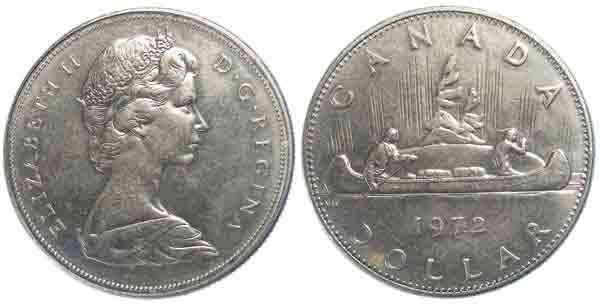
The following 1968 to 1987 dollar coins are struck in pure nickel and at 32 mm are smaller than the 36 mm actual silver dollars made during this same period. They will also attract to a magnet while the silver ones will not. During this period may dates are the standard voyageur design, but others were special commemorative's. We will note the special commemorative's in their listings, and if such is not noted you can assume it is the voyageur design.
From 1968 to 1980 these come as standard circulation strikes (MS, AU, XF, etc) which were issued in rolls through the banks, Proof-like quality strikes issued in the standard official poly-pack Proof-like sets (selected very nice coins), and Specimen strikes which were double struck to give them sharper images and higher lustre and which were issued in both the double dollar black leather box sets, and special specimens sets which in early years were in red leatherette double penny sets, and later years in the hard blue boxed sets.
From 1981 to 1986 they still come as standard circulation strikes to issue through the banks, proof-like strikes in the standard poly-pack PL sets, specimen strikes in the blue boxed sets, but in the double dollar black leather box sets they changed to Proof strikes which have mirror like fields and frosted images. A few special commemorative's were also issued in either proof and/or specimen strike in various types of single coin boxes. 1987 is different because there are no circulated strikes, but rather only Proof-like, specimen and Proof strikes in the sets.
As with the cased silver dollars, these nickel dollars from sets or issued with boxes will not be shipped without the boxes as it makes the shipping costs too high (and those from sets have to be removed from the sets). We don't have capsules for most of these so they will be in standard card 2x2's.
In 1968 there are six varieties of the nickel dollars, with the 1968 small and no island types difficult to differentiate:
1) REGULAR ISLAND (has strong water lines)
2) SMALL ISLAND (slight short water lines, clear ghost of Island seen from all angles)
3) NO ISLAND shorter water lines and only a trace ghost of Island seen only at some angles)
4) DOUBLED HORIZON AND WATER LINES.
5) EXTRA WATER LINE (above the regular ones, and found only in PL sets).
6) DOUBLE DIE REVERSE (parts of date and inscriptions heavily doubled).
1968 NICKEL DOLLAR I have noticed many 1968 proof-like dollars have flan defects as parallel horizontal lines into the flan, that were on the flans prior to striking. I will select specimens to offer below that have as few of these marks as possible (hopefully none) but if you are interested in one that has such marks clear and strong, please let me know and I can select for that feature.
|
1969 NICKEL DOLLAR
|
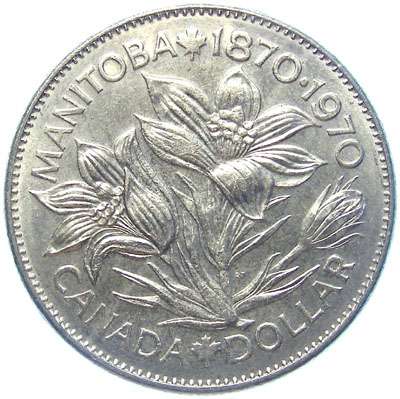
1970 NICKEL DOLLAR The 1970 nickel dollar commemorates the 100th anniversary of the Province of Manitoba's entry into confederation, and shows official Provincial flower of the prairie crocus. This type was only made in nickel.
|
Beginning in 1971, the mint begins striking three different striking qualities of coins, with a fourth added in 1981 :
Mint state (abbreviated MS) which are coins struck for issue through the banks and have average lustre and surface qualities. In most cases MS coins have little value unless in the highest range of the MS coins, and those are seldom seen. We don't list most dates in MS because they are not of high enough value to justify the time and trouble to list and/or ship them.
Proof-like (abbreviated PL) are standard mint set coins, usually from the pliofilm packaged sets, red double penny sets, and later the blue book set, but in later dates there were a variety of other types of sets they can come from. PL coins have a much higher lustre than MS coins, mostly because they are struck from dies in their newest die state. They also have very minimal marks (the average PL is a PL-64) as they did not go through as many of the mint handling processes as MS coins do, but they are not perfect coins and one should not expect them to be absolutely mark free.
Specimen (abbreviated SP or SPEC) which were in the black leather double dollar sets from 1971 to 1980, and for later dates in various types sets. Like PL coins they are struck from dies in their freshest die state but differ in being double struck to give them a higher lustre and sharper images, and they do not go through any mint handling processes before going into the sets so are nearly mark free. The rims tend and edges tend to be a little sharper although this is not obvious on a casual inspection. When we list a coin as being a specimen, it is because we personally took it from a specimen set before listing it here.
Proof (abbreviated PR) coins are very nice coins found mostly issued in the double dollar black leather boxed proof sets starting in 1981, although some specialty coins did come other ways. The coins are clearly differing from the other striking qualities by being double struck from specially prepared dies so they have mirror fields and frosted images (and ultra cameo effect) and are specially handled so they go into the sets in near perfect condition as possible.
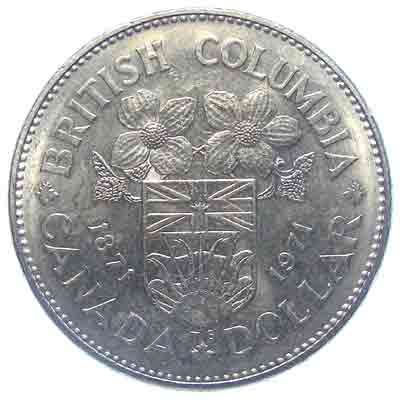
1971 NICKEL DOLLAR The 1971 nickel dollar commemorates the 100th anniversary of the Province of British Columbia's entry into confederation, with the Provincial crest with the Provinces official flower of the Dog Wood above. These made in nickel at 32 mm, as well as 500 fine silver at 36 mm. Only the nickel on is offered here.
|
1972 NICKEL DOLLAR The 1972 nickel dollar has the standard voyageur design and was made in nickel at 32 mm in MS, PL and specimen quality. They were made in 500 fine silver at 36 mm in Specimen quality. Only the nickel one is offered here although I sometimes have the Specimen examples available (ask).
|

1973 NICKEL DOLLAR The 1973 nickel dollar commemorates the 100th anniversary of the Prince Edward Islands entry into confederation, and depicts the provincial legislature building. The standard Queen's portrait is on the obverse but the same slightly modified small bust design used on the 1973 quarters. These were only struck of nickel as the 500 fine silver dollar was a different design.
|
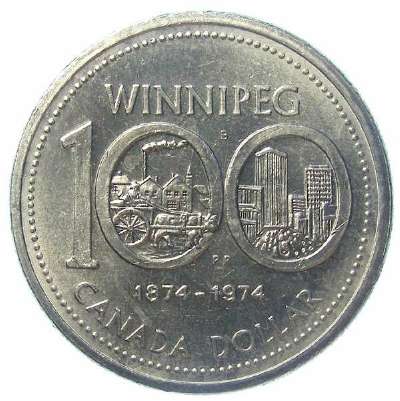
1974 NICKEL DOLLAR The 1974 nickel dollar commemorates the 100th anniversary of Winnipeg and was struck with the same design in both nickel at 32 mm and 500 fine silver at 36 mm. Only the nickel examples are offered here but sometimes I have 500 fine silver ones available (ask). There are a number of varieties in the nickel type, of which some are scarce and discussed below.
|
There are several variations of the of the 1974 nickel dollars which you will find discussed in detail on Ken Potter's website. There is also a detailed list of them in the Charlton Standard catalogue of Canadian coins, 2013 edition, pages 302-307, which is what I use to reference and price the general reverse varieties, although for the Double Yolk #1, 2 and 3 I price from the Canadian Coin News trend sheet.
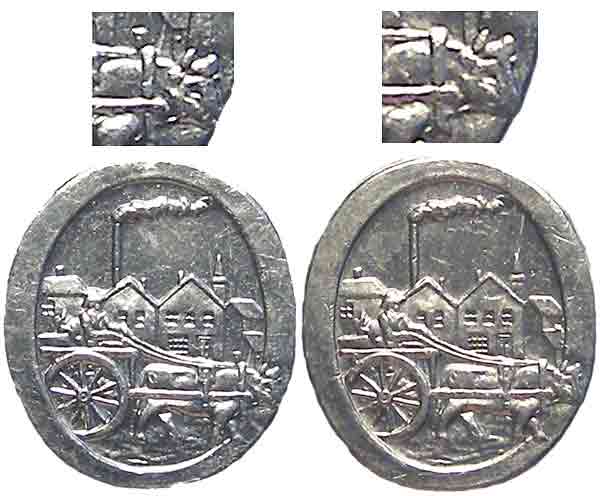
1974 NICKEL DOLLAR VARIETIES
|
From 1975 to 1981 all nickel dollars have the voyageur design although there were minor design changes in some years.
1975 NICKEL DOLLAR The 1975 nickel dollar comes in two varieties where the small jewel at the front of the Queen's tiara either attached or detached from it's support below. The attached jewel is more common and found in all striking types. The scarcer detached jewel is only found in some PL and Specimen strikes, but as there are degrees of detachment I will only call one detached if both jewels are detached (there are two side by side).
|
1976 NICKEL DOLLAR The 1976 nickel dollar comes with the same attached and detached jewel varieties, but in this case the detached jewel is the common one, and the attached jewel scarcer. Both are found in all striking types.
|
1977 NICKEL DOLLAR In 1977 and only 1977 the toothed border on the reverse was replaced by a beaded border. The northern lights behind the voyagers changes from recessed lines to more pronounced raised lines, a change that was used on all voyager design dollars up to 1987. These are also found with the attached and detached jewel varieties, plus short and long water line varieties, with three combinations known:
|
1978 NICKEL DOLLAR
|
1979 NICKEL DOLLAR
|
1980 NICKEL DOLLAR
|
1981 saw the introduction of proof sets to replace the double dollar specimen sets. The proof coins have frosted images against mirror fields and while specimen strikes continued to be struck, they were in other types of sets. Whether proof or specimen coins are easier to get as single coins, depends mostly in the value of the intact sets they come from. Generally after 2012 most proof sets are worth more intact than broken up so those coins are harder to get in proof.
1981 NICKEL DOLLAR
|
1982 VOYAGEUR NICKEL DOLLAR
|
1982 CONSTITUTION NICKEL DOLLAR A second type of 1982 nickel dollar was issued depicting the fathers of confederation seated discussing the constitution with 1867 over Confederation above and CONSTITUTION over 1982 below. A modified smaller Queen's head, with CANADA 1982 DOLLAR above and ELIZABETH II below, was used on the obverse. These are issued both for circulation (MS) and in Specimen quality in a red box but we normally ship without the box as it cannot go letter mail and adds at least $8.00 to the postage cost.
|
1983 VOYAGEUR NICKEL DOLLAR
|
1984 VOYAGEUR NICKEL DOLLAR
|
1984 JACQUES CARTIER NICKEL DOLLAR Some 1984 nickel dollars commemorate the 150th anniversary of Jacques Cartier's landing at Gaspe, Quebec. The obverse depicts Jacques Cartier on the shore with a large cross with 1534 JACQUES CARTIER 1984 on a ribbon below. The same obverse type as the 1982 Constitution dollars was used with just the date changed. These were issued for circulation as well as in Proof in a green box.
|
1985 VOYAGEUR NICKEL DOLLAR
|
1986 VOYAGEUR NICKEL DOLLAR
|
1987 VOYAGEUR NICKEL DOLLAR 1987 nickel dollars are only found in Proof-like (just over 212,000), Specimen (just over 74,000) and Proof (just over 175,500) with none were issued for circulation through banks. That is a total mintage of about 562,00 which is the lowest of all nickel dollar.
|
The aureate-bronze plated nickel Loon dollars was introduced in 1987 to replace both the nickel dollars and paper $1.00 bills. The obverse design of the Queen wearing a tiara was by Arnold Machin. The swimming loon reverse design was a joint effort of Robert Carmichael and Terrance Smith. As soon as they appeared people started calling them loonies which has stuck to this day. Some years saw special commemorative designs which will be discussed below in the appropriate years.
Introduced at 7.0 grams, 26.72 mm diameter and 1.95 mm thick of bronze plated over a pure nickel core for a total of 91.5% nickel and 8.5% bronze. In 1988 the size was reduced slightly to 26.5 mm and 1.75 mm thick while retain the weight at 7.0 grams. I have not done the measurements to find out how they reduced both the diameter and thickness without reducing the weight, but I assume the designs and rims are lower relief making the body thicker.
Only slightly heavier and larger than a quarter they were at first often mistaken for a quarter when pulled from one's pocket by feel alone in spite of being 11 sided with a smooth edge which should have allowed anyone, including the blind, to easily differentiate them. After a few years people go used to them and that confusion does not seem to exist any more.
The earlier dates tone easily and many of the MS examples I now see have considerable toning straight from original rolls. All examples I offer, including those in Proof or Specimen strikes are in standard 2x2 card holders unless otherwise specified and if there is toning I will mention it.
1987 BRASS DOLLAR 1987 Loon dollars, the first of this series, were issued in bank rolls (MS) and as Proof singles in a blue box. They are not found in the proof, specimen and proof-like sets as those contained voyageur nickel dollars instead
|
1988 BRASS DOLLAR
|
1989 BRASS DOLLAR
|
A new obverse design by Dora De Pedery-Hunt and Ago Aarand was introduced in 1990 and used until 2003, showing Queen Elizabeth wearing a diamond diadem and necklace. The reverse design remained the same as in 1987.
1990 BRASS DOLLAR
|
1991 BRASS DOLLAR
|
1992 LOON BRASS DOLLAR 1992 Loon design dollar have the same design as previous ones except the date commemorates Canada's 125th anniversary of confederation so is written as 1867-1992 below the loon. These were struck in MS, Proof-like, Specimen and Proof quality.
|
1992 PARLIAMENT DOLLAR A 1992 brass dollar commemorating Canada's 125th anniversary was issued depicting three children seated on the ground in front of the Parliament buildings, with the dates as 1867 - 1992 below the Queen's head. These are found in Mint State for circulation, proof-like and Proof but not in Specimen. The PL examples are in the official 125th anniversary quarter sets, and Proof as single coins in blue boxes.
|
1993 BRASS DOLLAR
|
1994 LOON BRASS DOLLAR
|
1994 WAR MEMORIAL BRASS DOLLAR A commemorative type was also issued for 1994 depicting the national War Memorial at Ottawa, struck only in MS for circulation and Proof in the red box proof sets (offered here without the box, but if you need the box there will be extra shipping cost). These are also known as Remembrance.
|
1995 LOON BRASS DOLLAR
|
1995 BRASS DOLLAR The second 1995 brass dollar commemorates the 50th anniversary of the founding of the United Nations and Canada's service as UN peace keepers. It depicting the Peace Keeping Monument in Ottawa which had been unveiled three years earlier and was issued in both Mint State in bank rolls, Proof-like in red card holders, and in Proof in red box proof sets.
|
In 1996 the mint introduced a lined matte finish on Specimen strikes. In most years proof-like coins have a more mirror finish but a few of the following years have a similar matte finish on both PL and Specimen strikes.
1996 BRASS DOLLAR
|
From 1997 to 2001 no brass dollars coins were struck for circulation but are available from the various types of mint sets.
1997 BRASS DOLLAR The 1997 loon dollars were struck in two types. Those in the standard cellophane proof-like and proof sets have the normal swimming loon. The proof-like sets were struck at Ottawa with a slightly lined background, and at Winnipeg with an even lustre over the entire surface. Those in the red card proof-like sets, and in all specimen sets, commemorate the 10th anniversary of the loon dollar and depict a flying loon. The PL and Specimen examples of this type have the same finish and are very difficult to differentiate (if not impossible), so I price them the same and only designate Specimen if I take it from the set myself, otherwise I list them only a proof-like.
|
1998 BRASS DOLLAR 1998 loon dollars are only be found in Proof-like, Specimen and Proof sets, as none were issued in bank rolls. Most were struck at Ottawa without a mint mark but some of the proof-like sets were struck at Winnipeg with a W mint mark to the lower right of the Queen. The finish on 1998 proof-like coins is the high luster finish of earlier years while specimen coins have the slightly matte fields introduced in 1996.
|
1999 BRASS DOLLAR
|
2000 BRASS DOLLAR 2000 loon dollars are only found in mint sets. All specimen and proof coins, plus some proof-like sets were struck at Ottawa are without mint mark. Some proof-like sets were minted at Winnipeg with the W mint mark below the Queen's head.
|
2001 BRASS DOLLAR
|
In 2002 and all years after that brass dollar were again issued for circulation as well as in the various types of mint sets, although the brass dollars in 2002 Specimen sets have a special loon dance design, then from 2004 to 2016 have a variety of other bird design.
2002 BRASS DOLLAR To commemorate the 50th anniversary of Queen Elizabeth's ascension, 2002 coins double dates 1952 over 2002 with the date on the obverse below the Queen's head. The standard loon type was issued in mint state for circulation (the first time since 1997), proof-like and proof. To commemorate the 15th anniversary of Loon dollars all specimen strikes depict a family of loons with the male doing a loon dance.
|
2003 Old Effigy Brass Dollar Coins struck earlier in 2003 have the crowned effigy of the Queen first introduced in 1990. All examples in specimen and the normal silver proof sets are of this bust type. These are also in some of the regular proof-like sets.
|
2003 New Effigy Brass Dollar Later in the year a new effigy Queen's portrait by Susanna Blunt and Susan Taylor was adopted depicting the Queen's Portrait without crown. These were struck at Ottawa without mint mark but only in MS for circulation. They were also struck at Winnipeg with the W mint mark but only in Proof-like. This is the only year where the W and P are found together.
|
2004 BRASS DOLLAR Four different brass dollar designs were issued in 2004. The regular loon design was struck in MS, PL and Proof. An Olympic Flame loon, known as the lucky loon, was issued in MS for circulation, proof-like in reddish card holders, and as a colored sterling silver Proof. A flying Canada Goose design was included in specimen sets. A design called the elusive loon depicting a loon seated on it's nest, struck in specimen quality and sold through the post offices in a wood box also containing some stamps (it is well named as they are difficult to find).
|
2005 BRASS DOLLAR Three brass dollar designs were issued in 2005. The normal loon was issued in MS for circulation as well as in PL and Proof sets. The Terry Fox commemorative design was issued only in MS circulation but comes in two varieties depending on how bold the grass next to his feet shows with the variety known as no grass is really just weak grass. The third type, issued only in specimen sets has a Puffin on the reverse.
|
Starting in 2006 the mint went crazy with designs on Loon and Loon related dollars. In 2009 alone there are at least 15 different designs as well different alloys and striking qualities, but most only issued in mint sets. From here on I will only discuss the basic designs issued for circulation and standard mint sets but will list other design when I have them available.
2006 BRASS DOLLAR For 2006 the regular loon design was struck in MS, PL and Proof with those made earlier in the year with nothing below the Queen's head but later the MS and PL examines have the mint logo below the Queen's head. An Olympic commemorative known as the Settling Loon issued in MS only. The specimen sets have a special Snowy Owl reverse.
|
2007 BRASS DOLLAR In 2007 only the standard Loon design was issued in MS, PL and Proof, and a Trumpeter Swan design in the specimen sets.
|
2008 BRASS DOLLAR For 2008 the regular loon issued in MS, PL and Proof quality. An Olympic loon dance type was issued in MS and as PL as a single coins and as part of the Vancouver 2010 Olympic sets in the blue card. An eider duck design was in the specimen sets
|
2009 BRASS DOLLAR In 2009 with the regular loon issued in MS, PL and Proof quality, a 100th anniversary of the Montreal Canadians design issued only in MS quality. A Great Blue Heron design was in the specimen sets.
|
2010 BRASS DOLLAR In 2010 saw several usual types issued in MS quality for circulation. The regular loon was issued in MS, PL and Proof quality, and comes in large (A in Elizabeth points to a bead) and small (the A points between two beads) varieties. There were a few special commemorative's issued for circulation including A 100th anniversary of the Canadian Navy and 100th anniversary of the Saskatchewan Rough Riders which are also found in 5 pack sets that are technically PL quality but look more like MS coins so I list them that way but which sometimes have a slight residue on them caused by the packaging. A Vancouver Olympic design was issued in MS and PL quality. A Northern Harrier design was only in specimen sets.
|
In 2011 the mint stopped striking intentionally superior quality coins for the standard Proof-like sets, rather using normal MS coins that bypassed some of the mint handling processes rolled coins go through. There no way to differentiate a coin from a set from a coin from a bank roll, so there is now only one category of MS (Mint state) for standard coins. This has made MS-64 and MS-65 examples a little more common, although MS-66 or higher examples are still scarce.
Some specialty designs issued only in sets for the collector market still to qualify for a description as Proof-like.
2011 BRASS DOLLAR In 2011 saw only two design issued for circulation which included the regular loon issued in MS and Proof quality, and a 100th anniversary of parks Canada in MS quality. A Great Grey owl design is in the specimen sets. A test token known as the concept loon was issued in a special issue mint set. There are two security circles, to either side of the date above the loon with a T in the one on the left and E in the one on the right (i assume meaning TEST), as listed in the Charlton Standard catalogue of 2018 on page 292. These are on brass plated steel blanks.
|
Part way through 2012 a major changed was introduced when a security circle was placed above the loon on the reverse, while there was no longer a mint logo below the Queen on the obverse. The security circle contains a small smooth maple leaf surrounded by a larger laser engraved textured maple leaf. This new type has a brighter gold colored finish that probably will resist the toning most earlier loon dollars get, with the specifications a brass plating over a steel core at 26.6 mm x 1.95 mm and 6.27 grams. Most look dollars listed below will be on these blanks unless otherwise stated.
2012 BRASS AND STEEL DOLLARS 2012 loon dollar occur in many variations and are somewhat complicated. I have done my best to work out what exists below, but is possible I will need to modify this later. Early in 2012 brass (1988 standard) loon dollars with the date as 2012 below the loon, without a security circle but with the obverse mint logo, were struck in MS (mint state) for circulation and in some specialty mint sets, and in Proof sets. Most 2012 loon dollars struck for circulation are on brass plated steel blanks with a security circle above the loon and the date as 2012 below the Queens head. Two other design were issued for circulation on brass plated steel with the security circle on the reverse and date below the Queen's head, the Grey cup and the Olympic loon. Most 2012 loon dollars in 2012 specimen sets are brass at 1988 specifications but depict a Loon mother swimming with chicks, but I have seen another type discussed below. Some 2012 loon dollars have a standard loon design without security circle but date as 1987-2012 below the loon to commemorate the 25th anniversary of the loon dollar. There are several varieties of this coin. Some are silver plated over bronze cores (non-magnetic) with a rectangle below the Queen's head indicating they are silver plated, and were sold as single coins and have a normal circulation strike finish. I have seen examples in specimen, magnetic so on brass plated steel blanks, but I am not certain which set they came from. Some are a very bright yellow with a proof finish but while non-magnetic test negative for silver so likely gold plated solid brass blanks and come from the silver dollar proof sets. Others are a slightly darker proof finish, non-magnetic but test positive for pure silver so gold plated on pure silver blanks and come from the all Silver proof lets. Another 2012 25th anniversary loon type depicts two loons swimming in opposite directions, overlayed by a large 25. These were issued as single coins as silver plated Proof and have a P in a square below the Queen's head to indicated plated. These 25th anniversary loon dollars are all somewhat difficult to find.
|
2013 DOLLAR With 2013 standard loon dollars now have the security circle so I will no longer mention it in the descriptions, although the 2013 proof loon from the all silver proof sets is gold plated silver without security circle but with a P for plated in a box below the Queen's head.
|
2014 DOLLAR
|
2015 DOLLAR
|
2016 DOLLAR
|
2017 DOLLAR Canada's 150'th anniversary as a country was celebrated in 2017, with regular coins and special anniversary coins issued. Nearly 16 million regular loon dollars issued both in rolls and some mint sets. The 150th anniversary commemorative issue depicts a view which include two trains, a tug boat, light house, bridge and top of the parliament building with roughly 10 million mintage in rolls and some mint sets. A number of other special commemorative dollars were issued. A 100th anniversary of the Toronto Maple Leafs issued for circulation, and the other types only in specialty mint sets.
|
2018 DOLLAR
|
2019 DOLLAR
|
2021 DOLLAR
|
2022 DOLLAR
|
Please note that up to 2010 I describe coins as Proof-like (PL) if they come from a mint set. PL coins are easily differentiated by their superior strike and luster, with only very minor bag marks and while nicer than MS coins from bank rolls they are easier to find in high grades and usually worth less. ICCS and some references refer to these as NON-CIRCULATING NUMISMATIC MINT STATE which I find confusing which is why I to call them Proof-like. In 2011 the mint started putting standard Mint State coins in the normal mint sets, although these bypassed some of the mint handling procedures so these coins will usually be MS-64 and MS-65. This makes those grades more common than for earlier dates. Specimen and proof sets still use specially struck coins with distinctive finishes.
In 1994 and 1995 the Royal Canadian mint was experimenting with different shapes, alloys and weights for the proposed $2.00 coins that were eventually issued in 1996. Test tokens were made of various possibilities, with 17 different types now documented. The only type officially made for sale to the public were the 28 mm, 7.30 grams, 1.7 mm thick with interrupted serrations, bi-metallic tokens of the format that was eventually adopted for the $2.00 coins.
TWO DOLLAR TEST TOKENS
|
Canada discontinued the $2.00 bill and replaced it with a bimetallic $2.00 coin in 1996. These were quickly nicknamed the twoonie. Proof-like, specimens and MS strikes are normally a 99% nickel white outer ring, and a 92% copper, 6% aluminum, 2% nickel yellow inner plug. Most have a walking polar bear design although other commemorative designs exist, which I will describe when listing them. Most Proof strikes are 8.83 grams of sterling (92.5%) silver containing 0.262 ounces of silver, with a 24 K thin gold plating over the center, although other alloys exist in 1996 and after 2011.
Proof set holders are not air tight, allowing silver coins to develop a light golden brown toning, especially around the edges. Tone free (pure white) examples can be difficult to find for some dates so one should expect a little toning around the edges, which can be fairly attractive. If you prefer white (tone free) examples please specify such on your order and I can try to accommodate such requests. Examples with heavier toning will be noted in my descriptions.
1996 $2.00 The 1996 $2.00 was issued in large numbers for circulation, and while they were not included normal Proof-like and proof sets, PL and Proof examples so exist. Both the CCN trend sheet and the Charlton Standard Catalogue of Canadian coins list these in specimen but seems to be an error referring the Proof-like which they don't list. Proof-like examples came in a mint issued blue and white card holder as a single $2.00 coin along with a 1986 $2.00 bill. Proof examples were issued as boxed single coins and are found in three alloys, cupro-nickel, silver and gold). A cupro-nickel ones weigh 7.30 grams. The Sterling (92.5%) silver examples weighing 8.83 grams. The gold examples weigh 11.40 grams with a 22k stamped next to the Queen's portrait, although only the gold colored center plug is 22K while the outer ring is 4K white gold and the over all average of these coins is 12K with a gold content of 0.185 troy ounces. Piedfort (double thickness) sterling silver proof examples were sold in a large fold over blue box contain the coin and two uncut $2.00 BRX bank notes.
|
1997 $2.00 Proof-like 1997 $2.00 coins come with two finishes on the bear. Those struck at Ottawa have a high lustre finish on the bear, those struck at Winnipeg have a frosted finish. Specimen examples have the high lustre finish on the bear with a frosted (matte) outer ring and look much like the PL Ottawa coins but with slightly sharper strike.
|
1998 $2.00 In 1998 a W mint mark was placed below the Queen's head on those struck at Winnipeg, while those struck at Ottawa do not have a mint mark. W mint mark examples are only found in proof-like sets. The finish on 1998 proof-like coins returns to overall high with a frosted bear on both Ottawa and Winnipeg mint examples. Specimen coins retain the slightly matte finish fields with high lustre designs that first appeared in 1996.
|
1999 $2.00 Two $2.00 designs were issued in 1999. All issued in Mint State for circulation have an Inuit drum dancer to commemorate the creation of the new Canadian territory of Nunavut, which can also be found in some PL, Specimen and Proof sets. The standard single bear design is also found only in Proof-like, Specimen and Proof sets, but was not issued for circulation. There were several different Proof-like sets issued, some with a standard finish on the bear and others with a frosting on bear. A rare variety known as the Nunavut Mule Error is found in some PL sets, missing the raised ring around the drum dancer. All Proof examples are occasionally missing that ring, so they are only rare in proof-like, resulting from a die intended for Proofs being accidentally finished with a PL surface and used for the PL sets. No circulation strikes are known with this error.
|
2000 $2.00 Two $2.00 designs were also issued in 2000. Those issued in Mint State for circulation all have an three bear knowledge design, which was also in some PL, Specimen and Proof sets. The second type has the single walking bear design, and is only found in some PL, Specimen and Proof sets, and some have the W for Winnipeg but those are only found in PL.
|
2001 $2.00 PL examples in 2001 have a high mirror finish with a frosted bear, while the specimen strikes have an over all matte finish.
|
2002 $2.00 To commemorate the 50th anniversary of Queen Elizabeth's ascension, 2002 coins have the double date 1952 - 2002 below the Queen's head. PL examples have a high mirror finish with a frosted bear, which the specimen strikes have outer matte finish but the a more mirror finish on the portrait and bear.
|
2003 was an interesting year for Canadian coins with a number of varieties including the introduction of a new effigy of the Queen without a crown. It is also the last year in which the W (Winnipeg mint mark was used and the only year in with the W for Winnipeg and the P for plated appear on some coins side by side, although not on the $2.00 coins.
2003 Old Effigy $2.00 Coins struck earlier in 2003 have the crowned effigy of the Queen first introduced in 1990, which has become known as the old effigy. Some examples in Proof-like, and all examples in specimen and silver proof of this bust type.
|
2003 New Effigy $2.00 Later in 2003 the Queen's bust was redesigned without a crown. Timed to celebrate the 50th anniversary of her coronation, this new effigy is sometimes called the Coronation Portrait but as it became the standard portrait for later years it is more commonly known as the New Effigy. These were issued for circulation and in some proof-like sets both with and without a W. Those struck Winnipeg with the W mint mark are not found with WP as $2.00 were not on plated blanks.
|
2004 $2.00
|
2005 $2.00 2005 proof-like $2.00 are found with both Matte and Mirror background with frosted bear finishes.
|
2006 date above $2.00 2006 $2.00 coins struck early in the year have the date below the Queen's head, with a small maple leaf above, which is not the mint logo. Those struck for circulation and in some proof-like sets have the single date as 2006 below the Queen's head. Some in Proof-like sets and all in Specimen and Proof sets have the double date 1996 - 2006 celebrating the 10th anniversary of the $2.00.
|
2006 with mint logo $2.00 Later in 2006 the mint logo of a small maple leaf in a circle was adopted for all denominations of regular Canadian coins but for the $2.00 coins this type was only for circulation, not in mint sets. A type known as the Churchill reverse was struck with very strong aurora lines above the bear, the logo below the Queen's head and the double date 1996-2006 above. Those struck for circulation at Winnipeg have an elongated slightly pointed ear on the bear and are known as the Pixie ear variety. Those struck at Ottawa have a short rounded ear with two small nicks at the top and bottom and are considered the normal type are actually scarcer at less than 1% of the Churchill variety mintage.
|
2007 $2.00 2007 $2.00 coins are found in circulation (MS), Proof-like, Specimen and Proof. There are two Proof-like varieties, with those in the standard polyethylene packaging have a mirror finish with a heavily frosted bear (as nice a the frost on most proof coins) and those in the card holders sets (birthday sets, etc) with an overall matte finish. There is no difference in rarity or value but as they are very distinctive I will list these as matte and mirror. Specimen examples have the usual matte background with more mirror finish on parts of the design.
|
2008 $2.00 2008 $2.00 coins were issued with both a standard bear design, and a special 400th anniversary of Quebec City commemorative.
|
2009 $2.00 2009 $2.00 coins from Proof-like sets are similar to the 2007 examples with two different finishes, mirror and matte, other than the bear on the mirror ones is not as strongly frosted as in 2007. These are found with two different finishes, with a third finish on the Specimen examples.
|
2010 $2.00 The 2010 $2.00 coins are found either 14 or 16 serrations on each group of serrations on the edge. Both types found on circulation (MS) strikes. The main references say only 16 serration examples are found in mint sets (proof-likes) and most have the high lustre finish with 16 serrations, but some of the specialty sets in the card holders have matte finish with 14 serrations. All specimen and proof strikes have 16 serrations.
|
In 2011 the mint stopped striking intentionally superior quality coins for the standard Proof-like sets, rather using normal MS coins that bypassed some of the mint handling processes rolled coins go through. There no way to differentiate a coin from a set from a coin from a bank roll, so there is now only one category as MS (Mint state) for standard coins. This has made MS-63 and MS-64 examples a little more common, although MS-65 or higher examples are still scarce.
Some specialty designs issued only in sets for the collector market still to qualify for a description as Proof-like.
2011 $2.00 In 2011 two different $2.00 types were issued for circulation, the normal bear type and the Boreal Forest commemorative which is the scarcer of the two but was sold in 5 coin packs which generally contain fairly nice coins in the MS-64 and MS-65 range. A concept type, used as a test token, has a normal bear with two security circles below. The circle on the left has a T inside it while that on the right has a E (short for TEST), edge lettering reading CANADA 2 DOLLARS which overlays the reeding. These are similar to those issued for circulation in 2012 and later years but without the T E for test. These are listed in the 2018 Charlton Standard Catalogue on page 284.
|
In 2012 at the same type the security devices were added the alloy of most $2.00 coins was changed to a multi-ply nickel plated steel outer ring and a multi-ply brass plated aluminum bronze inner core, which was used on all the standard bear types. Special commemorative's continue with the old 1996 alloys until 2015 when the new alloy was adopted even for them.
2012 $2.00 Early in 2012 about 1.5 million $2.00 coins were struck for circulation with the standard bear design, without laser security devices or edge lettering, as was the normal type for 2011 and earlier. Additional examples were included in standard mint, specimen and proof sets. Later nearly 83 million were struck only for circulation (none in mint sets) with laser security devices and edge lettering reading CANADA 2 DOLLARS as well as the areas of serration. 5 million additional coins depicting the ship Shannon were struck for circulation or in special 5 pack sets made with circulation (MS) strikes and for some reason most of the Shannon coins will have what looks like a very minor toning around the edges of the center core. A special wolf cubs design was also struck but only for a special issue specimen set. With only about 1.5 out of over 80 million examples the standard bear without security devices or edge lettering, these are by far the scarcer circulation type and while you would expect that to make them more expensive and difficult to find than the security device type, the numbers of them in mint sets which average MS-65 means really nice example are not difficult to find, keeping the value down. Proof examples come at 9 gram pure silver (non-magnetic) and 6.99 gram with nickel plated steel rings (magnetic) with brass plated aluminum bronze cores, the first time since 1996 proof $2.00 coins issued that were not solid silver.
|
2013 $2.00 2013 $2.00 coins minted for circulation and the standard mint sets were of the same design adopted later in 2012 with the security devices. No special commemorative's were issued for circulation but in some of the specimen sets one finds a design of bear cubs using frosted backgrounds with polished designs creating the reverse cameo effect.
|
2014 $2.00 2014 $2.00 coins minted for circulation with two designs. The standard bear design with security devices was minted for both circulation and in normal mint sets. A special commemorative was struck known as the WAIT FOR ME DADDY design showing a man going off to war with his son reaching out to him.
|
2015 $2.00 2015 $2.00 coins minted for circulation with three designs. The standard bear design with security devices was minted for both circulation and in normal mint sets. A special commemorative depicting Sir John A. MacDonald was issued only for circulation and is the scarcest of the types. A second special commemorative was issued depicting John Grey writing In Flanders Fields.
|
2016 $2.00 2016 $2.00 coins minted for circulation with two designs. The standard bear design with security devices was minted for both circulation and in normal mint sets. A standard bear but without the security devices is found in specimen strikes. The second design, commemorating the world war II battle of the Atlantic was also issued for circulation.
|
2017 $2.00 Canada's 150'th anniversary as a country was celebrated in 2017, with both regular coins and special anniversary coins issued that year. On the $2.00 coins the walking polar bear saw just under 25 million issued in both bank rolls and some mint sets. The 150th anniversary type is called Dance as it depicts the northern lights dancing over a lake with a boat, issued in both regular metal and with glow in the dark colors, with both types found in bank rolls and in some mint sets. A third $2.00 type was issued to commemorate the 100th anniversary of the battle of Vimy ridge.
|
2018 $2.00
|
2019 $2.00
|
2019 $2.00, D Day A 2019 $2.00 was issued commemorating the 75th anniversary of the end of the D-Day invasion for World War II, depicting a military Helmet and group of soldiers.
|
2020 $2.00 75th Anniversary WW II. A 2020 $2.00 was issued commemorating the 75th anniversary of the end of World War II, depicting the V/Torch design originally used on the 1943 to 1945 5 cents, with the double date 1945-2020.
|
2020 $2.00 Bill Reid In 2020 a special $2.00 was issued depicting a Haida style Grizzly Bear, commemorating the Haida artist Bill Reid. These were issued with and without color on the bear design and I believe only in MS for circulation.
|
2021 $2.00 In 2021 a special $2.00 was issued commemorating the discovery of Insulin, depicting laboratory instruments, red blood cells as well as glucose and insulin molecules. These were issued with and without light blue color on the insulin molecules and I believe only in MS for circulation.
|
2022 $2.00 In 2022 a special commemorative $2.00 was struck to commemorate the 50th anniversary of the Canada Russia hocky tournament.
|
2022 $2.00 Upon the passing of Queen Elizabeth late in 1922, a special $2.00 was struck with a black outer ring.
|
2023 $2.00 A few different $2.00 coins are struck in 2023 including one celebrating indigenous people. These 2023 coins still have the portrait of Elizabeth.
|
Please note that up to 2010 I describe coins as Proof-like (PL) if they come from a mint set. PL coins are easily differentiated by their superior strike and luster, with only very minor bag marks and while nicer than MS coins from bank rolls they are easier to find in high grades and usually worth less. ICCS and some references refer to these as NON-CIRCULATING NUMISMATIC MINT STATE which I find confusing which is why I to call them Proof-like. In 2011 the mint started putting standard Mint State coins in the normal mint sets, although these bypassed some of the mint handling procedures so these coins will usually fairly high grade (average MS-64) making those grades more common than for earlier dates. Specimen and proof coins are still specially struck with distinctive finishes.
From 1912 to 1914 Canada struck $5.00 and $10.00 gold coins to the same purity and weight standards as American $5.00 and $10.00 gold coins. Both are of a 90% gold and 10% copper alloy, with the $5.00 21.6 mm and 8.36 grams, and the $10.00 16.7 mm and 26.92 grams. Other than the denominations below the date, they have identical design wither the obverse by E. B. Mackennal and the reverse by W. Blakemore.
The Government of Canada was holding thousands of these coins ever since they were minted, which make them scarce in the market place. Recently the government sold much of those holdings and destroy many others when they refined them to recover the gold. The huge release, combined with lots of advertising created an interesting market for them, but also completely altered the supply to demand ratios for the various dates. This will have an effect on the long term prices, and we may find that the dates that were previously the rarest because they were nearly all still at the mint, are now of average rarity or even the commonest since the mint has released so many of them. It is currently not possibly to predict where they will eventually settle out although I will make my best guess below.
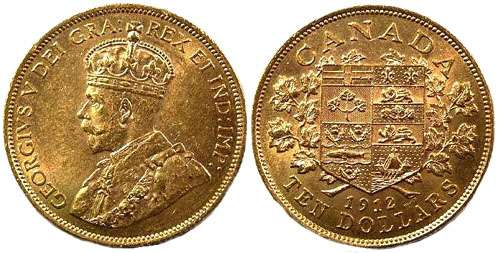
$5.00 GOLD Just looking at the mintages, the 1912 has the highest, 1913 middle and 1914 the lowest and that was reflected directly in the market up to the recent release. Because of the recent mint release it is like that the survival rate in circulated condition will still have 1912 the commonest, but in mint state it now likely 1913 is the most common, 1912 in the middle, but due to it's much lower mintage 1914 will probably still be the rarest but not by the same degree it use to be.
|
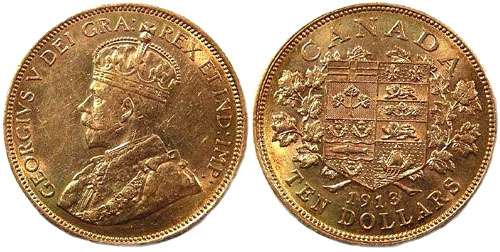
$10.00 GOLD Just looking at the mintages, the 1912 has the lowest yet the easiest to fine, 1913 middle and 1914 the lowest and rarest. The survival rate in circulated condition will still have 1912 the highest as those were released in 1912 and circulated. Due to the recent mint release of uncirculated coins, it is now likely the survival rate in mint condition will be about the same for 1913 and 1914 (they have similar mintage) and 1912 will be the rarest although since 1912 was never considered rare before, this means all three are now fairly common.
|
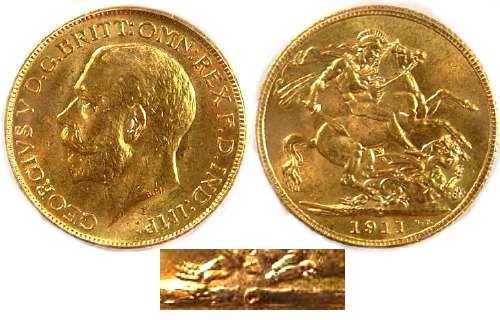
GOLD SOVEREIGNS From 1908 to 1919 with the exception of 1912 and 1915, gold sovereigns were struck at the Royal Canadian mint with a C mint mark on the ground line below the horse's hoof. 1913 has the lowest mintage at about 3700, and 1916 is second lowest about just over 6000. 1913's show up but for unknown reasons very few (possibly less than 20) 1916 C sovereigns are now known to exist and it is not known what happened to the reset. The mint has no record of destroying them, and while some people think they were lost in a ship sunk during World War I, there is a possibility they are all sitting in some bank vault as just a bag of sovereigns and might come to light some day (as happened with the 1916 London mint sovereigns that used to be rare).
|

© 1997-2024 R & T Enterprises Ltd.
 |
 |