|
Canadian coins are a specialty at Calgary Coin Gallery. This page discusses using this site for pricing, the meaning of grading and striking terms, and a warning about some fake Canadian coins that have recent appeared on the market.
Using This Site as a Price Guide.
This site is not intended as a price guide for Canadian coins but with my broad selection including a variety of grades most common dates and many scarce ones, you will be able to use it to get a general feel for the values of many Canadian coins. To accurately value your own coins you need to understand striking and grading standards which can be confusing the people who have not collected coins for many years. It is not a simple matter of "this date is worth that much". Value depends on quality as defined mostly by the amount of wear to the coin, but there are other factors. Many common coins have little or no value to collectors if even lightly circulated and for newer coins even if in as new mint state condition, although some may have value in any gold or silver they contain. The same can be true for even scarce coins in very poor condition. On the other hand high quality rare coins can be very valuable, with the key to researching values on line understanding of both rarity and quality.
If you have coins I do not list do not assume they are rare. They may be too common and of low value for me to list here, or of only gold or silver metal value so not worth listing to sell by mail. If you see a coin with a very high price and you have the same coin, the price comparison can only be made if your example is of the same quality and variety. An example would be a 1943 half dollar where in MS-64 it would list $200, in MS-60 at $75.00, in XF-40 at $10.00 and below XF-40 I would sell it off for its silver value. If you have a 1943 half dollar you cannot assess its value without understanding what MS-64, MS-60, XF-40 and other grading terms mean. With that in mind you will find and introduction to grading terms below.
Grading terms and Standards.
You will find that every coin I offer for sale has a grade (description of quality) in front of the price. Experienced collectors understand what these coded descriptions mean, but this can be very confusing to novices. Please remember that grading standards are not absolutely fixed, and not all dealers grade exactly the same way. These are the standards I use, which I believe you will find to conservative but accurate.
Each grade has two parts, a letter or letters and a number. The letter are two descriptions of same thing but within a grade there is a range and the numeric part qualifies it as being average or nicer than average within the grade, with the higher the number the higher the grade. For example a VG is a well worn coin, with a VG-8 being a very average VG while a VG-10 will be slightly nicer VG.
For every type of coin there are definitions of what must be visible to make a particular grade. It is not possible here to provide the definitions for every type of coin, so what I describe below is designed to give you the basic concepts of how much wear to expect for each grade. Canadian George V (1912 to 1936) coins are the easiest to use for this purpose, although the 5 cent and dollar coins must be treated slightly differently. The basic principle of the grade as a description of the amount of wear to the coin is all I am trying to show here. Learning to grade accurately for many different types of coins requires years of experience.
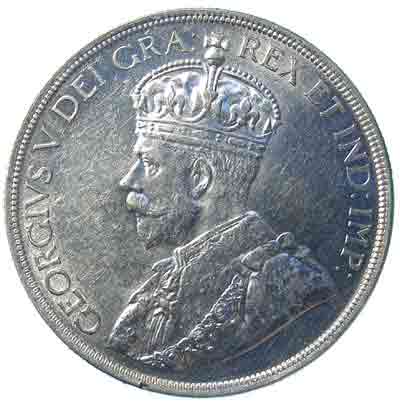
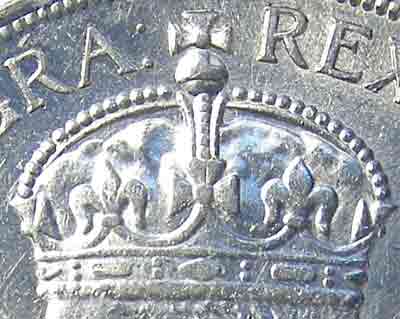
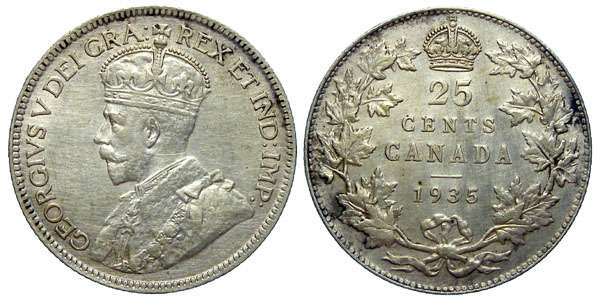
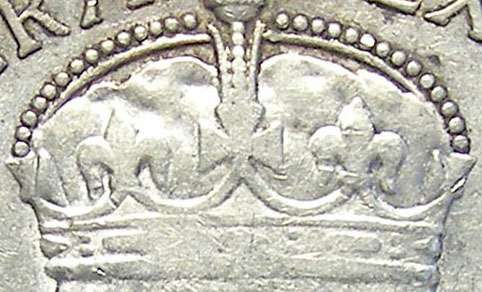
Note the band of the crown just above his ear, delineated by distinct upper and lower lines between which are three complete jewels including a center diamond shape and two squares, plus two more partial jewels at the ends. Between the jewels are a total of 8 pearls in pairs separating the jewels. There are also six small pearls up the centerline of the top of the crown. On George V coins the grade is determined mostly by how many of these jewels, pearls and band lines are visible on the coin.
MS-60 (Mint State-60) are coins with no wear even under 10 power magnification, with all of the jewels and pearls are not only clear, but very sharp. This does not mean a perfect coin as during the minting process coins are subject to several handling procedures prior to ending up on new rolls, which usually result in light marks due to contact with other coins. There are 11 different grades of Mint state from MS-60 to MS-70, defined by how few (or how many) marks they get, how well struck they are, how fresh the dies were and a few other factors. Grading at that level is very technical and cannot be addressed well on a website like this, as it takes years of experience to learn to grade high end coins properly. There are a few turns used to refer to MS range coins, such as Mint State (MS), uncirculated (UNC) and brilliant uncirculated (BU, as defined by the preservation of mint lustre).
AU-50 (About Uncirculated-50) is a coin with wear similar to that shown above with only traces of wear on the highest points. No major or minor details are worn and the six pearls up the center line of the top of the crown are all not only separate and distinct but relatively sharp (as is the rest of the coin in general). While it is not obvious on the image, there are traces of wear on the two pearls in front of the center diamond, and on the bottom two pearls up the center line at the top of the crown, which are the highest points on the coin. A coin with any wear on it cannot be called a Mint State coin. AU is normally divided into AU-50, 55 and 58. AU-58 is a coin with only microscopic wear and which probably would have been MS-63 or better without it. By the time a coin has circulated enough to wear to AU-55 you begin to see a light haze of disturbance in the luster between the portrait and lettering, caused by random multiple contact points leaving microscope marks in those areas. AU-50 and AU-55 are differentiated by the amount of that haze, and the amount of wear on those high points. As the wear is often only visible under 10 power magnification, it cannot be illustrated well on an image and requires some experience to judge accurately with the coin in front of you. On newer coins you would expect to see a significant luster on an AU-50 (at least on silver coins), but this is not necessarily required for earlier coins that have toned.
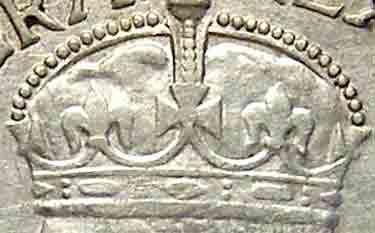
XF-40 or EF-40 (Extra Fine-40) is a coin similar to the above with no significant details worn away but there is now more visible wear on the tops of the finer details. All jewels and all 8 beads on the crown band are visible although the 2 beads in front of the center diamond can be weak as on this example. The 6 beads up the center line of the crown are less sharp and the bottom ones usually begin to merge (other than on silver dollars) as you see on this example. Other parts of the design, such as the King's shoulder decorations, begin to show minor wear which is often how you distinguished a nice XF from an AU. No luster is necessary at XF-40 to XF-45 but some will usually be present, especially on newer coins. It should be noted grading George V nickels is different because they tend to be weakly struck, often with only 4 or 6 pearls visible in mint state. Grading XF and better George V nickels requires specialized knowledge. XF (or EF) is divided into XF-40 and XF-45. The coin imaged for this grade has what are known as hairline scratches from being cleaned which is considered a significant flaw that reduces the value and should be mentioned as part of the grade description.

VF-20 (Very Fine-20) is where some finer details have begun to wear through but only at the higher points. More than 50% of the center diamond should be visible with at least five of the eight pearls present but the two in front of the center diamond can be totally gone on a VF-20. On this coin there are six visible pearls although one is weak. VF is divided into VF-20 and VF-30 with the distinction a combination of how much of the center diamond is visible and exactly how many pearls are visible. A VF-20 has at least half of diamond with 5 to 6 pearls and a VF-30 has a nearly full diamond with 6 or 7 pearls visible.
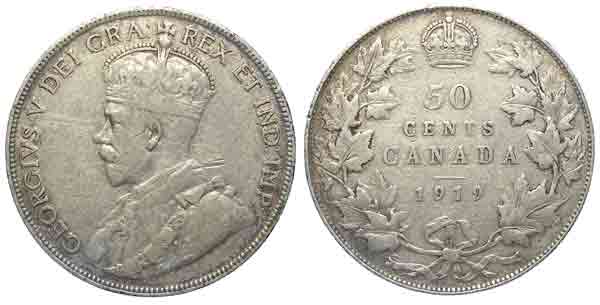
F-12 (Fine-12) is coin where major details are clear but minor details show significant wear. The most important feature is that the bottom edge of the crown band is visible all the way across, although it can be very weak with the center visible only at some light angles. None of the center diamond or any of the other jewels and pearls need be visible for a F-12 so a coin like that above with some of them is a fairly nice F-12. Fine is divided into F-12 and F-15 where F-15 will have part of the center diamond and more importantly at least four pearls visible. By the time a coin has been in circulation to wear down to F-12 you should expect some very light knocks and/or abrasions, but large ones as one sees on the King's collar on this coin should be mentioned along with the grade as they do affect the coin's value.
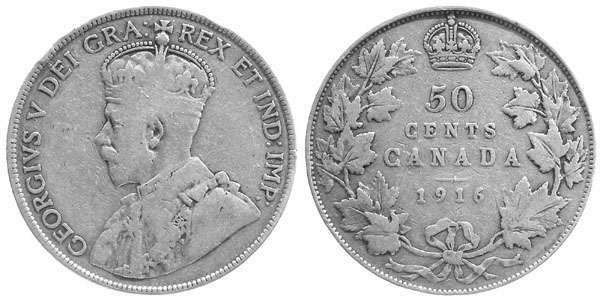
VG-8 (Very Good-8) is a coin similar to that above where the major details are starting to wear through and most of the minor details are well worn. There is still some internal detail on the portrait but the band of the crown is worn through at the middle. At least 20% of the band should be visible between the two ends combined. The center diamond, jewels and pearls on the band are now completely gone. VG is divided into VG-8 where at least 20% of the band is visible, and VG-10 which requires at least 60% of the band to be visible. The coin illustrated would grade VG-8 although it has a little more band that needed to quality for that grade.
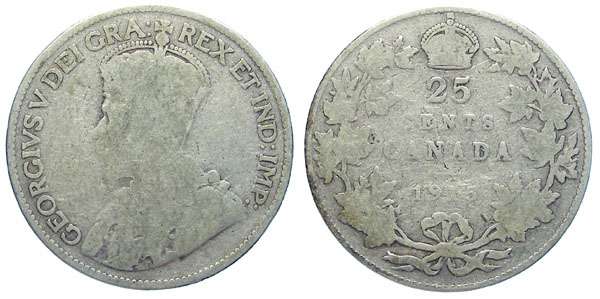
G-4 (Good-4) is a coin at least as good as the one above although in most cases it will be slightly nicer (this is the most wear a G-4 can have). Little of the crown band is visible, but the most important factor is all letters around the head are still there with no letters merged into the rim. Some lettering in the center of the reverse can be worn through, but all 4 digits of the date must be visible. G is subdivided into G-4 which is worn to where the portrait is little more than an outline and no part of the band line or internal details of the portrait need be visible. G-6 has some minor internal portrait details, often with significant parts of the ear visible, and usually 10 to 20% of the crown band present. Every date of George V coins, and even for different dies within one date, have slightly different wear patterns. The coin illustrated is a 1915 quarter, a date that seems to wear more rapidly than others, which is why this example is a good G-4 with a full inscription, but the portrait shows very little detail. On some other dates you would expect the portrait to look like this on an aG-3 where parts of the inscription are worn through. Most other dates in G-4 would have more portrait detail. Once a coin is worn to G-4 or below, you should expect it to have lots of small nicks and/or abrasions, often light scratches, which do not significantly affect its value unless they are large or deep.
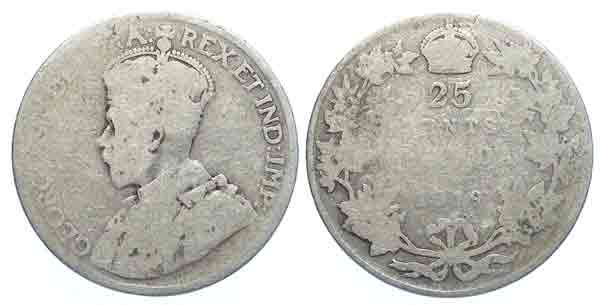
aG-3 (about good-3) is a coin so worn parts of the lettering around the portrait are no longer visible and the rims may be worn flat in places. You might not even see the entire portrait outline although on this example it is still there. The date must be readable with certainty, although it might only be faintly by the last two digits. The most important aspect of this grade is the obverse inscription is no longer completely visible. Only very rare dates have any value to collectors in this grade, and even then at a fraction of what a G-4 would bring.
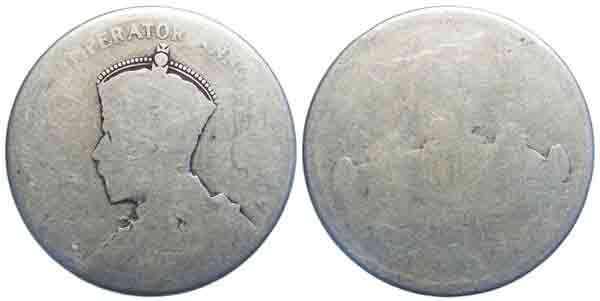
Fair-1 is a coin like this 1935 dollar so worn you can barely identify the type, the date normally cannot be read, rendering the coin worthless to even beginning collectors. Only fragments of inscriptions are visible, the portrait truncation has merged into the rim with reverse visible by traces. A Fair-2 is only very slightly better than a Fair-1 but the difference is not important for valuation.
These grading standards are based on those set down in the original 1965 Charlton grading guide book. If you have the newer edition published about the year 2000, you will notice that for the lower grades (VF-20 and below) the grades in that book are not as strict as I use here. I believe these are the correct standards and grade my coins to them. I do not agree with those shown in the new edition, but many dealers and newer collectors use them. I cannot say they are wrong to do so, just that I don't agree with them but if you are happy with those standards you will be very happy with the coins you buy from me.
The concepts of grading by the amount of wear on these George V coins apply to any coins, but the definitions of what will still be visible on each grade will vary from type to type. This page will not teach you to be a coin grader as that takes years of experience. This should give you a reasonable idea of what to expect of non-illustrated coins you order from my site, each of which has its grade listed just before the price.
STRIKING STYLES
The grade refers to the amount of wear, but there are also different striking styles or finishes, which are a different thing.
MINT STATE abbreviated MS, are coins struck to be issued through banks for normal circulation. They have gone through all normal mint handling processes leaving "bag marks" on the coins. Straight from original rolls most will have significant marks. Coins from rolls prior to the 1970's averaging about MS-62 and those from the 1970's to early 2000's about MS-63, but nice MS-64 or better coins are scarce in them. Rolls newer than the mid 2000's often average MS-63 to MS-64 with MS-65 coins fairly common.
PROOF-LIKE abbreviated PL, are coins minted for some official mint sets. The mint only called them choice MS coins, but they are early strikes from new dies put in sets having gone through far fewer mint handling procedures than regular MS coins. The luster is better and slightly different than on regular MS coins and experience collectors and dealers know them when they see them. They are not perfect mark free coins but average PL-64 or higher. The term Proof-like was invented by dealers to differentiate them from normal MS coins, for reasons I will discuss below. Proof-like sets were first sold to the public in 1954 in white card holders that were used until 1960. Starting in 1961 they were packaged in sealed cellphone packs. Single PL coins dating earlier than 1954 exist but were not sold in sets to the public. One point of common confusion is the 1953 sets issued in the same white cards but which are not PL sets. The true PL sets from 1953 and that catalogue for about $2000, were in leather cases and have more in common with Specimen sets than PL sets.
Specimen abbreviated SPEC or SP, are coins minted for special mint sets and which are from specially finished dies and struck twice to create sharper designs with either a high luster or sometimes matte finish. They have high sharp rims and design elements meet the fields at a sharp right angle. Specimens have been made since the beginning of Canadian coinage in 1858. Most early sets or single coins from sets are rare as the sets were only for government presentations, but in 1908, 1937 and 1967 sets were also sold to collectors. Starting in 1971 specimen sets for sale to collectors become part of the mints normal product line with most dates very common. Specimen coins go through even fewer mint handling procedures, and in later dates none, so should be relatively mark free averaging SP-66 or higher.
PROOF abbreviated as PR are struck only for special sets or sale as proof singles. Canadian Proof coins are struck on selected blanks. The dies have carefully polished fields with frosted designs with each coin double struck to give it a perfect sharp image. Each coin is individually taken from the die and packed to keep them virtually mark free. Frosted images and lettering against a mirror background creates and ultra-cameo effect that is extremely attractive. The typical proof coins will be PR-67 or higher, and anything below PR-66 is considered slightly impaired. Proof's were introduced to the mint product line up with Montreal Olympic coins struck between 1973 and 1976, but proof sets of all denominations do not begin until 1981. Earlier Canadian coins are sometimes seen with a cameo affect, occasionally ultra-cameo, but are not proofs. Not all world proof coins, such as US coins, have frosted images but all do share the mirror fields.
Understanding these distinctions is necessary as in many years two or more striking types exist and they are not priced the same. Once Proof-like, Specimen and Proofs sets begin to be sold in large numbers these very attractive coins are much more common and of lower value that higher quality Mint State coins, generally MS-64. For example a 1967 silver dollar, which can easily be found in PL-65 or SP-65 for only a little more than its silver value but an MS-65 from a bank roll is rare and can sell for about $500. Occasionally sellers offer PL and SP coins as high end MS coins asking MS coin prices, either because of inexperienced or sometimes they are committing fraud.
Much to my dismay the standard references have started referring to newer coins from the normal mint sets as "non-circulating Mint State" (abbreviated NCMS) or "Numismatic Brilliant Uncirculated" (abbreviated numismatic BU). While meaning the same and technically correct, this confusion between Mint State coins from bank rolls and non-circulating Mint State from normal mint sets. Proof-like for coins from normal mint sets does not create that confusion. On this website I will refer to coins from mint sets as Proof-likes, Specimen or Proof, depending on its finish and type of set it came from.
In 2011 the mint stopped making Proof-like sets using selected superior quality coins. Most standard sets starting in 2011 contain normal MS quality coins and cannot be distinguished from coins taken from bank rolls. The only coins from Specimen and Proof sets have distinctive finishes. Most coins in these sets are MS-63 to MS-65 making coins in those grades easier to find than in earlier periods. The price guides still list MS-65 coins at high prices but for coins 2011 and newer that usually cannot be justified.
THE MEANING OF RED.
When copper coins freshly first struck they come off the dies with a color described as RED. It does not exactly mean the color red, only that the coin has its original striking color. The exact color will depend on the alloy and could be anything from more yellow on brass or an off red or reddish brown on bronze alloys. When judging the red on a copper coin, one has to understand what is normal for that particular type of coin. A copper or bronze coin with no remaining red and a naturally aged surface is called BROWN, but again the exact color depends on the alloy of the coin.
Just to confuse things, many people confuse red with lustre. In most cases they go together, but lustre is a texture created during striking that causes light to reflect off the surfaces in what is often described as a cartwheel effect. As the red on a coin oxidized to brown that effect and thus the lustre is lost but not always. Rarely a brown coin will retain its lustre and be described as lustrous brown. Once lustre is gone it cannot be restored as the textures that are lustre can only be created during striking. Polishing may make the coin shine but will not have the cartwheel effect of real lustre. Someone with experience will know the difference and consider such a cleaned damaged with a much reduced value.
When a copper coin is described as RED, the degree of red required depends on the grade of the coin. It is generally accepted that a coin described as a red MS-63 requires at least 70% of the original red remaining, MS-64 requires at least 80% and MS-65 or higher requires at least 90%. Coin retaining above 95% of original lustre usually command premium although that generally applies coins at least 60 years old as newer coins are expect to be near full red. Coin retaining between 30% and 70% of the original red are described as RED AND BROWN, and below 30% as lustre as TRACE RED.
WARNING ABOUT FAKES
Recently some slightly deceiving die-struck fakes of Canadian coins have been made in China and often sold on Ebay. The sellers in China do not hide the fact they are fakes but some dishonest re-sellers later off them as fake, and the odd innocent collector who does not understand them will offer one for sale. Ebay has done a fairly good job of cleaning up this problem but some still appear and many are already out there.
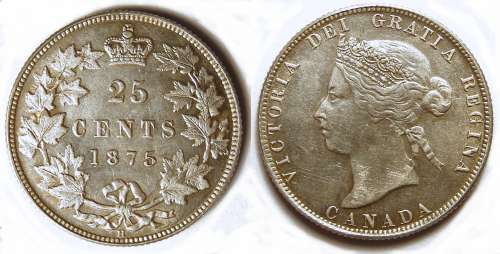
ENLARGEMENT
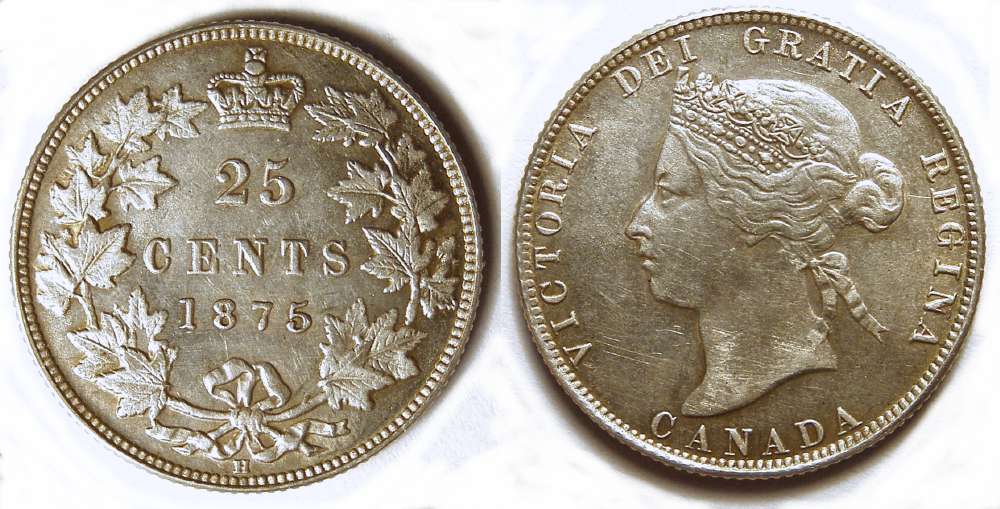
This is a typical Chinese fake from dies which appear to be made by the spark erosion process. Under a microscope it has odd surface textures and heavy die polish marks in unusual places. Viewed in the hand or on a digital image it is fairly deceptive. These exist for several dates and it appears they made the initial dies from a genuine common date, than the date modifying on their dies, usually resulting in some miss-shaped digits. I was once shown a complete date set of Victorian 50 cents all struck from the same obverse die.
Recently I came across an 1885 quarter that appeared to be of the same manufacture, and on a Sigma Metalytics tester I use it tested as non-silver, although it looked like silver. I sent it for an XRF test which came back as 73.18% copper, 21.34% zinc, 3.46% nickel, 1.30% silver, 0.46% manganese and 0.26% iron, which means it was silver plated brass.
In 2015 the Charlton Standard Catalogue (69th edition) published a list of the then known 25 cents from this fake series, pages 296 to 312. The list included 1870, 1871 H, 1872 H, 1875 H, 1881 H, 1882 H, 1883 H, 1885, 1887, 1888, 1889, 1890 H, 1891, 1893, and 1894. There is one characteristic of the fakes he lists for every date, but which one must be careful with, which is the missing stem on the lower right that attaches the maple leaf to the main branch. While he is correct for the dates he lists, for 1880 H genuine coins are missing that stem, and 1875 H the stem is very weak and might not be visible on lower grade specimens.
It appears the forgers started with a genuine coin of 1880 H, and used it to produce spark erosion dies, then modified the dates on those dies to produce other dates, in some cases resulting in a characteristic seen on some genuine Heaton Mint coins showing up on London mint coins that should never have that characteristic.
Top of page
© 1997-2023 R & T Enterprises Ltd.
|