HOME | Contact | Place Orders
1 cent | 5 cent | 10 cent | 25 cent
50 cent | Dollars | Newfoundland | Tokens
World coins
 |
 |
Mature Head
|
1876 H CENT I find it interesting that these 1876 H coins, struck at Heaton mint, use the same obverse 1 design as the London mint coins in following years. In other denominations the Heaton mint dies are different than London mint dies, so it seems likely these 1 cent dies were cut at London for use at Heaton.
|
The 1876 issue was fairly large and satisfied Canada's need for 1 cents for several years, resulting in no 1 cent coins struck from 1877 through 1880.
1881 CENT There are a few small varieties for 1881, including obverse 1 and 1a, double punching of various letters, and some N's missing part of their serifs. For the most part I do not bother to sort these out.
|
1882 CENT This is the first year with two different portrait varieties, obverse 1 and 2 which I do sort out. There are minor varieties of obverse 1/2 or 2/1 as well as some double punched lettering, but I make no attempt to sort those out. Obverse 1 and 2 are fairly easy to sort out, as Victoria's chin on obverse 1 has a smooth line at the bottom, which on Obverse 2 there is a small dimple on the bottom line of her chin.
|
No 1 cent coins were issued in 1883.
1884 CENT Both Obverse 1 and 2 occur in 1884, but obverse 1 much scarcer than obverse 2 and I suspect they were just using up a left over obverse die originally mean for use in 1882 and which most likely had already used on some 1882 coins. This need research because if it is the case 1884 obverse 1's should have been struck with a slightly worn obverse die.
|
No 1 cent coins were issued in 1885.
1886 CENT Both obverse's 1 and 2 occur in 1886 but obverse 1 is scarcer than 2 but not as scarce as for 1884. This is the last year in which obverse 1 was used.
|
1887 CENT Only obverse 2 occurs in 1887.
|
1888 CENT All 1888 cents are obverse 2. Some 1888 cents are found with doubling on part of the date, with either one or two of the 8's doubled with those with the middle 8 doubled listed by Hans Zoell as RT9e. I generally do not sort out those varieties.
|
No Canadian 1 cent or 50 cent coins were minted in 1889, and the 5, 10 and 25 cents are all scarce. There was an economic contraction in Canada during 1889 and the first part of 1890, likely reducing the demand for new coins.
1890 CENT All 1890 are obverse 3. Some examples have a doubled (re punched) 8.
|
1891 CENT In 1891 there are three major varieties OF large cents, each of which can be found with either obverse 2 or 3a:
Depending on the reference you are using, the letters designating the variety can be reversed. For example, SD LL for Small Date with Large Leaves might also be designated as LL SD for Large Leaves with Small Date.
|
1892 CENT This is the only year with three difference obverse types, listed in the references as obverse's 2, 3 and 4. Many people have trouble telling these obverse's a part. The first problem is the references list obverse 3 which was not used in 1892, rather they used 3a which has long uprights serifs on the center of the E's, the only obverse like that. This will be clear in all grades. In my opinion this should have been called obverse 5 but as all references call it 3 so I list them that way. If you have eliminated obverse 3, obverse 4 has a fairly heavy jowl line coming down from the mouth bending back along the jaw, while the ribbon end on the shoulder is fairly pronounced. As these are not clear on worn specimens you also look at the dimple under Victoria's chin which is just barely present so her jaw line looks smoother, closer to an obverse 1. Obverse 2 has a minor jowl line only coming 1/2 way down from the mouth, does not bend back along the jaw and the ribbon end is weaker nearly blending into the shoulder. On worn specimens one should look at the jaw line which on obverse 2 has a fairly distinct dimple in the base.
|
From 1893 to 1901 only obverse 4 was used, so I will not mention any obverse types for these dates. |
1893 CENT
|
1894 CENT There is a scarce variety in 1894 cent where the 4 is thicker than most examples. Some references call it large and others a thick 4 but there is no significant size difference so thick 4 describes it better. In my experience the thick for is scarcer, possibly by 50 to 1.
|
1895 CENT
|
1896 CENT There are two varieties in 1896 with most of the coin a very evenly spaced date but on a few examples the 6 is farther from the 9 resulting in what is known as the FAR 6 variety. The easiest way to tell the difference is that on the regular variety the 6 is centered below the NT of CENTS, but on the Far 6 variety the right edge of the 6 is below the left edge of the T.
|
Normally coins wear equally on both sides but starting around 1897 and continuing for about 10 years, some large cents were struck with a concave reverse die resulting in a convex reverse which wears more quickly than the obverse. Such coins can be Fine or VF on the portrait but yet on the reverse the CE of CENTS is very weak or even worn through. There is no standard way to grade such coins so will split grade them, listing the obverse grade first and the reverse as G-4 or G-6 depending on how worn it is, and will price them accordingly. |
1897 CENT
|
While not listed in the CCN trend sheet or the standard listings in the Charlton catalogue, the position of the H on the 1898 H 1 cent comes in two major varieties of a low and high H. On the high H the top left of the H will touch or slightly over lay the left above. On the low H the H will not touch the leaf at all. On looking at a group of 20 of these right now, there was a roughly even split between the two types so there is no difference in rarity or price and as this is a relatively unimportant variety I will not note this variety in my listings, but if you are specific about which you want when ordering, I will try to sort it out for you.
1898 CENT
|
1899 CENT
|
1900 CENT
|
1900 H CENT The 1900 H cent sometimes causes confusion because the H small and while centered below the date it is between the bottom leaf and the rim denticles and can be difficult to see. People are often looking for it above the ring of beads as it is on the 1907 H, so do not see it.
|
1901 CENT The average quality in which we see 1900 1 cents is nicer than for earlier dates, reflected in a lower prices for higher grade examples. This was the last year for Queen Victoria resulted in people putting these 1 cents to save as the Edward VII designs were introduced. To this day people still do this when a type is phased out, expecting them to one day become rare which actually causing them to be the most common and least valuable in the series. We see this with the 1920 large cent, 1936 small cent, 1952 George V cent, and the 2012 final issue of the 1 cent.
|
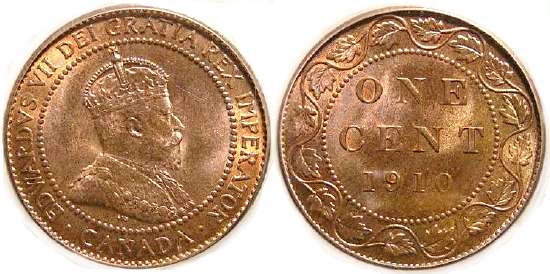
Prior to 1908, Canadian coin without a mint mark was struck at the Royal Mint in London England and the 1907 cents With an H mint mark (centered below the date, above the ring of beads) were struck at the Heaton mint at Birmingham England. Starting in 1908 all Canadian cents were struck at the Royal Canadian mint in Ottawa.
This Obverse type was designed by G. W. DeSalles, with the reverse the same type designed by Leonard C. Wyon used since 1858. These were struck from an alloy containing 95% copper, 4% tin and 1% zinc. The standard weight was 5.67 grams with a diameter of 25.4 mm (1 inch).
While the alloy remains the same, something is different starting about 1904 as it is common to see coins with streaks of differential tone, and sometimes streaks of lustre or scattered spots of lustre, which are not normal on earlier dates. These suggest the alloys might not have been well mixed so that there are areas of higher and lower tin and zinc contents across one coin, which cause different types of toning. It is also common to see examples between 1903 to 1909 which tone a much lighter brown than is normal on other dates, but is not due to cleaning.
1902 CENT
|
1903 CENT
|
1904 CENT
|
1905 CENT With a mintage of about 2 million 1905 is the scarcest of the Edward VII large cent, although none of them can be considered rare.
|
1906 CENT
|
1907 CENT
|
1907 H CENT The H on a 1907 H is centered below the date, just above the inner ring a beads, unlike some earlier dates where it is lower between the leaves and the outer ring of beads. The exact position and size of the H varieties slightly between coins, and on some coins can be very small. This is the last Canadian coin struck at the Heaton mint.
|
The Royal Canadian Mint opened in Ottawa in 1908 after which nearly all Canadian coins were minted in Canada. While the designs and alloy specification remain the same, there appears to be some type of change in the metallurgy. When they tone they are often a paler brown than earlier coins, and if cleaned have are more yellow-brown color. Often there are streaks of brighter yellow that do not tone as much as the rest of the coin, which if light does not affect things but when more dramatic I personally find somewhat unattractive (I will describe it when dramatic). I don't know enough about the alloys to say what changed, but I suspect there is an increase in the zinc content in some specimens (that could cause the more yellow color and different toning) and poorer quality mixing of the alloys than was done in England would explain the streaks.
1908 CENT
|
1909 CENT
|
1910 CENT
|
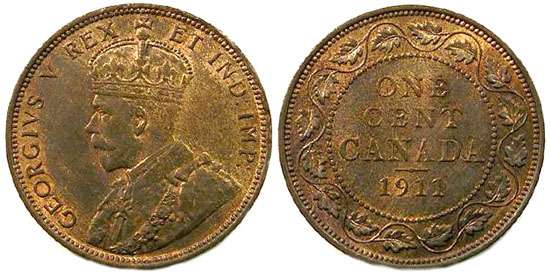
This Obverse type was designed by Sir E. B. MacKennal, and the reverse by W. H. J. Blakemore. These were struck from an alloy containing 95% copper, 4% tin and 1% zinc. The standard weight was 5.67 grams with a diameter of 25.4 mm (1 inch). All were struck at the Royal Canadian mint in Ottawa.
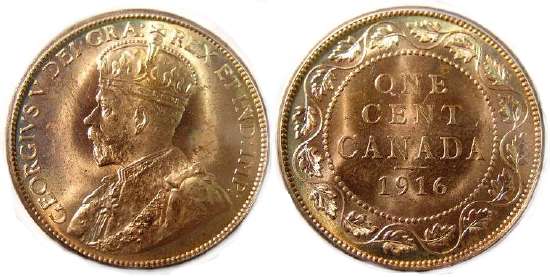
1911 CENT George V coins were introduced in 1911 without "DEI GRATIA", Latin for "God's Grace", in the obverse inscription. Known as the "GODLESS COINS" there was a public out rage or in 1912 "DEI GRATIA" returns to Canadian coins making the 1911's a one year type coin.
|
1912 CENT
|
1913 CENT
|
1914 CENT With a mintage of about 3.4 million the 1914 is the scarcest date of George V large cents, although only by a little and only commands a premium in the higher grades. The 1911 in has a higher mintage but due to being a one year type is in higher demand than the 1914.
|
1915 CENT
|
1916 CENT
|
1917 CENT
|
1918 CENT
|
1919 CENT
|
1920 LARGE CENT
|
1920 was both the last year in which they struck large cents, and the first year in which small cents were struck. A considerable number of the 1920 large cents were melted for striking of 1920 small cents, but both large and small cents remain relatively common.
1998 LARGE CENT To commemorate the Royal Canadian Mint's 90th anniversary special sets were struck with the sizes, sterling silver alloy (other than the 1 cent), and reverse designs of the 1908 coins, and and obverse showing Queen Elizabeth's portrait and date as "1908 - 1998". The early sets have an antiqued matte-proof finish that proved unpopular and were discontinued so now the scarcer of the two finishes. The later sets are mirror-proofs. The mint wanted to advertise these as all silver so the 1 cents are struck on copper plated silver, I believe the first coins ever struck that way. The designer forgot one cents should have "Canada" be below the Queen's portrait resulting in the antiqued matte-proof cents being the only Canadian coin without "CANADA" anywhere on them, but this was corrected on the mirror-proof examples.
|
2011 LARGE CENT To commemorate the 100th anniversary off the 1911 silver dollar special sets replicating all the denominations of 1911 coins were struck in 2011 coins using the George V portrait and obverse inscription. On the 1 cent the reverse is similar to the 1911 1 cent but the inscription reads 1 CENT CANADA 1911-2011. The alloy of these one cents is pure copper struck to a bright proof finish, at 5.67 grams, 25.4 mm diameter and 1.6 mm thick. Just under 6000 sets were made, so these are relatively scarce coins.
|
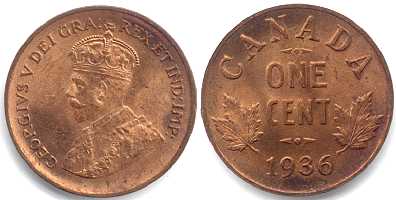
In 1920, mostly to reduce the cost of coinage production, the government ceased to issue large cents at the standard of the British half penny, and began striking small cents of the same weight standard as the American cent.
The obverse design is slightly different than that on the large cents and is by Sir E.B. MacKennal, whose initials B.M. appear on the truncation of the bust. The reverse design is a totally new by Fred Lewis. The alloy also changed slightly to 95.5% copper, 3% tin and 1.5% zinc. The standard weight is 3.24 grams, with a diameter of 19.05 mm (3/4 inch).
1920 SMALL CENT
|
1921 CENT
|
1922 CENT With a mintage of about 1,2400,000 this is the third lowest mintage of small cents.
|
1923 CENT With a mintage of just over 1 million, this is the second lowest mintage small cent, but the difference between it and 1925 is only about 2%
|
1924 CENT
|
1925 CENT With a mintage of just barely over 1 million, this is the lowest mintage date small cent, beating the 1923 by less than 20,000 coins.
|
1926 CENT
|
1927 CENT
|
1928 CENT
|
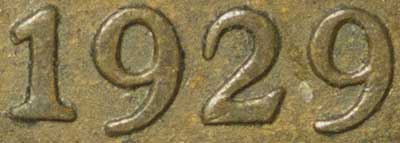
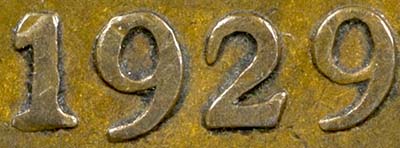
1929 CENT There are three major position varieties of the final 9 of 1929, low, middle and high, although every die was probably slightly different and there were many dies with minor differences. All standard references fail to discuss the middle 9 variety resulting in people mistaking middle 9 examples for high 9's. Both middle and low 9's are common so I only list the high 9's separately. | ||||||
| ||||||
|
1930 CENT
|
1931 CENT
|
1932 CENT
|
1933 CENT
|
1934 CENT
|
1935 CENT
|
1936 CENT
|
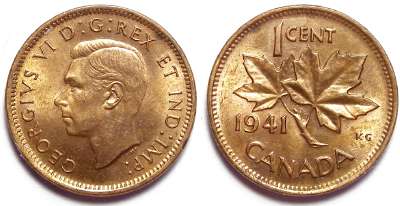
1937 saw a major change in Canadian coin designs, making them somewhat more artistic, and now each Canadian denomination had its own distinctive reverse designs (earlier coins were all variations on the same design).
The obverse (common to all the denominations) was designed by T. H. Paget, whose initials H.P. appear on the truncation of the bust. The reverse Maple leaf design is totally new and by Kruger Gray, as indicated by the initials K.G. in the lower right field. From 1937 to partway through 1942 these coins were struck from an alloy containing 95.5% copper, 3% tin and 1.5% zinc (the same as the earlier small cents) but during 1942 the alloy was changed to 98% copper, 0.5% tin and 1.5% zinc. The standard weight is 3.24 grams, with a diameter of 19.05 mm (3/4 inch).
All dates from 1937 to 1952 are common in average circulated condition. Because it is not economical for us to list coins under $1.00, some dates will not be listed here unless I have high-grade specimens available.
After 1936, there are no rare date Canadian 1 cent coins. While common as dates there are some scarce to rare varieties in 1949 (A to denticle) and in 1954 and 1955 the no shoulder fold type. Average circulated examples of all dates (including common varieties of 1949, 1954 and 1955) are of too little value to warrant listing, although we should have them available in the store in pick bins.
1937 CENT
|
1938 CENT
|
1939 CENT
|
1940 CENT
|
1 cents from 1941 to 1948 are all common but for some dates finding better then red MS-64 is difficult and examples in red MS-65 or high are far more expensive an previous or later dates. In some dates, finding them in a full red is difficult in any grade and it appears there was something different in the alloy used during that period that does not retain the red lustre easily. Many of the examples certified as red will be a more subtle red. Some have theorized the mint was using scrap metal copper during the war period, resulting in a higher level of impurities in the alloy.
1941 CENT
|
1942 CENT
|
1943 CENT
|
1944 CENT
|
1945 CENT
|
1946 CENT
|
1947 CENT
|
India received its independence on August 14, 1947 requiring that IND IMP (India's Emperor) be removed from all British Commonwealth coins dated 1948 or newer. A problem similar to that in 1937 when Edward the VIII abdicated, the new obverse designs for coins all over the British Commonwealth had to be prepared at the Royal Mint in England. Those for Canada were not ready at the beginning of 1948 and coins were needed, so early in 1948 coins were struck dated 1947 so that the IND IMP design could still be used but a small maple leaf was placed after the date indicating minted in 1948.
1947 MAPLE LEAF CENT Pointed and blunt 7's based on the shape of the point of the 7 next to the maple twig occur on 1947 maple leaf cents. The blunt 7 is slightly scarcer than the pointed 7 but there is not much difference in value up to MS-64 but in MS-65 and higher the blunt 7 is much scarcer and higher priced.
|
When the new designs arrived in 1948 with IND IMP (India's Emperor) removed, the entire inscription now reads GEORGIVS VI DEI GRATIA REX (George VI By The Grace of God King) and was used until 1952. Both 1948 and 1949 cents are found with an obverse variety where the final A of GRATIA points either between two denticles (known as either A between or A off denticle), or directly at a denticle (known as A to or A at denticle).
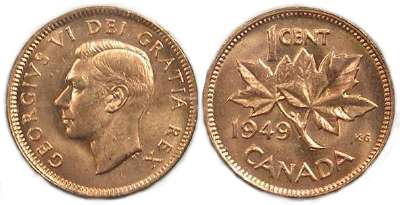
1948 CENT In 1948 both the A to and A off denticle varieties are relatively common and of equal value if it points to the large denticles. These varieties refer to how the final A of a GRATIA pointing at or between two denticles. There is a scarcer variety where the A points to a small denticle but I seldom have one available. The small denticles are about the same length as the wide, but they are thinner so the gap between them is wider. If you look at the I in GRATIA it just barely overlaps two small denticles but on a large denticle it clearly overlaps them going about 1/2 way across each of them.
|
1949 CENT For 1949 the A between denticles (also known as the A off denticles) is common while the A to denticle scarcer. Both types have large denticles.
|
1950 CENT
|
1951 CENT
|
1952 CENT
|
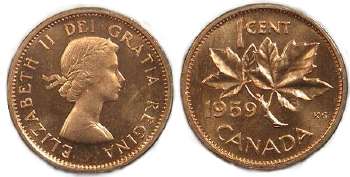
1953 saw the introduction of Elizabeth II's portrait designed by Mary Gillick,whose initials appear on the bust truncation. The reverse remains Kruger-Gray's maple leaf design, with his initials in the lower right. The flans remain 19.05 mm, 3.25 grams of 98% copper, 0.5% tin and 1.5% zinc
1953 NSS CENT The early 1953 dies had the shoulder too deeply cut into the die, and the metal could not be pushed far enough in to capture the shoulder fold design resulting in the shoulder fold usual not present, although on some well struck examples you may see traces of it. The Queen's shoulder appeared bare which many felt was inappropriate. Known as the No Shoulder Strap (NSS) or No Shoulder Fold (NSF) variety, it is best to confirm this type by the strong serifs at the top and bottom of the I's in II and DEI.
|
1953 SS CENT Later in 1953 the dies were re-designed so the shoulder fold would strike better and be visible on most examples, although not on some weaker strikes and it is a high point of the coin so it might wear off on examples VF or below. Known as the Shoulder Strap (SS) or Shoulder Fold (SF) variety, the serifs at the top and bottom of the I's were made much smaller so those I's nearly appear straight, which is the best way to confirm this type. This is the scarcer of the two types.
|
From 1954 to 1964 the obverse shoulder fold design was intended for all examples but some 1954 proof-like sets contain cents struck with a 1953 NSS die resulting a 1954 NSF variety. No 1954 circulation strikes were struck with this variety but some PL sets were broken up and spent so circulated examples have occasionally turned up (I have only ever seen one). In 1955 some circulation strikes were struck from a left over 1953 die, resulting in a 1955 NSS variety that is not found in mint sets. Some have been known to polish off the shoulder fold lines from regular examples, and some regular strikes are weakly struck so the shoulder fold does not show, but in both cases the I's will not be serifed so it is important to check that letter form to confirm these varieties.
1954 CENT Note that 1954 cents in Proof-like quality will normally have slightly purple-red tone and are considered red that way. I am not sure why this tone only happens on this date.
|
1954 CENT NSS In 1954 one of the dies used on Proof-like coins for the official mint sets was of the NSS variety and can be differentiated by the heavily Serifed I's on the obverse. It appears it may have been as many as 1 in 20 PL sets had these, and like most 1954 PL cents they usually have the purple-red tone. No 1954 NSS cents were issued for circulation via bank rolls and while I have seen a circulated one it was likely from a mint set someone broke up and spent.
|
1955 CENT
|
1955 CENT NSS All 1955 circulation strikes were intended to be the shoulder fold variety but a left over 1953 NSF obverse die appears to have been accidentally used, resulting in 1955 NSF examples. These coins always look slightly worn, even in mint condition, resulting from that die been somewhat worn when first used on these. One must look at both sides of a 1955 NSF cent and the grade will be based more on the reverse design which was struck with a fresh die. As with the 1953 and 1954 NSS varieties the heavy serifs on the I's is how you identify these.
|
1956 CENT
|
1957 CENT
|
1958 CENT
|
1959 CENT
|
1960 CENT
|
1961 CENT
|
1962 CENT
|
1962 DOUBLE DATE CENT Some 1962 cents have considerable doubling on last three digits of the date with the ghost under date shifted up slightly from the main date. Known as the DOUBLE DATE variety, it is very similar to that seen on some 1962 5 cents, suggesting machine doubling where a problem with the minting press causes the die to bounce or rock during striking creating a slightly double strike with an off-set, where both the 1 and 5 cents with this feature struck on the same press. This variety was listed by Zoell as #D86p.
|
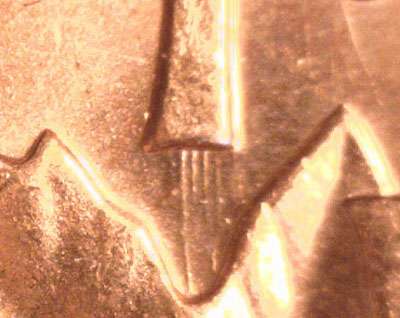
1962 HARP CENT Some 1962 dies have vertical lines between the 1 of 1 CENT and the notch in the maple leaf, probably die polish marks. Commonly known as the HARP but when the lines are stronger at the bottom it is also known as the GUITAR variety. While not listed in the standard catalogues Hans Zoell catalogues it as #K86c.
|

1962 HANGING 2 CENT A die clash caused the Queen's chin to be transferred to one reverse 1962 cent die, resulting in a faint line curling from the left maple leaf to the top of the 2, known as the "hanging 2" variety.
|
1963 CENT
|
1963 Hanging 3 CENT A die clash caused an outline of the Queen's chin to transferred to one reverse 1963 cent die, resulting in a faint line curling from the left maple leaf to the top of the 3 and is known as the Hanging 3 variety.
|
1964 CENT
|
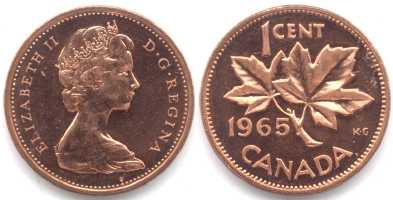
1965 saw an updated more mature portrait of the Queen wearing a tiara, by Arnold Machin. The reverse design by Kruger-Gray was retained unchanged, as was the specifications of 3.24 grams, 19.05 mm, of 98% copper, 0.5% tin and 1.5% zinc.
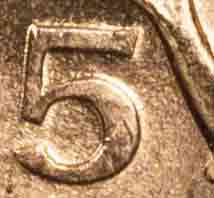
1965 CENT There are four varieties of the 1965 cent, based on the size of the beads around the Queen's head, and the shape of the top right of the 5: Both type 2 and 3 with a blunt 5 are common. It is generally thought that type 4 (pointed 5, large bead) is the scarcest type, but in my experience type 1 (pointed 5, small bead) is actually more difficult to find, although priced far less in the price guides. Many type 4 examples exhibit doubling of the INA in REGINA and the beads opposite REGINA, which is common and illustrated below. The doubling of the bead makes it look like a small bead over large bead, but it is the lower outline of the bead that defines the bead size, which is confirmed by the A pointing at that lower outline, while on the small bead the A points between two beads (slightly closer to the lower bead). The beads on a T-3 with large bead usually do not exhibit that doubling. |
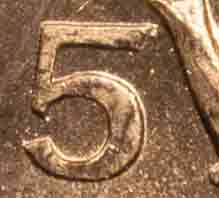 POINTED 5 |
 BLUNT 5 |
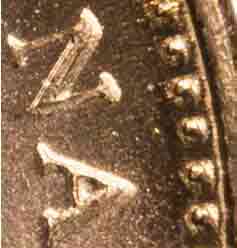 Large Beads A points at bead. |
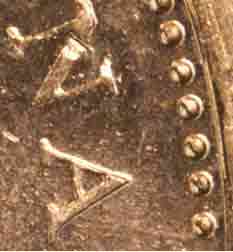 Small bead A points between beads. |
|
1966 CENT
|
1967 CENT In celebration of Canada's 100th anniversary of Confederation, all coins issued depicting an animal common to Canada, with a dove by Alex Covillie on the 1 cent. These were struck in huge numbers and are very common now, even in grades up to MS-63. Lesser one have very little value.
|
Please note that up to 2011 when I describe a coin to be Proof-like (PL) I mean a coin from a mint set, intestinally struck to a higher quality than normal, but worth less than a MS (Mint State) coin from a bank roll in the same grade. They are fairly easily differentiated by their strike and luster. ICCS and some references call such coins NON-CIRCULATING NUMISMATIC MINT STATE which I feel will cause confusion in beginning collectors. Starting in 2012 the mint stopped making intentionally nicer coins for the standard sets and the coins are all simply MS (mint state) except for specimen and proof examples.
1968 CENT
|
1969 CENT
|
1970 CENT
|
Beginning in 1971, the mint begins striking three different striking qualities of coins, with a fourth added in 1981 :
Mint state (abbreviated MS) which are coins struck for issue through the banks and have average lustre and surface qualities. In most cases MS coins have little value unless in the highest range of the MS coins, and those are seldom seen. I don't list most dates in MS because they are not of high enough value to justify the time and trouble to list and/or ship them.
Proof-like (abbreviated PL) are standard mint set coins, usually from the pliofilm packaged sets, red double penny sets, and later the blue book set, but in later dates there were a variety of other types of sets they can come from. PL coins have a much higher lustre than MS coins, mostly because they are struck from dies in their newest die state. They also have very minimal marks (the average PL is a PL-64) as they did not go through as many of the mint handling processes as MS coins do, but they are not perfect coins and one should not expect them to be absolutely mark free.
Specimen (abbreviated SP or SPEC) which were in the black leather double dollar sets from 1971 to 1980, and for later dates in various types sets. Like PL coins they are struck from dies in their freshest die state but differ in being double struck to give them a higher lustre and sharper images, and they do not go through any mint handling processes before going into the sets so are nearly mark free. The rims tend and edges tend to be a little sharper although this is not obvious on a casual inspection. When I list a coin as a specimen, it is because I personally took it from a specimen set before listing it here.
Proof (abbreviated PR) coins are very nice coins found mostly issued in the double dollar black leather boxed proof sets starting in 1981, although some specialty coins did come other ways. The coins are clearly differing from the other striking qualities by being double struck from specially prepared dies so they have mirror fields and frosted images (and ultra cameo effect) and are specially handled so they go into the sets in near perfect condition as possible.
1971 CENT
|
1972 CENT
|
1973 CENT
|
1974 CENT
|
1975 CENT
|
1976 CENT
|
1977 CENT
|
1978 CENT
|
1979 CENT
|
1979 Double Date Some 1979 cents show clear doubling on the date and occasionally other parts of the design. The amount and exact position of the doubling varies from coin to coin consistent with machine doubling were a slightly loose die creates the doubling when it bounces on striking. Examples with extra strong doubling, especially if all four digits are doubled command a premium. While not expensive, these are slight difficult to find.
|
In 1980 while the design and alloy remain the same but the weight was reduced from 3.24 grams to 2.8 grams, the diameter from 19.05 mm to 19.00 mm, and the thickness from about 1.5 mm to 1.38 mm. Most people did not notice the change and while a 0.44 gram weight reduction does not sound like much, with a mintage of about 1 billion coins per year the raw material savings to the mint was huge. This standard was only used in 1980 and 1981.
1980 CENT
|
1981 saw the introduction of proof sets to replace the double dollar specimen sets. The proof coins have frosted images against mirror fields and while specimen strikes continued to be struck, they were in other types of sets. Proof sets proved more popular than specimen sets so proof coins of this period are fairly abundant but both continued to be struck right up to 2012 end of the one cent.
1981 CENT
|
In 1982 the weigh was again reduced, from 2.8 grams to 2.5 grams even tough the diameter increased from 19.00 mm to 19.1 mm. This was achieved by a change from round to 12 sided thus decreasing the amount of metal needed to achieve that diameter. The alloys remained the same but there was a minor design modification to the reverse where the denticle border was replaced by a beaded border.
1982 CENT
|
1983 CENT 1983 cents are found in two varieties in the beads around the Queen's head. The far bead variety has slightly smaller beads nearly 1/2 way between the rim and the tip of the Queen's bust. The near bead variety beads are slightly larger and only about 1/3 of the way between the rim and the bust. This can be difficult to determine unless you have the two side by side to compare. Both varieties are found in MS, Proof-like, Specimen and Proof quality. The CCN trend sheet and the Charlton Standard Catalogue both list the far bead is the more common in all striking qualities. In my experience that is true for MS the near bead is more common in Proof-like, Specimen and Proof quality.
|
1984 CENT
|
1985 CENT 1985 cents are very common with a blunt 5 (straight up and down on the top front of the 5) and is found in all striking qualities. The pointed 5 variety (front top of the 5 angles to the right) is much scarcer and only found circulation (MS) strikes, never in mint sets. I seldom have the pointed 5 available and based on recent sales on eBay the CCN trend listings well below the real market values for this type.
|
1986 CENT
|
1987 CENT
|
1988 CENT
|
1989 CENT
|
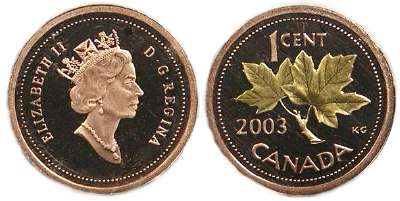
1990 saw and update the Queen's portrait to a more mature style wearing a crown, designed by Dora de Pedery-Hunt. This issue caused some concern when many people noticed the Queen was wearing a King's crown rather than a Queen's crown, and people thought it was an error that would be recalled. That crown was designed for George IV around 1830 to be a comfortable light weight crown, and has been worn by every King and Queen (including Elizabeth) since then, and is the correct crown for the design of these coins. Kruger-Gray's maple leaf design remains on the reverse, as does the alloy of 98% copper, 0.5% tin and 1.5% zinc, with 12 sides at 19.1 mm and 2.5 grams.
1990 CENT
|
1991 CENT
|
1992 CENT 1992 was Canada's 125th anniversary of confederation, and all 1 cents of this year have the date shown as the double date 1867-1992.
|
1993 CENT
|
1994 CENT
|
1995 CENT
|
Starting with 1996, on 1 cents with the proof-like strikes, the finish is different than in previous years. Instead of the overall high lustre finish over the entire coins, the 1996 cents have a matte finish with high lustre only on the portrait and maple leaves. The result is more like a reverse of the cameo proofs, although the degree of contrast is not consistent and some are slightly more dramatic than others.
1996 CENT
|
1997 saw a major change in the cent coins. The designs remained the same with the mature crowned bust of the Queen by Dora de Pedery-Hunt, and reverse maple leaf design by Kruger-Gray, but the alloy was changed to a pure zinc core plated with copper. The coins were made round (rather than 12 sided) and are 19.05 mm with the reduced weight 2.25 grams. From 1997 to 2000 all 1 cent in MS, Proof-like and Specimen strikes were on these new blanks but Proof coins continue on solid bronze flans. I recently examined a 1997 specimen set, and found no clear distinction between the Proof-like and specimen 1 cents as both had the matte backgrounds and higher lustre designs. When I list them as PL or Specimen it is because I personally took them out of the appropriate sets.
1997 CENT
|
1998 CENT In 1998 a W mint mark was placed below the Queen's head on coins minted at Winnipeg, although those were all in proof-like sets. Coins struck at Ottawa, including those in mint sets made at Ottawa in later years, have no mint mark. All circulation (MS), specimen and proof coins were without mint mark. The finish on 1998 proof-like coins returns to high luster finish, while specimen coins retain the slightly matte finish fields with high lustre designs that first appeared in 1996.
|
In 1999, the mint sets were all minted in Ottawa so do not have a mint mark. The proof-like coins all have the high lustre finish while the specimen coins have the vague reverse cameo finish. I have noted that a high percentage of 1999 proof-like cents have a surface with a lot of very small (nearly microscopic) bubbles, probably resulting from problems with the plating process while copper plating the coins with the zinc core. If ordering one of these in Proof-like striking you should expect it to have that feature. The Specimen strikes do not seem to have this problem, nor do the proof strikes while are solid bronze blanks so are not plated.
1999 CENT
|
1999 P TEST CENT As a cost saving measure in 1999 the Canadian Mint made plans to strike 1, 5, 10, 25 and 50 cent coins on plated steel blanks. The one cents look like copper as they were first nickel plated then copper plated prior to striking. All other denomination were nickel plated, then copper plated, then nickel plated again so they looked like nickel coins. A P for plated on steel was placed below the Queen's portrait so they could be differentiated. First struck only as test tokens for vending machine companies to calibrate their equipment to and the companies were supposed to return them to the mint when done with them. Some came on the market at very high prices, up setting mint officials who struck an additional 20,000 sets to sell to collectors at much lower prices, both making money for the mint and disrupting the market for those vending machine companies. Packaged like Proof-like sets their exact status is unclear and while I prefer to call them Proof-likes, others including ICCS call them Mint State (or Uncirculated). The mintage of only 20,000 makes them nearly as scarce as 1948 dollars but at a tiny fraction of the price. The vinyl packaging often leaves a light film on them which can be removed with rubbing alcohol. I recently bought a large group of world coins from a company that has used them to test their equipment to make sure it would not accept them as Canadian coins. The same company used the 1999 P test coins on their equipment to be sure they would be accepted and in the same group I found a number of 1999 P cents that are true test token examples and from different dies that the 1999 P cents in the sets the mint sold. The dies were more carelessly finished with two distinct varieties. One had a number of scratches on the die just to the left of the I in ELIZABETH, resulting in raised lines on the coins. The second type has extra metal around the EL in Elizabeth and the P mark. I had a number of each that were identical in these features showing they were on the dies rather than striking defects. The dies used for the P cents in the mint sets were perfectly cut.
|
2000 CENT Most 2000 coins in all striking qualities have nothing below the Queen's bust. A few very rare examples exist with the P and are accidentally released test coins. Some of the PL and Specimen coins come with the W for Winnipeg below the bust. PL coins have a high lustre even finish. Specimen coins have high lustre images with matte backgrounds.
|
Beginning in 2001, 1 cent coins come in three alloys. MS, Proof-like and specimens coins are found with a P (for plated) below the Queen's portrait if the flans are copper plated on steel, without the P if the flans are copper plated zinc, except all proof coins are on solid bronze or copper flans (depending on the year) with nothing below the Queen's bust.
2001 CENT
|
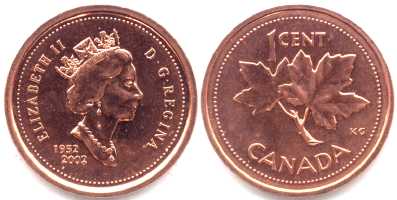
2002 CENT 2002 cents were part of a special issue for the Queen's 50th anniversary, with the date on the obverse below the Queen's portrait written as the double date 1952-2002. I have had many phone calls from people saying they had a 1 cent with no date on it, but they need only turn the coin over and look below the portrait to find one.
|
2003 was an interesting year for Canadian coins, with a number of varieties including the introduction of a new effigy of the Queen without a crown.
2003 CENT Old Effigy Coins struck earlier in 2003 have the crowned effigy of the Queen first introduced in 1990 and are found both with a P below the Queen's bust on plated steel or without the P if on plated zinc (MS only) and on solid bronze blanks from proof sets. Those without the P on plated zinc blank generally have a textured surface due to plating problem, which is to be expected but I will mention it if the textures are courser than normal. Most proof-like and all specimen and normal proof sets in 2003 are of this bust type. The mint had a lot of plating problems at this time, and many of the MS coins have a pebbled surfaces caused by the plating process. There were two special issued in 2003. The first was included in the covers of mint reports with a mintage of less than 8,000 and have a Proof finish but selective gold plating on the Maple Leaves giving them a green appearance. The second was in a special issue proof set for the 50th anniversary of the Queen' coronation and used the young head from the 1953 type, flank by the dates 1953 and 2003. A few 2003 P old effigy cents were struck on plated zinc blanks, so are non-magnetic. As far as I know, they were only found in mint sets, and are probably the rares of that type of error in this series and are rarely encountered.
|
2003 CENT New Effigy Later in 2003, to celebrate the 50th anniversary of her coronation a new Coronation Portrait was introduced depicting a more mature Queen without crown. This became the standard portrait for later years so is known as the New Effigy. These are found on non-magnetic copper plated zinc blanks without the P, on magnetic copper plated steel blanks with the P, both only found in bank rolls with the non-magnetic having only 1/10 the mintage of the magnetic examples and are difficult to find. Both types are listed in the CCN trend sheet in PL but I suspect that is an error. Also, both types are listed at the same prices and that makes no sense to me as I usually have the P types available and nearly never had the non-magnetic examples. Some examples found only in special mints sets are magnetic and have both the W mint mark for Winnipeg and the P.
|
2004 and all later dates use the new effigy portrait. Circulation strike (MS) coins occur on both copper plated steel flans with the P below the Queen's head, and copper plated zinc flans without the P. Proof-like and specimen coins only exist with the P on plated steel blanks. Proof coins are on pure copper or bronze flans without the P. As in previous few years, Proof-like coins have an over all even lustre while specimen examples have high lustre designs with matte backgrounds. Proof strikes with gold plated leaves exist on copper plated zinc flans from mint report covers.
2004 CENT
|
2005 CENT 2005 circulation strike (MS) coins are found on copper plated steel flans with the P and copper plated zinc flans without the P. Proof coins are on pure copper flans. As with the previous few years, Proof-like coins have an over all even lustre while Specimen strikes have high lustre designs with matte backgrounds. Proof strikes with gold plated leaf also exist on copper plated zinc flans for the mint report covers. A rare variety of the 2005 cent, with the P but non-magnetic, is occassionally found in some of the specialty mint sets and are considered to be Proof-like quality.
|
2006 is the year the mint logo first appears Canadian 1 cents. Early 2006 coins still have the P (plated on steel) and non-P (plated on zinc). Later in 2006 and continuing for the following years both types were still made but with a stylized maple leaf mint logo below the portrait and only way to tell them a part is with a magnet. Proof strikes continue to be on non-plated solid copper or bronze blanks with nothing below the bust.
2006 CENT With all the different P, no-P, and logo dies used in 2006, occasionally flans got mixed up and plated zinc blanks were accidental struck with the P for plated steel blanks, and plated steel blanks were accidental struck without the P. These are not types but rather off metal blank errors and when I list them I will list them as errors.
|
2007 CENT Starting in 2007 all 1 cents have the Logo below the Queen's portrait which I will not mention. Both Zinc (non-magnetic) and steel (magnetic) core blanks were used for circulation coins and can only be differentiated with a magnet. Non-magnetic examples were only about 1% of the mintage so scarce. Proofs are non-magnetic on solid copper or bronze. Specimen examples are all magnetic. Most proof-like examples are magnetic with a brighter finish but some non-magnetic examples with a matte finish are found in the hard pack mint sets.
|
2008 CENT All 2008 circulation, proof-like and specimen examples are on magnetic steel core blanks. The only non-magnetic examples are the Proofs on solid copper or bronze blanks.
|
2009 CENT 2009 circulation strike cents occur both magnetic and non-magnetic. Proofs are on non-magnetic on solid copper or bronze blanks. Proof-like and specimen examples are on magnetic steel core blanks.
|
2010 CENT All circulation strike 2010 cents (MS) are non-magnetic on copper plated zinc blanks with most examples showing a minor degree of surface imperfections due problems with the plating process. In the specialty card mint sets there are proof-like strikes that are also non-magnetic, in spite of the Charlton Standard Catalogue not listing that as existing. Proof strikes are also non-magnetic on solid copper or bronze blanks. Proof-like strikes in the standard cellophane sets, and Specimen strikes, are magnetic with steel cores.
|
In 2011 the mint stopped minting intentionally superior coins for Proof-like (standard) mint sets, rather using normal mint state coins that had not gone through all the handling processes. Most cents from these sets grade MS-63 and 64, while MS-65 examples are still scarcer. With no way to differentiate between MS-63 or better coins from sets vs rolls, and MS-64's being common in the sets I cannot justify the higher prices earlier MS-64 bring. Also, because they were the last two years for the 1 cent, a lot of rolls of 2011 and 2012 were put away by people and are common today. One cents of 2011 and 2012 I will price MS-64 at $2.00 and MS-65 @ $12.00. Specimen coins struck with frosted backgrounds and mirror designs I price slightly higher than the MS-64 price at $4.00.
2011 CENT Both copper plated zinc non-magnetic and copper plated steel magnetic 1 cents were minted in 2011 for circulation and in standard mint sets and once removed from the roll or set cannot be differentiated so I price them the same price. The specimen and proof strikes have distinctive finishes and are scarcer so are priced higher. All Specimen strikes are on copper plated steel magnetic blanks. Proof strikes are on non-magnetic solid copper or bronze blanks.
|
2012 CENT The characteristics and striking qualities are the same as for 2011, other than the all silver proof sets one finds examples struck from silver with a brown overlay on the leaves. Those in normal proof sets are bronze allow and look like bronze.
|
Please note that up to 2010 I describe coins as Proof-like (PL) when from a mint set. PL coins are easily differentiated by their superior strike and luster and although nicer than MS coins from bank rolls are generally worth less. ICCS and some references call these coins "NON-CIRCULATING NUMISMATIC MINT STATE" which I feel is confusing. Starting in 2011 the mint stopped making intentionally nicer coins for standard mint sets, instead using MS (mint state) coins which had not gone though some of the normal mint handling procedures that leave marks on MS coins. Specimen and proof sets still use specially struck coins, which have a very different finish.


© 1997-2026 R & T Enterprises Ltd.
 |
 |