
HOME | Contact | Place Orders
1 cent | 5 cent | 10 cent | 25 cent
50 cent | Dollars | Newfoundland | Tokens
World coins
 |
 |
No Canada 5 cents were struck from 1859 to 1869. DOMINION OF CANADA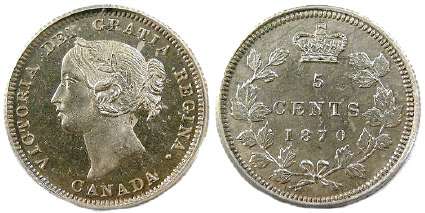
(image of type only)Unlike the other denominations except for the 10 cent, the Wyon young head design continued in use after Confederation right up to 1901. The standards remain as the 1858 issue at 1.16 grams, 15.5 mm and coinage axis. Coins without mint mark were struck at the British Royal mint in London England while those with the H mint mark were struck at the Heaton mint in Birmingham England.
No Canada 5 cents were struck in 1873. In 1874, there are two varieties of 5 cent coins, the crosslet 4 with a small vertical bar on the back of the 4 (also known as the small date), and the plain 4 without that bar (also known as the large date). The plain 4 is very slightly scarcer than the crosslet 4 but not by enough to affect the value.
No Canada 5 cents were struck from 1876 to 1879.
In 1885 and 1886, there are varieties where the final digit can be either large and small.
No Canada 5 cents were struck in 1895 but were struck every year after that.
EDWARD VII
|
1902 5 CENT Many but not all 1902 5 cents were struck with a concave reverse die, so that the portrait bows out very slightly. These coins tend to wear more quickly on the King's ear and one can find examples with the top of the ear worn through, but with VF-20 details in all other respects, however as will not grade one of these VF-20 without seeing a full ear, I prefer to grade those examples as F-15. For those who are type only collectors, 1902 is the least expensive date of George V 5 cent to find in high quality.
|
1902 H 5 CENT For 1902 there is a scarcer small H without serifs, a more common large H with clear serifs top and bottom, and a much scarcer (probably just one die) large H over small H where the top of the small H sticks out of the top of the large H.
|
Prior to 1903 Edwardian 5 cent coins had a St. Edward's crown at the top of the reverse, with 21 leaves in the wreath. That design is retained for the Heaton (H) mint coins right up to 1907 but starting in 1903 coins struck at the Royal Mint in London (which do not have the H) have W. H. J. Blakemore's design slightly modified with the Imperial state crown and 22 leaves in the wreath.
1903 5 CENT
|
1903 H 5 CENT For 1903 there are small and large H examples with the large H scarcer. There are also some with the small H slightly re-cut to look sightly doubled, but I am noticing there are some variations in these even in ICCS certified examples, so they will not all look exactly as the one illustrated in the Charlton Catalogue.
|
1904 5 CENT
|
1905 5 CENT
|
1906 5 CENT
|
1907 5 CENT
|
The Royal Canadian Mint opened in Ottawa in 1908 at which point nearly all Canadian coins were minted in Canada. The designs remained the same but the die axis changes from coinage to medal on all denominations except for the 1 cent which were always medal axis. Coinage axis means if you place your fingers above and below the portrait and spin the coin side to side the reverse comes out upside down. Medal axis means it stays right side up.
1908 5 CENT 1908 5 cent coins come with either a small or large 8, also called small and large date although only the 8 is different. It can be difficult to differentiate these looking at the 8 but the small cross above the reverse crown (above 5 cents) is a sharper cross on small date examples and a badly engraved Maltese cross (looks more like a bow tie) on the scarcer large date.
|
In 1909 and 1910 two different leaf shapes occur on the reverse wreath, with some having slightly rounded tips similar to maple leaves and others have more pointed tips similar to holly leaves. They can be slightly difficult to tell a part. Some references refer to them as pointed leaf (PL) and round leaf (RL) and other maple leaf (ML) and holly leaf (HL).
1909 5 CENT The 1909 point leaves type has the cross over bow tie small crown at the top of the reverse. The round leaves type normally has only a bow tie but there is a fairly rare variety with a cross over bow tie.
|
1910 5 CENT In 1910 all pointed leaves examples have a cross over bow tie on the small crown at the top of the reverse. Round leaves examples are found only with the bow tie.
|
The 1903 reverse design by W. H. J. Blakemore was retained, along with the standards of a 1.16 grams, 15.5 mm, and an alloy of from 92.5% silver and 7.5% copper until 1919 when the alloy was reduced to 80% silver and 20% copper.
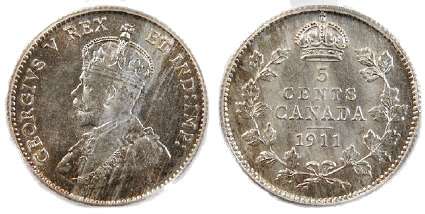
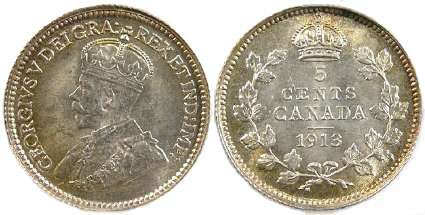
1911 5 CENT George V coins were introduced in 1911 with "DEI GRATIA", Latin for "God' Grace", omitted from the obverse inscription. Known as the "GODLESS COINS" there was a public out rage and in 1912 "DEI GRATIA" returned to Canadian coins.
|
1912 5 CENT
|
1913 5 CENT
|
1914 5 CENT
|
1915 5 CENT At about 1.17 million, the 1915 5 cent is the lowest mintage in the George V 5 cent silver series.
|
1916 5 CENT
|
1917 5 CENT
|
1918 5 CENT
|
1919 5 CENT
|
1920 and 1921 5 cent silver coins remain the same design, weight and diameter as the previous dates but the alloy was reduced to 80% silver and 20% copper.
1920 5 CENT
|
1921 5 CENT More then 2.5 million 1921 5 cents were struck but on deciding 5 cents would be struck in nickel starting in 1922, most of the 1921 examples were melted. Estimates of how many survive vary from just over 300 to about 800 but I believe it is higher. Just over 300 having been certified although some examples may have been sent in more than once, most of the examples I come across have not yet been certified. Due to the numbers I see raw, and the fact it is not unusual to see several of them available at major coin shows, I believe there are at least 800 to 1000 and probably a little more than that. This still makes them one of the scarcest coins in the Canadian series. Most examples will be weakly struck on one side suggesting the weakness is due to a worn die, otherwise it would be on both sides. Before assigning a grade one must example both sides carefully, especially the veins on the leaves on the reverse to determine if it is die wear or coin wear, making these difficult to grade accurately. Examples struck from strong dies on both sides, where the sides are even, bring a premium above the trend sheet estimates which assume some weakness on one side. I am always looking to purchase 1921 5 cents in any grade.
|
1998 5 CENT SILVER To commemorate the Royal Canadian Mint's 90th anniversary special sets were struck with the sizes, sterling silver alloy (other than the 1 cent), and reverse designs of the 1908 coins, but with an obverse showing Queen Elizabeth's portrait and date as "1908 - 1998". The early sets have an antiqued matte-proof finish that proved unpopular with collectors so were discontinued and are now the scarcer of the two finishes. The later sets are mirror-proofs.
|
2011 5 CENT SILVER To commemorate the 100th anniversary of the 1911 dollar, the mint produced a set of coins including a 5 cent silver were struck with the sizes, alloys, and same general obverse and reverse designs of the 1911 coins. The date is shown as 1911 - 2011, with the portrait that of George V including the godless inscriptions.
|

1922 saw the introduction of the larger 5 cents made of nickel, struck at 21.21 mm and 4.54 grams which is exactly 100 to the pound. The obverse design by Sir E. B. Mackennal is retained, but with a new reverse design by W. H. J. Blakemore.
The Royal Canadian Mint equipment was not designed to strike relatively hard nickel. Higher die pressures were introduced resulting in good strikes but short die life due to rapid die deterioration. Die pressures were reduced to preserve the die but resulted in the weaker strikes we see on most 5 cents between 1922 and 1936, most noticeable on the King's crown band with was engraved with three jewels and eight pearls but most examples only had six and sometimes seven pearls visible even when mint condition. Examples with eight visible pearls are scarce, and eight strong pearls are rare and very had to find on some dates and I do charge a premium for those examples.
The mints nickel came from the International Nickel Company (INCO) which used furnace (fire) refining which produced nickel no higher than 92% pure. They bought the highest purity nickel INCO could produce but in the ingots delivered to the mint the nickel would be mostly between 88 and 90% nickel with only a small portion between 91 and 92%, inconsistent even within one bar. We call these pure nickel because industrially nickel was said to be pure as long as it is at least 77% nickel.
Purer nickel softer, so small percentage of nickels struck at 92% will show strong crown detail with 8 clear pearls, and usually higher lustre. Those in the 90 to 91% range may show seven or eight pearls but can be weaker, and will have slightly less lustre. The majority, which are 88 to 90% pure will generally only have six visible pearls and I have seen some mint condition examples with only four, and generally a very low matte lustre. Grading George V nickels is difficult as one must consider the lustre, surface marks plus wear to the reverse details, and the rule for other denominations that an XF or higher coin must show eight pearls is not apply to these.
The price guides are for coins of average strike, meaning in XF or higher only 6 or seven pearls are visible. If less than six beads are clear on an XF or higher coin I will comment and price lower. If there are eight visible beads I will describe such and if they are strong beads I will describe that as well and as such coins are scarce I will price them higher.
At an Edmonton coin show reception on March 2, 2014 I heard Mark Bink (an metallurgist who studies these alloys) comment that 1961 was the year the beaver got it's whiskers back. I asked him what that meant and he explained how in 1961 the mint changed from the inconsistently pure INCO nickel to chemically refined 100% pure Sherritt nickel, which is much softer and results in consistently better strikes with a lower die pressure, but are challenging to find above MS-64 as they tend to have significantly more bag marks. A discussion followed where I brought up the erratic striking characteristics of earlier coins, and we realized how the two were directly related. It appears the mint did not use up all of their old stock of INCO nickel until some time in 1964, which is why one sees some very weakly struck 1961 and 1962 nickels often described as Bald Beavers, although I have seen a few of these in 1963 and rarely in 1964.
Nickels were used extensive in parking meters and vending machines which often left scratches on them, commonly called "meter marks". Scratch free George V nickels below XF to find but I endeavor to offer only scratch free examples and on the few I offer with scratches I will clearly describe them and price accordingly.
Nickel dies between 1922 and 1936 were sometimes engraved with a flat field, resulting in flat fields on the coin, resulting in the appearance that the S and the end of CENTS and the F in FIVE are further from the rim. The most visible aspect is the field and rim meet at a right angle. Other dies have a concave field, resulting in a convex field on the coins and S and F appearing further from the rim. The most visible aspect is a play of light that show the field rolls up against the bottom of the rim and occasionally the rim will appear slightly doubled. On some dates it can be difficult to differentiate and the spacing is a bit of an illusion so not always clear, so describing Flat vs Convex fields in more accurate than Near or Far S, but both description found in standard references. Only one some dates are found with both types.
1922 5 CENT 1922 5 cents are found with both Convex (near S) and Flat (far S) fields, but the Flat fields are significantly scarcer. Often ICCS does not designate these fields varieties in which case I designate them myself. If mentioned on the ICCS holder I will state the variety before ICCS, if on the holder between ICCS and the grade.
|
1923 5 CENT
|
1924 5 CENT
|
1925 5 CENT 1925 is the lowest mintage and scarcest date of the George V nickel series.
|
1926 5 cent comes in two varieties with respect to the position of the 6. The more common near 6 variety has the tip of the 6 closer to the maple leaf which farther from the rim. The scarer far 6 has the 6 rotated slightly away from the maple leaf, causing the tip of the 6 to be slightly farther from the maple leaf while the bottom is slightly closer to the rim. One must look at both as the distance from the rim and the maple leaf as people have tried to cut down a 6 but they cannot decrease the spacing at the bottom.
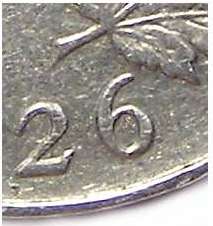 1926 NEAR 6 |
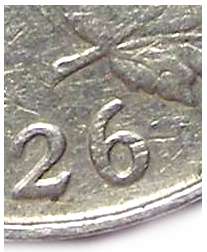 1926 FAR 6 |
1926 near 6
|
1926 far 6
|
1927 5 CENT
|
1928 5 CENT
|
In 1929, 1932, 1934 and 1936 references designate NEAR and FAR rim types referring to the gap between the S of CENTS and the rims as we see on the 1922 nickel, however while 1922's have a significant gap difference, there is little difference on the other dates making things very confusing. The actual difference is flat and concave fields where on flat field examples the fields meet the rim at a sharp angle, while for concave fields there is a slight rounding. As there is no difference in value or rarity for these dates, I do not sort them out.
The one question mark is on the 1932 where there may be a near and far 2 variety related to these fields, but no one seems to agree on these. The Charlton standard catalogue does not list a far 2 variety with a different value, while the Canadian Coin news trend sheet lists one with a major difference in price. Recently I have heard of a few that people felt where the far 2 sending them for certification, but could not find a certification company willing to do so and without that they are not very salable.
1929 5 CENT
|
1930 5 CENT
|
1931 5 CENT
|
1932 5 CENT I have been looking at the near and far S varieties of the 1932 5 cent and find them difficult to differentiate as it is really about flat (far S) vs concave (near S) fields. I will only list them below if they are identified on certification holders. The more distinct 1932 varieties are the date position relative to the maple leafs, of which there are three although only two are listed (one incorrectly) in the Charlton catalogue. If a line is drawn across the bottom tips of the maple leaves it would pass clearly above the 2 (far 2 and rare), just touch the top of the 2 (medium 2, slightly scarce) or pass directly through the 2 (near, most common). The Charlton Catalogue correctly illustrates the rare far 2, but the one illustration as the common near 2 is actually medium 2. The very common near 2 is not illustrated. I am still trying to sort out the near and far S issues, and until just recently thought near 2's are all far S, the medium 2's can be either near or far S, and the far 2's are all near S, but I am now coming to see far 2's can be either near or far S.
|
1933 5 CENT
|
1934 5 CENT Telling flat (far rim) vs convex (near rim) fields on this date is more difficult than for other dates
|
1935 5 CENT
|
1936 5 CENT
|
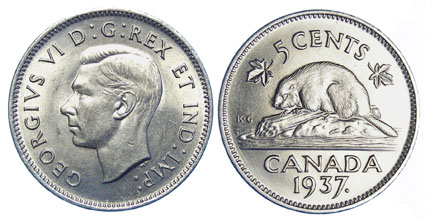
With George VI coming to the throne in 1937, an new set of designs was introduced for the reverse of all Canadian coins other than silver dollars, with the beaver chosen for the 5 cent coins. There are no rare dates in this series, although there are some rare varieties for some dates such as the 1947 dot, 1951 high relief, 1953 mules, 1964 extra water line and a few others discussed below. Only examples of fairly high quality are worth the time and expense of listing them here. Average circulated examples of most dates are available in our store in a "pick bin" very inexpensively (please do not ask me to pick them out and ship them, they are available in store only).
As these were struck from the same INCO nickel as discussed above the 1922, the same problem of inconsistent hardness remained and in mint state examples one see's a wide variation in the strength of the hair lines on the King, making these somewhat difficult to grade, plus the King's eyebrow rarely strikes up, and finding mint state examples with a fill eyebrow is very difficult (nearly impossible for some dates).
1937 5 CENT The image above shows a 1937 with the dot after the date. All 1937 5 cent coins have this dot, which the designer felt was needed to balance the design due to lean of the 7 creating a bigger gap to the right than the left of the date.
|
1938 5 CENT
|
1939 5 CENT
|
1940 5 CENT
|
1941 5 CENT
|
1942 5 CENT - NICKEL ALLOY
|
WW II created a nickel shortage in Canada, so starting part way through 1942 through to the end of 1943 Canadian 5 cents were struck from a brass alloy known as tombac. Realized the color was similar to one cents they were made 12 sided to reduce confusion, although this was not successful and people did not like these coins. Although not required by grading standards, most examples AU-50 and MS-60 will retain at least some lustre, and examples MS-62 and high will be red.
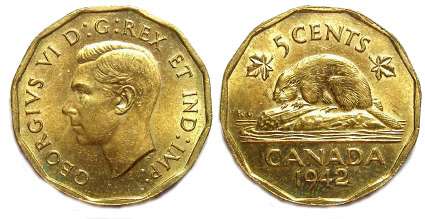
1942 5 CENT - TOMBAC ALLOY The 1942 Tombac 5 cents retain the same design as the 1937 to 1942 nickel issues, with only the alloy and 12 sided shape being different.
|
The twelve sided shape was not enough to stop the confusion with one cent coins, so in 1943 the reverse design was replaced by the "V" (for victory) design which was used until the war ended in 1945.
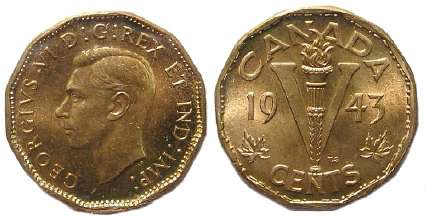
1943 5 CENT - Tombac In 1943 the traditional beaver design was replaced with a V over a torch, with a Morse code (dot and dashes) around the edge that spells out "We Win When We Work Willingly". The V had two meanings, first it stood for Victory, second it was the Roman numeral for 5 in the denomination.
|
In spite of the new V design and 12 sided shape, the public still found the brown tombac five cents were too easily confused with one cents making them unpopular. As the war created nickel shortage was still a problem 1944 and 1945 5 cents with the v design were struck on steel blanks that were first nickel plated then chrome plated. The chrome has a silvery-blue appearance and while not exactly like nickel people accepted them. The plating process was not perfect and one sees various problems. It is common to see examples with incomplete plating which exposed nickel and chromed areas, but less commonly one finds examples that totally missed chrome plating resulting in a nickel plated coin with a finish that looks like a regular nickel 5 cent and are known as no chrome examples. More rarely examples who up that missed both the nickel and chrome plating so struck directly on the steel blank.
There is a miss-understanding where some people believe the chrome can be easily removed without removing the nickel plating, thus turning regular chromed coins into no chrome examples. Believing this miss-understanding a few years ago ICCS stopped designate examples as no chrome. I found several websites explaining how to remove chrome by soaking in acetone and is likely what other's miss-understood to mean electroplated chrome could be removed. These websites were discussing removal of chrome paint, not the electroplated chrome on these 5 cents which can only be removed with acid that will damage the entire coin and not leave an intact nickel plating.
The chrome plating on 1944 and 1945 V nickels is easily scratched and/or wears through at the high points. Nice examples of these are common and inexpensive even if high quality. I throw scratched or significantly worn examples in my till to be handed out in change. The examples offered below are scratch free unless otherwise noted.
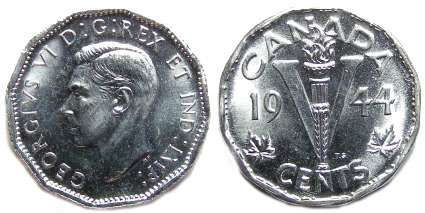
1944 5 CENT There has been controversy over a 1944 tombac 5 cent that first appeared in the late 1950's as the only known specimen, which was certified by PCGS and sold on a Heritage auction in 1999. The 1944 mint report records $400 face value in Tombac nickels (8000 coins) was shipped to Banks in Ottawa in 1944, but it is not specific as if these were coins were dated 1944, or left over 1943's still in the mint at the end of 1943. If 8000 1944 tombac nickels were shipped to banks others would show up reasonable often, yet none have. It is more likely those 8000 were 1943's left still in the mint, and the single 1944 tombac is an off metal strike error on a tombac flan that was hung up somewhere in the mint and was accidental struck in 1944. As such I feel it should be considered a mint error, not an official type.
|
1945 5 CENT
|
When the war ended there was no longer a nickel shortage so 1946 saw a return to both the standard "beaver" design, and the use of a nickel alloy, but retaining the 12 side form used since the 1942 tombac.
1946 5 CENT
|
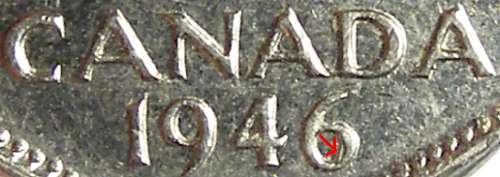
1946 6/6 5 CENT Some 1946 nickels have doubling of the 6 and are known as the 6/6 variety. There are two distinctly different types of doubling that occur. The first is a true re-punched 6/6 with a well formed with smooth outline of a second 6 both inside the lower right edge and along the upper back of the 6. These are somewhat scarce and what I consider a true 6/6 and what I feel the trend sheet price reflects. The second 6/6 type is due to die deterioration with slightly rough and irregular doubling inside the lower right and occasionally a little along the back of the 6. These weak 6/6 types are more common I price them lower than the strong 6/6. I have recently seen both types in certification holders with no distinction between them. I recently saw one 1946 with doubling along the bottom of the 4 and 6 due, but this was more a double date related to the 1962 double date types.
|
1946 5 CENT - ARROWHEAD A distinct triangular mark occurs inside the 6 of some examples, and is known as the "arrowhead" variety. These were listed by Hans Zoell as P176a.
|
1947 saw two major varieties of 1947 nickels. The first are the plain 1947 actually issued in 1947. The second is the 1947 dot where one of the dies pitted resulting in a dot to the lower right of the date and while this is a die deterioration variety, it is widely collected. The third is the 1947 ML actually struck in 1948 and discussed below.
1947 5 CENT
|
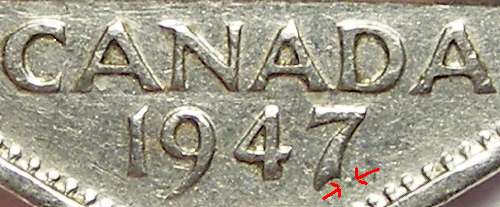
1947 DOT 5 CENT Some people believe the 1947 dot with the small dot behind the 7 was intentional to mark where the maple leaf was to be punched for the later 1947 ML variety. This is not the case as there are other dots in other positions on these, showing the dots result from die deterioration. The dot is a very small and close to round. Many people have trouble seeing it without magnification and miss-identify the larger and more ragged maple leaf on the 1947 Maple Leaf as 1947 dots (I see this several times a week).
|
India received its independence on August 14, 1947 requiring that IND IMP (India's Emperor) be removed from all British Commonwealth coins dated 1948 or newer. A problem similar to that in 1937 when Edward the VIII abdicated, the new obverse designs for coins all over the British Commonwealth had to be prepared at the Royal Mint in England. Those for Canada were not ready at the beginning of 1948 and coins were needed, so early in 1948 coins were struck dated 1947 so that the IND IMP design could still be used but a small maple leaf was placed after the date indicating minted in 1948.
1947 MAPLE LEAF 5 CENT
|
When the new designs arrived in 1948 with IND IMP (India's Emperor) removed, the entire inscription now reads GEORGIVS VI DEI GRATIA REX (George VI By The Grace of God King) and was used until 1952.
1948 5 CENT The newly designed 1948 5 cent dies were a little late arriving so they were struck for only a limited period time resulting in a lower than normal mintage. The new obverse design had not just a new inscription, but were engraved to produce a higher relief King's portrait with bolder hair lines. This new bold portrait was used until mid 1951 when the 1951 steel nickels were introduced and it proved difficult to strike the high relief design on steel.
|
1949 5 CENT
|
1950 5 CENT
|
Because of the economic importance the Sudbury nickel deposits the 200th anniversary of the Swedish chemist A. F. Cronstedt's discovery of nickel was commemorate by depicting a refinery building in the early year 5 cent coins. Because they were unusual people saved them so today they are very common and most are high quality. Please note this type is always has the High Relief portrait which is rare on the beaver type that replaced it later in the year.

1951 COMMEMORATIVE 5 CENT
|
1951 COMMEMORATIVE HALF MOON 5 CENT Some 1951 commemorative nickel dies have a half moon bump immediately above the smelter to the the left of the smoke stack. The shape is an exact match for the inside of the King's ear on the opposite side and results from a die clash. This variety was not noted by Zoell and is not listed in any of the standard references.
|
The Korean war created a nickel shortage so chrome-plated steel blanks were used for the beaver design 5 cents struck later in 1951. The high-relief obverse introduced in 1948 proved difficult to strike on steel blanks so after a short time with not many struck in high-relief a new low-relief portrait was used for most 1951 beaver and all 1952 nickels. The 1951 high relief portrait beaver nickels scarce but low-relief examples very common.
5 cents continued to be struck on chrome plated steel blanks through 1952, 1953 and 1954. The chrome plating scratches easily most examples below VF-30 will be scratched. See my comments above (just above 1944) about the mistaken believe some people (including those at ICCS) have that the chrome can be easily removed, which it cannot with destroying the coin.
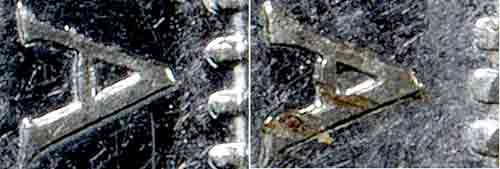
1951 BEAVER 5 CENT As discussed above 1951 beaver type nickels comes with the very common low relief and the much scarcer high relief portraits. They are fairly easy to differentiate as the final A in GRATIA behind the King's head points between two denticles (left side of the image above) on the common low-relief but directly at a denticle on the rare high relief (right side of the image). As with all chrome plated steel nickels most examples have been scratched and I generally do not offer such examples for the common low relief. On the high relief examples I do listed scratched ones but will describe the scratches and price them accordingly.
|
1952 5 CENT
|
INCO nickel was still until about 1961 when the mint switched to Sherritt nickel refined by a leaching process that resulted in 99.9% pure nickel. The inconsistent purity, thus hardness of the INCO nickel continued with inconsistent strikes with how sharp or clear the laurels in Queen Elizabeth's hair differed from coin to coin. This makes them difficult to grade accurately. The switch to Sherritt nickel in 1961 solved this but because the nickel was softer the coins were less resisted to bag marking so nickels from 1961 to 1967 are difficult to find in MS-65 (even MS-64) and command higher prices when that nice than do 1950's nickels.
The early 1953 dies had the shoulder fold weakly cut so the shoulder fold was usual not present, although on some well struck examples you may see a trace of it. This made the Queen's shoulder appeared bare which many people thought to be inappropriate. Known as the No Shoulder Strap (NSS) or No Shoulder Fold (NSF) variety, the easiest way to determine these is by the strong serifs at the top and bottom of the I's in II and DEI on the obverse. There is also a distinct gap (wider than on the later type) between the small maples leaf's to the upper right and left and the denticles around the rim which is why these are known as the No Shoulder fold Far Leaf variety. The entire design is slightly smaller so the date is also further from the rim.
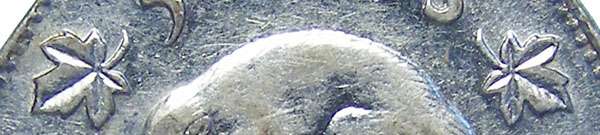
1953 NSS FAR LEAF 5 CENT
|
Later in 1953 the dies were re-designed with a deeper shoulder fold which usually will be visible on the coin, although not on some weaker strikes. Known as the Shoulder Strap (SS) or Shoulder Fold (SF) variety, the easiest way to be certain of this variety is because the serifs at the top and bottom of the I's on the obverse are much smaller to the point the I's nearly appear straight. On the reverse the entire design was made slightly larger resulting in a smaller gap between the maples leaf's and the denticles (they nearly touch the denticles) and the date is slightly closer to the rim, so these are known as the Shoulder Fold Near Leaf variety.
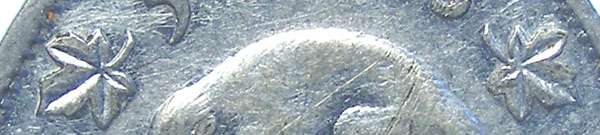
1953 SS NEAR LEAF 5 CENT
|
1953 MULE ERROR 5 CENT When the change from the NSF to the SS variety occurred, a few dies got mixed up resulting in a small number of 1951 nickels struck and No Shoulder Strap (or NSF) Far Leaf, and some as Shoulder Strap (or SF) Near Leaf. These are known as mule errors, a term for coins struck with incorrect die pairs. The No Shoulder Strap (NSF) mules are much rarer than the Shoulder Strap (SF) mules. |
|
1954 5 CENT 1954 also exists in a no shoulder fold (NSF) variety but they are very rare and so far I have not owned one.
|
1955 5 CENT
|
1956 5 CENT
|
1957 5 CENT
|
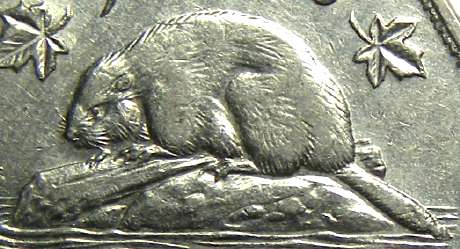
1957 BUG TAIL 5 CENT One 1957 die developed a die pit on the tip of the beavers tail, resulting in a raised dot, a variety known as the bug tail. This dot probably resulted from a foreign object on the die being struck into the die, as the pit is always the same size so did not form gradually.
|
1958 5 CENT Some 1958 five cents show a slight doubling of the 1 and 8 in the date, and are known as the double date, although sometimes ICCS calls them just double 18. I don't get this variety very often.
|
1959 5 CENT Similar to 1957, one of the 1959 dies develop a pit likely due to a foreign objects on the die at some point, but his time the pit is part way up the tail rather than at the tip, in a variety known as the 1959 bug. This variety is listed by Hans Zoell as B191Q.
|
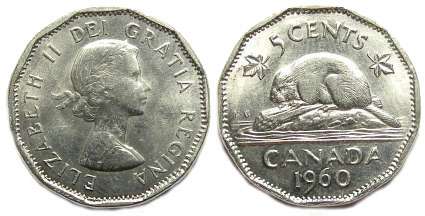
1960 5 CENT Some 1960 5 cents are weakly struck beavers with much of the fur on the beaver's back so weakly struck that most of the details is missing even on otherwise high quality coins. There is a corresponding weak point on the Queen's head in the hair just above her ear. Known as the "bald beaver", Zoell listed this for 1960 as his Y192b. The amount of fur showing varies from coin to coin, but for me to list a coin as a "bald beaver" at least 80% of the fur between the head and haunch must be missing. Between 50 and 80% I may list them but noting a weak slightly bald beaver.
|
With the switch to purer softer Sherritt nickel in 1961, I have heard this referred to as the year the beaver got it's whiskers back due to the better strikes resulting from the slightly softer metal. The softer metal also results in more bag marks in the mint handling processes, so coins grading higher than MS-64 are very unusual in this period.
With the softer nickel the mint reduced the die pressure which extended die life, as the higher pressures were not needed. They had not used up all of the old Inco nickel so some harder flans were occasionally used and with the lower die pressure those coins received poor strikes where some of the beavers fur did not strike up. When dramatic these are know as Bald beavers. Seen mostly in 1961, I have seen some in 1962 and 1963.
1961 5 CENT Some 1961 5 cents have some doubling of the bottom of the date and sometimes parts of the reverse inscription, usually either 61 or the first and last 1's but not as strong as on the 1962 double dates. 1961 5 cents also come in the Bald Beaver variety, and recently I had one that was both a bald beaver and a double date.
|
1962 5 CENT As described under 1960, some 1962 5 cents are known with the Bald Beaver variety.
|

1962 5 CENT DOUBLE DATE Some 1962 nickels have doubling at the bottom of the date and sometimes letters of the reverse. The doubling is slightly different from coin to coin showing it is striking effect known as machine doubling, not a result of the die cutting. The the amount of doubling can vary dramatically with the price in the CCN trend are for an average example with two or three digits doubled. Examples with some doubling on all four digits I call strong double date and price them higher, with the stronger the doubling the higher the value.
|
1963 5 CENT Some 1963 nickels have doubling of the beaver's head, back, the K of the K.G. designers initials, plus minor doubling on the bottom of some letters in CENTS. While not listed in any major references on Canadian coins, these are listed in Hans Zoell books as #R195j. I very occasionally see 1963 Bald Beaver 5 cents but they are much less common than in 1961 and 1962. In a recent roll I found several, but all had a nearly identical light scratch in spite of being straight from the roll, probably a die ejection defect.
|
1964 5 CENT In 1964 the government issued presentation sets, mostly for presentation to visiting dignitaries. Coin from these sets have high lustre fields with heavy to ultra cameo in both sides including on the lettering. They are different than cameo proof-likes which rarely are cameo on both sides and it is never perfectly even across both sides including the letter. ICCS calls these coins Specimen but because they do look like proofs, PCGS calls them Proof, but both mean the same thing. I have not been able to find the mintage of these sets but it was likely only a few hundred.
|
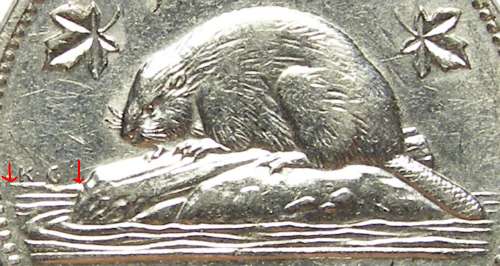
1964 Extra Water Line One 1964 reverse die developed a heavy die crack above the water lines to the left of the beaver, resulting in what looks like an extra waterline and is known as the extra waterline (XWL) variety and is listed in standard references and widely collected.
|
Starting in 1965, the Queen's portrait was updated to a more mature head, wearing a tiara.
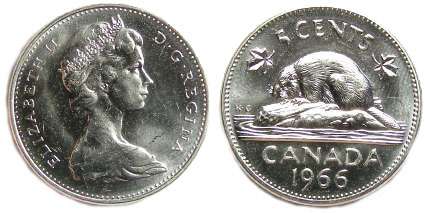
1965 5 CENT The 1965 nickel is a very common and worth very little unless high quality or the rare large bead variety. To differentiate between the common small and rare large bead most references say a line drawn between the II to the upper left of the Queen's head will point between two beads on the common small bead but directly at a bead on the rare large bead. I find it better to look at the A of REGINA which points between two beads on the common small bead type and directly at a bead on the rare large bead.
|
1966 5 CENT The purer and thus softer Sherritt nickel was adopted part way through 1961, the last old stock Inco nickel probably used up early 1963. 5 cents from 1964 to 1981 are all struck on the softer Sherritt nickel and tend to have more bag marks than earlier dates and high really high grade examples are difficult to find but reasons I do not understand this is especially true for 1966 where finding examples that grade MS-65 is nearly impossible. On the other hand, in 1966 there was a rumor that 1966 5 cents were going to be rare so people hoarded them in large numbers and today original rolls are very common.
|
In 1967, to celebrate Canada's 100th anniversary as a country, all of the standard circulating coins were issued depicting various animals common to Canada, with a rabbit on these 5 cent coins. Please note that the examples of this type we offer here are exceptional examples, either Proof-likes, Specimens or high end MS examples, often with a cameo portrait and/or rabbit. Normal examples, even in MS-60 to 63, or examples from proof-like or specimens sets with any problems, are very common and of no significant value beyond what you can spend them for, so we do not offer them here. For most coins if listed as cameo it is only the portrait side where the cameo effect is important. On these 1967 coins many people like the cameo effect on the animals, so for these we will note if the cameo is on the portrait, on the rabbit, or both (you seldom get it on both, but they do show up sometimes in the specimen sets).
1967 5 CENT
|
The beaver design resumes in 1968. Most 5 cent dates from 1968 and newer have no collectable value unless in very high quality (generally MS-63 or higher) or if from proof-likes, specimens or Proofs but even then the values are minimal. If I do not have a particular date listed below do not assume it is rare. It is more likely so common that I do not have one nice enough to be of enough value to justify listing.
Please note that up to 2011 when I describe a coin to be Proof-like (PL) I mean a coin from a standard mint set. Intentionally struck to a higher quality than circulation strikes, they are usually easier to find that mince Mint state (MS) coins from a bank rolls, thus less expensive. PL coins tend to have better strikes and higher luster than IS coins, so are fairly easy to differentiate. ICCS and some references use the term NON-CIRCULATING NUMISMATIC MINT STATE for these coins; which I find causes confusion in beginning collectors. In 2012 the mint stopped making intentionally nicer coins for the standard sets which then only contain standard MS (mint state) coins. Specimen and proof examples were still make with distinct differences.
1968 5 CENT
|
1969 5 CENT
|
1970 5 CENT
|
Beginning in 1971, the mint begins striking three different striking qualities of coins, with a fourth added in 1981 :
Mint state (abbreviated MS) which are coins struck for issue through the banks and have average lustre and surface qualities. In most cases MS coins have little value unless in the highest range of the MS coins, and those are seldom seen. We don't list most dates in MS because they are not of high enough value to justify the time and trouble to list and/or ship them.
Proof-like (abbreviated PL) are standard mint set coins, usually from the pliofilm packaged sets, red double penny sets, and later the blue book set, but in later dates there were a variety of other types of sets they can come from. PL coins have a much higher lustre than MS coins, mostly because they are struck from dies in their newest die state. They also have very minimal marks (the average PL is a PL-64) as they did not go through as many of the mint handling processes as MS coins do, but they are not perfect coins and one should not expect them to be absolutely mark free.
Specimen (abbreviated SP or SPEC) which were in the black leather double dollar sets from 1971 to 1980, and for later dates in various types sets. Like PL coins they are struck from dies in their freshest die state but differ in being double struck to give them a higher lustre and sharper images, and they do not go through any mint handling processes before going into the sets so are nearly mark free. The rims tend and edges tend to be a little sharper although this is not obvious on a casual inspection. When we list a coin as being a specimen, it is because we personally took it from a specimen set before listing it here.
Proof (abbreviated PR) coins are very nice coins found mostly issued in the double dollar black leather boxed proof sets starting in 1981, although some specialty coins did come other ways. The coins are clearly differing from the other striking qualities by being double struck from specially prepared dies so they have mirror fields and frosted images (and ultra cameo effect) and are specially handled so they go into the sets in near perfect condition as possible.
1971 5 CENT
|
1972 5 CENT
|
1973 5 CENT
|
1974 5 CENT
|
1975 5 CENT
|
1976 5 CENT
|
1977 5 CENT 1977 comes in two varieties where one has the 7's slightly lower than the other, resulting in a low high 7's varieties. Circulation (MS) strikes are found in both varieties with some confusion in the references as to which is scarcer where the CCN trend sheet lists the high 7 as scarcer but the Charlton Standard Catalogue lists the low 7 as scarcer. All proof-like and specimen examples are the high 7. I am not certain which is correct but will look into it. There are two things that are different about them. On the low 7 the gap between the date and CANADA is slightly wider, plus the top right tip of the 7 ends slightly to the right up the right side of the upright on the D. On the high 7 that gap is narrower, and that tip of the 7 ends more directly below that edge of the upright on the D. Even with that this can be a difficult variety to differentiate.
|
1978 5 CENT
|
1979 5 CENT
|
1980 5 CENT
|
1981 saw the introduction of proof sets to replace the double dollar specimen sets. The proof coins have frosted images against mirror fields and while specimen strikes continued to be struck, they were in other types of sets. Whether proof or specimen coins are easier to get as single coins, depends mostly in the value of the intact sets they come from. Generally after 2012 most proof sets are worth more intact than broken up so those coins are harder to get in proof.
1981 5 CENT
|
In 1982 the alloy for nickels was changed from pure nickel to a cupro-nickel alloy of 75% copper and 25% nickel. The size and weight remained the same at 21.21 mm diameter, 1.75 mm thick, and 4.54 grams and while they look exactly like the earlier dates they will not attract to a magnet. A peculiarity of 1982 nickels not seen on most other dates is many examples in proof-like and proof develop toning. Most go a light golden color but some go more vivid colors. I am noticing that as the years go buy more and more of them tone in these sets and white examples are becoming more difficult to find. I do not know why this happens to this dates but not other cupro-nickel examples after 1982.
1982 5 CENT
|
1983 5 CENT
|
1984 5 CENT
|
1985 5 CENT
|
1986 5 CENT
|
1987 5 CENT
|
1988 5 CENT
|
1989 5 CENT
|
1990 5 CENT One or more of the 1990 5 cent dies was missing some fur detail on the beavers belly resulting in what is known as the bare belly beaver variety. This probably results from over polishing of the dies.
|
1991 5 CENT
|
1992 5 CENT 1992 was Canada's 125th anniversary of confederation, and all 5 cents of this year have the date shown as the double date 1867-1992.
|
1993 5 CENT
|
1994 5 CENT
|
1995 5 CENT
|
From 1996 to 2011, all of the Proof strikes of five cent coins are of sterling (92.5%) silver at 5.5 grams, while proof-like, specimen and circulation strike coins are still of cupro-nickel alloy of 75% copper and 25% nickel. The holders for proof sets are not sealed air tight, so air can get in and often causes the silver coins to develop a light golden brown toning, especially around the edges. Tone free (pure white) examples can be difficult to find for some dates. One should expect at least a little toning around the edges on these coins, which can be fairly attractive, but if you prefer white tone free examples please specify such on your order and I can usually accommodate such requests. Examples with heavier toning will be noted in the descriptions.
1996 5 CENT There are near and far 6 varieties of 1996 nickels, defined by the distance between the tail of the 6 and the D of CANADA. All examples in mint sets are near 6 but both occur on circulation strikes. Starting in 1996 specimen strike have a slightly matte background with mirror finish designs so a reverse cameo effect. For a few years starting in 1996 proof-likes also have this effect but not as strongly as on the specimen strikes.
|
1997 5 CENT In 1997 one still sees the matte background with polished images on the proof-like and specimen strikes, but not as strongly as on 1996, and oddly the effect is sometimes stronger on the proof-likes than the specimens. Although the CCN trend sheet list different prices for Ottawa and Winnipeg mint nickels from sets, it is impossible to distinguish them once removed from the sets so as single coins there should not be a difference in price.
|
1998 5 CENT In 1998, the Mint put a "W" mint mark below the Queen's head on coins minted at Winnipeg, although those were all in proof-like sets. Later in the years the minting of these sets was moved back to Ottawa where no mint mark was used. Thus proof-like 5 cents are found both with and without the "W" mint mark. All circulation (MS), specimen and proof coins were without mint mark. The finish on 1998 proof-like coins returns to high luster finish, while specimen coins retain the slightly matte finish fields with high lustre designs that first appeared in 1996.
|
1999 5 CENT
|
1999 P TEST 5 CENT In 1999, as a cost saving measure, the Canadian Mint made plans to strike 1, 5, 10, 25 and 50 cent coins on nickel plated steel blanks which were first nickel plated, then copper plated and then for all denominations other than the 1 cent, nickel plated again. A P was placed below the Queen's portrait to indicate a plated steel blank. First struck only as test tokens for vending machine companies for calibrate purposes, those companies were supposed to return them to the mint. Some ended up on the market at very high prices so the mint got in on the action selling 20,000 sets to collectors at much lower prices. Packaged like Proof-like sets their exact status is unclear and I prefer to call them Proof-likes, but others including ICCS call them Mint State. A mintage of only 20,000 means they are nearly as scarce as 1948 dollars. The vinyl packaging leaves a light film on them that can be removed with rubbing alcohol.
|
2000 5 CENT Most 2000 5 cents, including those in Proof-like and Specimen sets, were on cupro-nickel blanks with nothing below the bust. Some examples in Proof-like quality were struck at Winnipeg with the W mint mark but those are also on cupro-nickel blanks. A relatively small mintage (just under 5 million) were struck on plated steel with the P but only for circulation, making them the first circulating Canadian coins on these blanks. It is not clear to me if these are a later year change, or an experiment that may have occurred any time during the year.
|
Two special commemorative 5 cents were issued in 2000. The first commemorates the Les Voltigeurs regiment headquartered in Quebec which was formed in 1862 and served as an armored regiment during world war II. The second commemorates the Royal Military College of Canada established at Kingston Ontario in 1874. Both are struck on 21.3 mm diameter, 1.85 mm thickness, 5.3 gram sterling silver (92.5% silver, 7.5% copper) flans.
2000 Les Voltigeurs 5 CENT A commemorative 5 cent was struck in 2000 to commemorate Les Voltigeurs regiment headquartered in Quebec, formed in 1862 and served as an armored regiment in world war II. All examples are struck in Proof at 21.3 mm diameter, 1.85 mm thickness and 5.3 gram of sterling silver (92.5% silver, 7.5% copper). The price listed is for an example in it's capsule but not the original box, which allows for reasonable priced shipping. If you want it in the original box I may be able to provide but because it is thick and has to go parcel post it will add about $8.00 to the shipping charge.
|
2001 5 CENT 2001 5 cents are found with two varieties. Some circulation strikes are on cupro-nickel blanks which are the last circulating 5 cents issued without the P below the Queen's bust and are the scarcer of the two types. Most circulation strikes and all 2001 proof-like and specimen strikes are on plated steel blanks with the P for plated. All proof strikes are solid silver without the P.
|
2001 ROYAL MILITARY COLLEGE 5 CENT A commemorative 5 cent was struck in 2001 to commemorate the Royal Military College of Canada established at Kingston Ontario in 1874. The specifications and shipping rules are the same as for the 2000 Les Voltigeurs 5 cent listed above.
|
2002 5 CENT 2002 was the 50th anniversary of the Queen's accession which is commemorated on most Canadian coins of that year with the double date as 1952 2002 to the lower left of the Queen's head. The area where the date would be on other dates is blank and I common get phone calls about these coins from people saying they have nickel with no date on it. All except the silver Proof's are on plated blanks with the P.
|
2002 BATTLE OF VIMY RIDGE A commemorative 5 cent was struck in 2002 to commemorate the 85th anniversary of the battle of Vimy Ridge which occurred from April 9th to 12th, 1927. The reverse depicts a lady in morning in front of the Vimy Monument. The specifications and shipping rules are the same as for the 2000 Les Voltigeurs 5 cent listed above.
|
2003 was an interesting year for Canadian coins, with a number of varieties including the introduction of a new effigy of the Queen without a crown.
2003 5 CENT Old Effigy Coins struck earlier in 2003 have the crowned effigy of the Queen first introduced in 1990 and are found both with a P below the Queen's bust on plated steel or without the P on solid silver blanks from proof sets. Most proof-like and all specimen and normal proof sets in 2003 are of this bust type.
|
2003 5 CENT New Effigy Later in 2003 the Queen's bust was redesigned without a crown. Timed to celebrate the 50th anniversary of her coronation, the new effigy Coronation Portrait was introduced showing her without a crown but as it became the standard portrait for later years it is commonly known as the New Effigy. All New Effigy examples are on plated steel with the P. Those with just the P are only found from bank rolls for circulation with some Proof-like sets struck at Winnipeg found with WP to designate the Winnipeg mint, the only time the W and P appear on coins at the same time. I just noticed the 2021 Charlton Standard catalogue lists the New Effigy as existing with only the P in Proof-like and specimen but I believe that to be an error as he does not list such for any other denomination.
|
2003 5 CENT Youthful effigy To commemorate the Queen's 50th anniversary of her coronation, a special issue of coins was struck depicting a youthful portrait flanked by 1953 and 2003. These come from a special edition proof set, only issued in sterling silver.
|
2004 and all later dates use the new effigy portrait and are struck on plated steel blanks other than the solid silver proof examples. As in previous few years, Proof-like coins have an over all even lustre while specimen examples have high lustre designs with matte backgrounds.
2004 5 CENT
|
2004 D DAY 5 CENT 2004 was the 60th anniversary of the D day landing so 5 cent coins with the reverse based on the 1943 to 1945 V nickels were issued but with the dates 1944 - 2004 flanking the V, and random dot's and dashes where the Morse code around the edge should have been. These only come in proof quality, on 12 sided 21.3 mm, 5.3 gram sterling silver (92.5% silver, 7.5% copper) flans.
|
2005 5 CENT
|
2005 V-E DAY 5 CENT 60th anniversary of Victory in European (V-E) Day commemorative 5 cents were issued with a similar reverse to the 1943 to 1945 V 5 cents but dated as 1945 - 2005 flanking the V and lack the Morse code seen on the earlier types. Circulation (MS) and Proof-likes are on round plated blanks with an obverse of the Queen with the P below. Silver proof examples are on 12 sided 21.3 mm blanks containing 5.3 grams of sterling silver with the portrait of George VI, with random dots and dashes around the reverse which does not say anything in Morse code. A few silver proofs found only in the 2005 mint report covers have selective gold plating on the V and torch, with a laminated plastic bubble over it.
|
2006 5 CENT 2006 5 cents come in three varieties. Those with nothing below the Queen's head, struck in both Cupro Nickel for circulation, and sterling silver in the proof sets. Those with a P below her head, struck on plated steel in mint state, proof-like and specimen earlier in the years. Those with the mint logo below her head, struck on plated steel in mint state and proof-like, struck later in the year. The circulation strikes without a P or Logo are generally the more difficult to find.
|
Starting in 2007, all Canada 5 cents including the silver proof coins, have the stylized maple leaf mint logo below the Queen's bust so I will not bother to mention it in the listings below here.
2007 5 CENT
|
2008 5 CENT
|
2009 5 CENT
|
2010 5 CENT
|
In 2011 the mint stopped making intentionally superior quality coins for Proof-like (standard) mint sets, rather using normal mint state coins that had not gone through all of the mint handling processes rolled coins go through. With no way to differentiate between coins from sets vs bank rolls, all coins other than Specimen and Proof coins are designated as Mint State (MS). It can be difficult to find original rolls of these later dates, and the mintages of mint sets is not huge, so the prices variety from year to year for the various grades.
At this point examples 2011 and newer are difficult to get in all striking qualities. The mint rolls seldom come in, specimen sets were made in only limited quantities, and most mint sets are worth more intact than cut up, so I seldom do so.
2011 5 CENT
|
From 1996 until 2011 all silver colored coins in normal mint sets were struck of silver but starting in 2012 they mint made them in both silver and nickel plated steel, with the only way to differentiate them is with a magnet which will not attract to the silver examples.
2012 5 CENT
|
2013 5 CENT
|
2014 5 CENT
|
2015 5 CENT
|
2016 5 CENT
|
2017 5 CENT Canada's 150'th anniversary as a country was celebrated in 2017, and both regular coins and special anniversary coins were issued that year. On the 5 cent the regular traditional beaver type is the most common, issued in over 100 million in both bank rolls and some mint sets. The commemorative issue was called the Livings Traditions beaver, depicting a stylized beaver with it's legs out, with about 20 million issued in both bank rolls and mint sets.
|
2018 5 CENT
|
2019 5 CENT
|
2020 5 CENT
|
Please note that up to 2010 I describe coins as Proof-like (PL) if they come from a mint set. PL coins are easily differentiated by their superior strike and luster, with only very minor bag marks and while nicer than MS coins from bank rolls they are easier to find in high grades and usually worth less. ICCS and some references refer to these as NON-CIRCULATING NUMISMATIC MINT STATE which I find confusing which is why I to call them Proof-like. Specimen and proof sets still use specially struck coins with distinctive finishes.

© 1997-2024 R & T Enterprises Ltd.
 |
 |


