HOME | Contact | Place Orders
1 cent | 5 cent | 10 cent | 25 cent
50 cent | Dollars | Newfoundland | Tokens
World coins
 |
 |
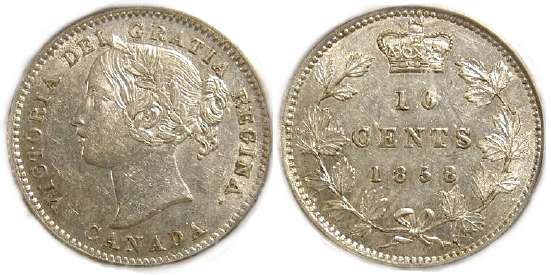
No Canadian 10 cents were struck from 1859 to 1869. When they resume in 1870 the young head type of the 1858 issue was used and continues though out the Victorian issues on both 5 and 10 cents, which a crowned head design was adopted for the 1, 25 and 50 cents.
No Canadian 10 cents were struck in 1895.
No Canadian 10 cents were struck in 1897.
EDWARD VII
|
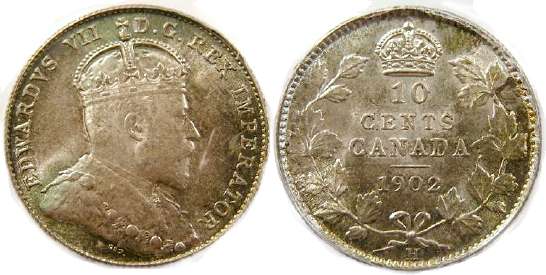
1902 10 cent
|
1902 H 10 cent
|
1903 10 cent
|
1903 H 10 cent
|
1904 10 cent
|
1905 10 cent
|
1906 10 cent
|
1907 10 cent
|
The Royal Canadian Mint opened in Ottawa in 1908, after which nearly all Canadian coins were minted in Canada. While the designs remained the same, the die axis for was changed from "coinage" to "medal", except for the 1 cent coins which had always been made at medal axis. Coinage die axis means that if you place your fingers above and below the portrait then spin the coin around the other side comes out upside down. Medal axis means it comes out the same way up.
1908 10 cent
|
1909 Victorian leaf 10 cent 10 cents struck earlier in 1909 have the same Victorian leaves used on earlier dates with subdued veins and some leaves slightly smaller than on the later Edwardian leaf type (also known as the Broad leaf). If you need to compare, all before 1908 have this Victorian leaf type.
|
1909 Edwardian leaf 10 cent Later in 1909 the leaf design was changed to what is known as either the Edwardian leaf or the Broad lead design. The leaves were made slightly larger with more pronounced veins If you need to compare, all 1910 to 1912 10 cents are all this Edwardian (broad) leaf type.
|
1910 10 cent
|
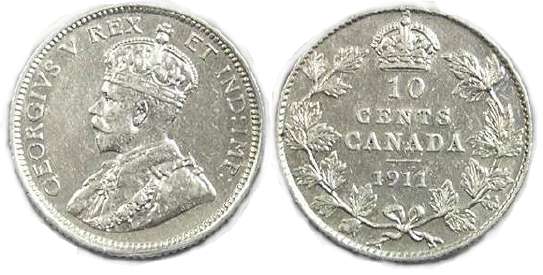
1911 10 cent George V coins were introduced in 1911 with "DEI GRATIA", Latin for "God's Grace", omitted from the obverse inscription. There was a public outrage against these "godless coins" and in 1912 "DEI GRATIA" again appeared on all Canadian coins.
|
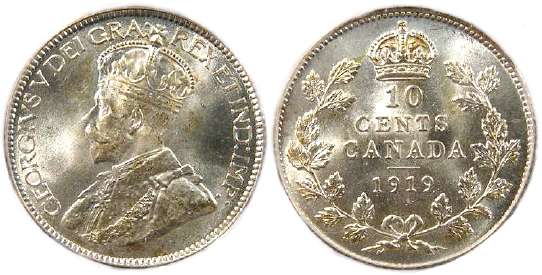
1912 10 cent In 1912 the "DEI GRATIA" again appears on the obverse inscription of all Canadian coins.
|
1913 Broad Leaf 10 cent Early 1913 10 cent coins have the broad (Edwardian) leaf design first introduced in 1909, but in 1913 they are scarce as later that year year the new small leaf design was introduced.
|
1913 10 cent A new small leaf design was introduced in 1913 with most 10 cents of this year struck with this type. The leaves were re-designed smaller, with less veining and a wider gap between the leaves and the rim and are similar to the older Victorian leaf design but not exactly. This new design was used until 1936.
|
1914 10 cent
|
1915 10 cent
|
1916 10 cent
|
1917 10 cent
|
1918 10 cent
|
1919 10 cent
|
While the designs did not change, in 1920 the alloy was reduced from 92.5% silver to 80% silver. The size and weight remain the same as the earlier issued.
1920 10 cent
|
1921 10 cent
|
No Canadian 10 cent coins were struck from 1922 to 1927 but this is the last gap as they have been struck continuously since 1928.
1928 10 cent
|
1929 10 cent
|
1930 10 cent
|
1931 10 cent
|
1932 10 cent
|
1933 10 cent
|
1934 10 cent
|
1935 10 cent
|
1936 10 cent Some 1936 10 cents have a die break between wreath ties below the date, and are known as the "BAR" type. This die break started off very weak and grew stronger over time, but in order to considered the bar type, the die break must be strong and clear. Bar types in ICCS holders will not always have the variety designated on the holders.
|
1937 10 cent
|
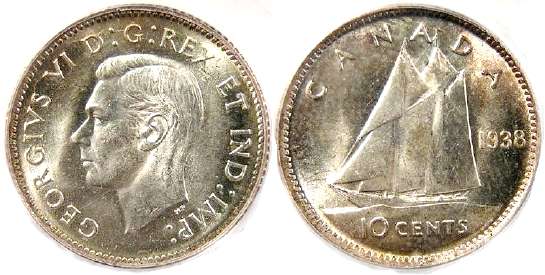
From 1938 to 1946 one sees doubling on the dates of some Canada 10 cents, with Hans Zoell recording examples of every date in his fourth edition MAJOR COIN VARIETIES, 1966-1967. The amount of doubling varies from coin to coin. Zoell refers these as re-entry varieties which I believe they are machine doubling caused by a faulty press where the die can bounce slightly creating minor double strikes which presents slightly differently on each coin. This also occurs in 1951 and I have seen 1952 examples with minor doubling, often just the leading 1. I am not certain for 1947 to 50 but would not be surprised if they can be found. I have also see strong date doubling on an 1953 NSS. When I have examples available I will note them in my listings.
It is interesting that in the same date range one sees significant die cracks running across the dates on 50 cent pieces, always in the same spot on every date, which is also caused by a faulty press with a die that can bounce slightly. It is likely the same press was used for those half dollars and the dimes in this series, introduced in 1938 and probably replaced part way through 1953.
1938 10 cent
|
1939 10 cent
|
1940 10 cent
|
1941 10 cent
|
1942 10 cent
|
1943 10 cent
|
1944 10 cent
|
1945 10 cent
|
1946 10 cent
|
1947 10 cent
|
Because India received its independence in 1947 "IND IMP" (India's Emperor) had to be removed from all British Commonwealth coins dated after 1947. The new designs were prepared in England and those for Canada were not ready until late in 1948. New coins were needed so for the first part of 1948 coins were struck dated 1947 with a small maple leaf after the date indicating minted in 1948.
1947 MAPLE LEAF 10 cent
|
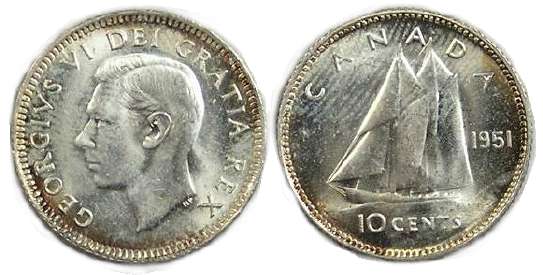
1948 10 cent 1948 was the lowest mintage 10 cent of that era which until 1980 were considerably scarcer than other dates. The silver melt of 1980 saw large numbers of silver 10 cents destroyed but 1948's were saved so that by 1981 the relative rarity diminished and today they only slightly scarcer than the others.
|
1949 10 cent
|
1950 10 cent
|
1951 10 cent Charlton list a variety in 1951 he calls the double die and illustrates an example with doubling on the 10 CENTS below the boat. As far as I can see this is a variation on the bouncing die double date varieties seen sence 1938, and the doubling can appears in other places, often seen on the first to digits of the date. The trend sheet price for double die varieties assume strong doubling on various parts of the reverse. Those with only double in a few places, such as the date, are worth less.
|
1952 10 cent
|
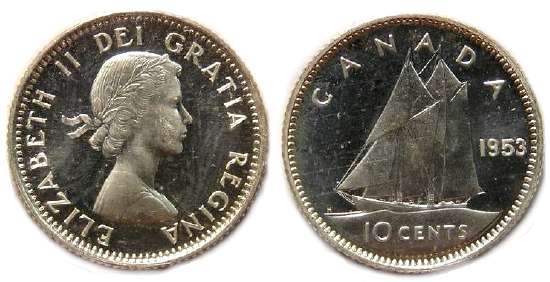
1953 NSS 10 cent The early 1953 dies had the shoulder fold weakly cut so the shoulder fold was usual not present, although on some well struck examples you may see a trace of it. This made the Queen's shoulder appeared bare which many people thought to be inappropriate. Known as the No Shoulder Strap (NSS) or No Shoulder Fold (NSF) variety, the easiest way to determine these is by the strong serifs at the top and bottom of the I's in II and DEI on the obverse.
|
1953 SS 10 cent Later in 1953 the dies were re-designed with a deeper shoulder fold which usually will be visible on the coin, although not on some weaker strikes. Known as the Shoulder Strap (SS) or Shoulder Fold (SF) variety, the easiest way to be certain of this variety is because the serifs at the top and bottom of the I's on the obverse are much smaller to the point the I's nearly appear straight. This is especially needed on more worn examples.
|
1954 10 cent
|
1955 10 cent
|
1956 10 cent One 1956 die developed a small pit centered just below the 9 and 5 resulting in a small raised dot on the coins. The position of the dot makes it look intentional and these are collected as a recognized variety. Small dots occur below the date in a number of different places in 1956, but there is only one type recognized as the official dot variety, which is clearly illustrated in the Charlton Standard Catalogue of Canadian Coins.
|
1957 10 cent
|
1958 10 cent
|
1959 10 cent
|
1960 10 cent
|
1961 10 cent
|
1962 10 cent
|
1963 10 cent
|
1964 10 cent
|
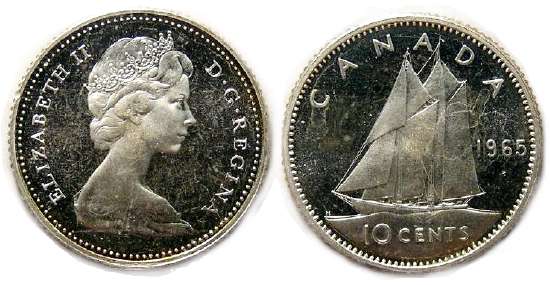
1965 10 cent
|
1966 10 cent
|
1967 10 cent In celebration of Canada's 100th anniversary of confederation, 1967 coins circulating coins depict animals common to Canada, with a mackerel on the dimes. For the first half of the year 1967 10 cent coins were struck to the 800 fine silver after which they were struck from 500 fine silver. There is no simple way to determine which purity a particular example was struck at as they look, feel and weigh exactly the same, although all examples in specimen and proof-like sets were struck at the 800 fine standard. 1967 coins were struck as Mint State, Proof-like and also in Specimen which were in the black boxed sets. Many of the specimen examples were toned by a reaction with the box's lid, and some of the toning can be a very attractive dark blue, although many examples have very unattractive toning.
|
Please note that up to 2011 when I describe a coin to be Proof-like (PL) I mean a coin from a mint set, intestinally struck to a higher quality than normal, but worth less than a MS (Mint State) coin from a bank roll in the same grade. They are fairly easily differentiated by their strike and luster. ICCS and some references call such coins NON-CIRCULATING NUMISMATIC MINT STATE which I feel will cause confusion in beginning collectors. Starting in 2012 the mint stopped making intentionally nicer coins for the standard sets and the coins are all simply MS (mint state) except for specimen and proof examples.
1968 SILVER 10 cent 1968 saw a return to the Bluenose design. For the first part of the year the coins were struck from 50% silver and 50% copper and are non-magnetic. No Proof-like silver examples were made. Later in the year they were pure nickel and will attract to a magnet.
|
During early 1968 the 10 cent coins were made of 50% silver, but later that year (and all following years until 1999 for circulation strikes and 1996 for proofs) they changed the alloy to pure nickel with no change in size or weight. They can easily be distinguished with a magnet as nickel ones attract and silver ones will not.
For most dates of nickel 10 cent coins I only list those from proof-like, specimen or proof sets, as circulation strikes from rolls are generally not of enough value to justify listing. There are a few exceptions which I will discuss among the listings.
There are no rare dates in this series, so if you don't see a particular date listed here, please do not assume it is rare, as it is more likely too common (thus low value) for us to list in a circulation strike, and for some reason I simply do not have one from a mint set to list at this time. I add this because I get a lot of e-mails from people asking why the date they have is not listed, and they assumed that means it is rare.
From 1968 to 1970, the only mint sets made for general distribution were Proof-like sets so generally we only offer these dates in Proof-like quality, unless exception MS coins are available.
1968 NICKEL 10 cent Due to a large need for nickel 10 cents where changing over from silver to nickel in 1968, the Royal Canadian Mint lacked the capacity mint enough coins so contracted the Philadelphia mint to make the needed extra coins. Those struck at the RC mint in Ottawa have a distinct V between the edge reeds, while those from Philadelphia have more flat bottomed U. In practice these can be very difficult to tell a part, although all examples in Proof-like sets were mint at RC mint in Ottawa.
|
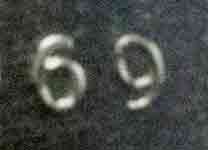 1969 SMALL DATE |
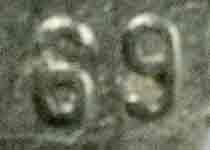 1969 LARGE DATE |
1969 10 cent Over 55 million 10 cents were struck in 1969 nearly all of which have a rather small date where the top of the 6 and bottom of the 9 both end pointing straight across. There is a large date variety where the date and most of the reverse design are larger, and the top of the 6 and bottom of the 9 curls further around to point more downward. The images above were both to the same resolution so the relative sizes are shown accurately, and the difference in the curl is clear (even if the images are a little fuzzy). Less than 20 of the large date variety are currently known to exist.
|
1970 10 cent
|
Beginning in 1971, the mint begins striking three different striking qualities of coins, with a fourth added in 1981 :
Mint state (abbreviated MS) which are coins struck for issue through the banks and have average lustre and surface qualities. In most cases MS coins have little value unless in the highest range of the MS coins, which are seldom available.
Proof-like (abbreviated PL) are standard mint set coins, usually from the pliofilm packaged sets, red double penny sets, and later the blue book sets, and even later from a variety of other types of sets. PL coins have a much higher lustre than MS coins, mostly because they fresh new dies, and they also have very minimal marks (the average PL is a PL-64) as they did not go through as many mint handling processes as MS coins do, but they are not perfect coins and one should not expect them to be absolutely mark free.
Specimen (abbreviated SP or SPEC) were in the black leather double dollar sets from 1971 to 1980, and for later dates in various different sets. Like PL coins they are struck from dies in their freshest new die state but differ in being double struck to give them a higher lustre and sharper images. They do not go through any mint handling processes before going into the sets so are usually nearly mark free. The rims and edges tend to be a little sharper than on PL or MS coins, although this is not obvious on a casual inspection. When I list a coin as specimen, I personally took it from a specimen set.
Proof (abbreviated PR) coins are very nice coins double struck to given them perfect lustre with specially prepared dies that create mirror fields and frosted images (and ultra cameo effect). They were specially handled to go into the sets as close to perfect condition as possible. Starting in 1996 proof 10 cent coins were struck in silver, and will sometimes have some light toning, especially around the edges.
1971 10 cent
|
1972 10 cent
|
1973 10 cent
|
1974 10 cent
|
1975 10 cent
|
1976 10 cent
|
1977 10 cent
|
1978 10 cent
|
1979 10 cent
|
1980 10 cent 1980 10 cents are found with narrow and wide digits in the dates and while these are sometimes called narrow and wide dates that does not really describe them. The easiest way to differentiate them is by the 0's where in the narrow the 0 is thinner at the top and bottom than the sides, while the wide is the same thickness all the way around. The same is true of the 8's and 9's but are less noticable. In my opinion they are better refered to as wide and narrow 0's. The wide 0 is only found on some circulation (MS) strikes and while it has the higher mintage it is the more difficult to find in collectable grade as most of them are now circulated. I believe the CCN trend sheet listing for them in PL sets is an error. The narrow dates are found in Proof-like and Specimen sets, and while they are a fraction of the mintage of the wide date, they are mostly still in new condition and thus the easier type to find in collectable grades.
|
1981 saw the introduction of proof sets to replace the double dollar specimen sets. The proof coins have frosted images against mirror fields and while specimen strikes continued to be struck, they were in other types of sets. Whether proof or specimen coins are easier to get as single coins, depends mostly in the value of the intact sets they come from. Generally after 2012 most proof sets are worth more intact than broken up so those coins are harder to get in proof.
1981 10 cent
|
1982 10 cent
|
1983 10 cent
|
1984 10 cent
|
1985 10 cent
|
1986 10 cent
|
1987 10 cent
|
1988 10 cent
|
1989 10 cent
|
1990 10 cent
|
1991 10 cent
|
1992 10 cent 1992 was Canada's 125th anniversary of confederation, and 10 cents of this year have the date shown as the double date 1867-1992 to either side of the Blue Nose.
|
1993 10 cent
|
1994 10 cent
|
1995 10 cent
|
From 1996 to 2011 all of the Proof strike ten cent coins are sterling (92.5%) silver at 2.4 grams. Proof-like, specimen and circulation strike coins continue to be either pure nickel at 2.07 grams, or in later dates nickel plated steel. The holders for proof sets are not sealed air tight, so air can get in and often causes the silver coins to develop a light golden brown toning, especially around the edges. This effect can be fairly attractive. Tone free (pure white) examples can be difficult to find for some dates. One should expect at least a little toning around the edges on these coins, which can be fairly attractive, but if you prefer white tone free examples please specify such on your order and I can usually accommodate such requests. Examples with heavier toning will be noted in the descriptions.
1996 10 cent In 1996 Proof-like and specimen strikes have a reverse cameo effect where the backgrounds are matte while the designs are more mirror finish, unlike previous sets which were mirror finish on all surfaces. The proof-likes and specimens can be very difficult to tell a part but specimens have very slightly crisper designs and slightly better formed rims due to having been double struck, but these difference is minor.
|
1997 10 cent In 1997 the normal Bluenose 10 cents were struck for circulation. While proof-like sets were struck earlier in the year at Ottawa and later at Winnipeg, the coins from the two mints are identical s one removed form the sets cannot be differentiated. The only way to be certain of the mint is to buy intact mint sets. 1997 saw proof sterling silver 10 cent's commemorating the 500th anniversary of John (Giovanni) Cabot's discovery of North America in 1497. Columbus only discovered the Caribbean Islands and central America, but not North America in 1492), although the Vikings were here long before either of them.
|
1998 10 cent In 1998 proof-like sets were minted at Winnipeg for the first part of the year, and those coins have a W mint mark to the lower right of the Queen's head. No circulation strikes were struck with this mark. Sets were minted at Ottawa later in the year, and those coins do not have the W or any other mint mark. In my experience the Ottawa examples in Proof-like are more difficult to find than the Winnipeg examples. All circulation (MS), specimen and proof coins were without at Ottawa mint mark. The finish on 1998 proof-like coins returns to high luster finish, while specimen coins retain the slightly matte finish fields with high lustre designs that first appeared in 1996.
|
1908-1998 COMMEMORATIVE 10 cent To commemorate the Royal Canadian Mint's 90th anniversary special sets were struck with the sizes, sterling silver alloy (other than the 1 cent), and general reverse designs of the 1908 coins, but with an obverse showing Queen Elizabeth's portrait and date as "1908 - 1998". The early sets have an antiqued matte-proof finish that proved unpopular with collectors so were discontinued and are now the scarcer of the two finishes. The later sets are mirror-proofs.
|
1999 10 cent All 1999 10 cents were struck at Ottawa without a mint mark, with specimen and proof-like examples easy to differentiate by the different finishes that are the same as those in 1998. I am not sure why but most of the times that I find in 1999 Proof sets do not have the peripheral toning common to other dates.
|
1999 P TEST 10 cent In 1999, as a cost saving measure, the Canadian Mint made plans to strike 1, 5, 10, 25 and 50 cent coins on nickel plated steel blanks which were first nickel plated, then copper plated and then for all denominations other than the 1 cent, nickel plated again. A P was placed below the Queen's portrait to indicate a plated steel blank. First struck only as test tokens for vending machine companies for calibrate purposes, those companies were supposed to return them to the mint. Some ended up on the market at very high prices so the mint got in on the action selling 20,000 sets to collectors at much lower prices. Packaged like Proof-like sets their exact status is unclear and I prefer to call them Proof-likes, but others including ICCS call them Mint State. A mintage of 20,000 means they are nearly as scarce as 1948 dollars. The vinyl packaging leaves a light film on them that can be removed with rubbing alcohol. Recently I came into posession of some 1 and 10 cent test tokens actually sent to firms for testing purposes and noticed the dies are not the same used in the 20,000 sets. While the differents are subtle it is possible to tell true test tokens from those the mint sold later as test tokens. I plan to eventually publish an article explaining what is different.
|
2000 10 cent In 2000 the circulation (MS), specimen and proof sets were all struck at Ottawa without mint mark while proof-like sets were made both at Ottawa without mint mark and Winnipeg with s "W" mint mark. They were all supposed to be struck in pure nickel, but a very small number experimental plated steel cored 10 cents with the P were made but never intended to be issued. Somewhere between 300 and 500 later turned up with most still in mint condition. A special issued of 2000 10 cents commemorate the 100th anniversary of the opening of the Caisse Populaire de Levis in Quebec, the first Credit Union in North America. These were all issued as sterling silver proofs.
|
Starting in 2001 all 10 cent coins other than solid silver proof examples are minted in steel core plated blanks. From 2001 to part way through 2006 they have the P for plated below the Queen's portrait but later in 2006 and all dates after that the P was replaced by the mint logo. The Canadian Coin News trend sheet lists inexpensive prices for 2001 non-P circulation strikes while the Charlton Standard Catalogue does not list them at all. I believe the CCN listing is in error.
2001 10 cent Two designs were issued for circulation in 2001, the standard bluenose and a one commemorating Canadian Volunteer workers. The bluenose design occurs in circulation MS, proof-like, specimen and silver proof. The volunteer design occurs in circulation MS, silver proof and while the standard references do not list it in proof-like (Non-Circulating MS) some that come in special souvenir cards have to be either proof-like or MS-65 to MS-66. As in that packaging there were never intended for circulation and they have the characteristics of a Proof-like coin, so I listed them as Proof-likes as they should not be confused with genuine MS-65 or MS-66 examples from mint rolls at much higher prices. Volunteer dimes are supposed to be on the same blanks as the bluenose 10 cents, but something is different as many vending machines reject them. I have not yet determined what is different.
|
2002 10 cent For the 50th anniversary of the Queen's accession 10 cents (and most other Canadian coins) of 2002 are double dated with 1952 above 2002 below the Queen's portrait a little to the left. No date appears on the reverse and I get phone calls from people claiming to have a dime without not date, as they have never noticed the date on the other side.
|
2003 was an interesting year for Canadian coins, with a number of varieties including the introduction of a new effigy of the Queen without a crown.
2003 10 CENT Old Effigy Coins struck earlier in 2003 have the crowned effigy of the Queen first introduced in 1990 and are found both with a P below the Queen's bust on plated steel or without the P on solid silver blanks from proof sets. Most proof-like and all specimen and normal proof sets in 2003 are of this bust type.
|
2003 10 CENT New Effigy Later in 2003 the Queen's bust was redesigned without a crown. Timed to celebrate the 50th anniversary of her coronation, the new effigy Coronation Portrait was introduced showing her without a crown but as it became the standard portrait for later years it is commonly known as the New Effigy. All New Effigy examples are on plated steel with the P. Those with just the P are only found from bank rolls for circulation with some Proof-like sets struck at Winnipeg found with WP to designate the Winnipeg mint, the only time the W and P appear on coins at the same time.
|
2003 10 CENT Youthful effigy To commemorate the Queen's 50th anniversary of her coronation, a special issue of coins was struck depicting a youthful portrait flanked by 1953 and 2003. These come from a special edition proof set and only issued in sterling silver.
|
2004 and all later dates use the new effigy portrait and are struck on plated steel blanks other than the solid silver proof examples. As in previous few years, Proof-like coins have an over all even lustre while specimen examples have high lustre designs with matte back grounds.
A special commemorate for the 100th anniversary of open championship golf in Canada was issued for direct sale but not for issue through banks. The mintage was less than 40,000. These are sometimes listed as mint state and sometimes Proof-like but I feel Proof-like is a better description.
2004 10 cent
|
2005 10 cent
|
2006 10 cent All 2006 10 cents, other than silver proofs are on plated blanks. Those struck earlier in the year have the P for plated but later in the year the P was replace by the stylized maple leaf mint logo. The mint logo does not indicated plated as in later years it also occurs on silver proofs. 2006 MS and PL 10 cents are found with either the P or logo. Specimen and proof strikes were struck only early in the year so all specimen examples have the P and silver proof examples are without either the logo or P.
|
Starting in 2007, all Canada 10 cent coins in all striking qualities including the solid silver proof examples, have the stylized maple leaf mint logo below the Queen's bust, so there is no need to mention the logo in descriptions.
2007 10 cent All circulation (MS) strikes and all silver proofs are straight 7. Proof-like examples from the black envelope sets are mostly straight 7 but occasionally curved 7. Proof-like sets with Olympic quarters and all specimen sets have the curved 7. Over all curved 7's are much scarcer and I price them slightly higher than the straight 7's.
|
2008 10 cent
|
2009 10 cent
|
2010 10 CENT
|
In 2011 the mint stopped making intentionally superior quality coins for Proof-like (standard) mint sets, rather using normal mint state coins that had not gone through all of the mint handling processes rolled coins go through. With no way to differentiate between coins from sets vs bank rolls, all coins other than Specimen and Proof coins are designated as Mint State (MS). It can be difficult to find orginal rolls of these later dates, and the mintages of mint sets is not huge, so the prices variety from year to year for the various grades.
At this point examples 2011 and newer are difficult to get in all striking qualities. The mint rolls seldom come in, specimen sets were made in only limited quantities, and most mint sets are worth more intact than cut up, so I seldom do so.
2011 10 CENT To commemorate the 1911 Godless coins a set of sterling silver Proof commemorative's was struck in 2011 which show the date as 1911-2011, and depict the bust and inscriptions of George V as they were in the 1911 coins.
|
In 2012 the mint began striking proof sets with different alloys. In some sets all of the coins other than the loon dollars are silver. In some sets only the silver dollar is silver but the other coins are base metal alloys, which in the case of the 10 cents means pure nickel. As you cannot visually differentiate a base silver proof 10 cent from a silver proof 10 cent, you have to use a magnet as the silver proof will not stick and the nickel proof will.
2012 10 CENT
|
2013 10 CENT
|
2014 10 CENT
|
2015 10 CENT
|
2016 10 CENT
|
2017 10 CENT Canada's 150'th anniversary as a country was celebrated in 2017, and both regular coins and special anniversary coins were issued that year. On the 10 cent the regular bluenose type is the most common, issued in nearly 200 million in both bank rolls and some mint sets. The commemorative issue was called the Wings of Peace although it actually depicts a stylized maple leaf, with about 20 million issued in both bank rolls and mint sets.
|
2018 10 CENT
|
2019 10 CENT
|
2019 10 CENT
|
2021 BLUENOSE COMMEMORATIVES In 2021 there were three different circulating 10 cents commemorating the 100th anniversary of the launch of the Bluenose were issued. The first is the traditional bluenose design used since 1937 except it has the double date 1921-2021 to either side of the sale. The second depicts the Bluenose racing with the sails swept forward and ohe double date 1921-2021 in the upper right but without color. The third is the same as the second excpet the water below is colored blue. I don't yet know the mintage of the commemorative type but while it was certainly several million they are seldom found in circulation.
|
Please note that up to 2010 I describe coins as Proof-like (PL) if they come from a mint set. PL coins are easily differentiated by their superior strike and luster, with only very minor bag marks and while nicer than MS coins from bank rolls they are easier to find in high grades and usually worth less. ICCS and some references refer to these as NON-CIRCULATING NUMISMATIC MINT STATE which I find confusing which is why I to call them Proof-like.


© 1997-2023 R & T Enterprises Ltd.
 |
 |