MEDIEVAL BRITAIN
SCOTLAND & IRELAND
England has a long history of coinage beginning before
the Roman invasions and continuing to the present day. On this page we
offer the coins issued in Britain, Scotland and Ireland, from the Dark
Ages (after the fall of Rome) up to the end of the 17th century. When
we have Celtic coins available you will find them listed on our Ancient Celtic page. When we have coins from
Roman Britain they will be found on this Roman
Imperial page. More modern milled coins (other than milled coins of
Elizabeth I) can be found in our Modern
World Coins in the Great Britian section.
ARCHBISHOPS OF YORK
EANBALD II, AD 796-830
WULFHERE, AD 854-900
ANGLO-SAXON KINGS OF ALL ENGLAND
In AD 959, King Eadgar extended the boundaries of the
Kingdom of Wessex to include all of England, after which the Kings of
Wessex became known as the Kings of All England.
AETHELRED II, AD 978-1016
Aethelred II (Aethelred the unready) was the son of King
Eadgar and Aelfthryth. This reign was marked by frequent Viking raids,
which he tried unsuccessfully to curb by making large payments of
silver to the Viking Kings. His name of the Unready comes from the
Anglo-Saxon word Unrede, which means no-counsel which suggest he either
got bad advice or refused to take good advise. His coins are the most
common British Anglo-Saxon coins found today.
The flans from which these coins are struck is fairly
thin, and sometimes the depths of the designs on the dies are slightly
deeper than the metal is thick. The result is a very thin spot on the
coin after striking, and often the metal will be cracked (or more be
cut through) at those thin points. About 1 in 3 specimens of this
coinage will show such a crack although they are often only noticeable
when you hold the coin to a light. The coin is not in any danger of
breaking during normal handling, and the crack would have been there
when the coin was new.
EDWARD the CONFESSOR, AD 1042-1066
Edward the Confessor was the son of Aethelred II and
Emma of Normandy. Following the death of Aethelred, England fell into
the hands of Viking invaders lead by Cnut of Denmark and remained under
Viking rule for 36 years until Edward regained the throne for the
English. (When available, we list the coins of Cnut and his family
under the heading of Viking Coinage above.)
Some of the medieval letter forms on these are unusual
and difficult to read, with occasionally a letter form actually
representing two letters in the inscription.
NORMAN KINGS
HENRY I, AD 1100-1135
Under Henry I, the quality of work at the mints greatly
deteriorated and most of his coinage will be poorly struck. Specimens
with clear full portraits are rare, and seldom will both the obverse
and reverse inscriptions be fully legible. On many specimens the mint
and moneyer names cannot be determined with certainty.
STEPHEN, AD 1135-1154
Henry I died in AD 1135 making it known that he wished
his daughter, Matilda (then in France married to Geoffrey, Count of
Anjou), to succeed him to the English throne. Henry's nephew, Stephen
of Blois (Count of Boulogne), saw this as an opportunity for himself
and rushed to England to claim the throne. Stephen succeeded in
claiming the throne, but in 1137 Matilda arrived and along with her
half brother, Robert of Gloucester, set up an alternate court at
Bristol. A civil war that lasted for 15 years was the result, although
eventually it was Matilda's line, through her son Henry (II), that came
to again unify England under one monarch.
The coins of Stephen tend to be very carelessly struck,
and most specimens will show only fragments of the portrait and
inscriptions. Specimens that are clear enough to show the main features
of the portrait, have enough obverse inscription to be sure of his
name, and enough reverse inscription to make out the mint and moneyer,
are the exception.
PLANTAGENET KINGS
RICHARD I, AD 1189-1199
This is the same Richard that is known as "Richard the
Lionheart", who is famous for his exploits in the Crusades, and from
the Robin Hood stories. All of his coinage struck in England was struck
in the name of Henry. Only his coinage struck in Aquitaine and Pointou
(western France) bear his name.
THE HOUSE OF LANCASTER
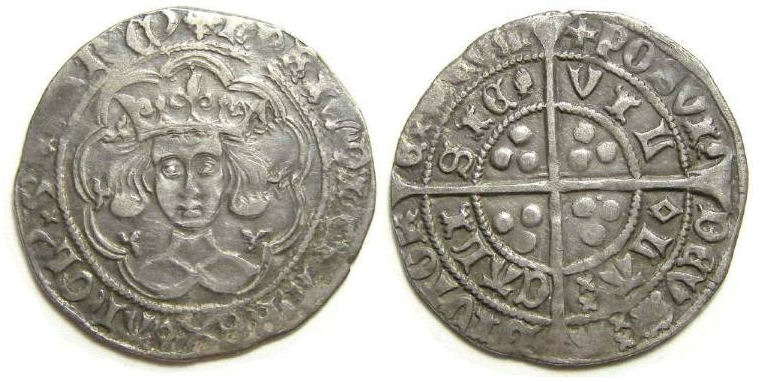
HENRY VI, First reign AD 1422-1461
THE HOUSE OF YORK
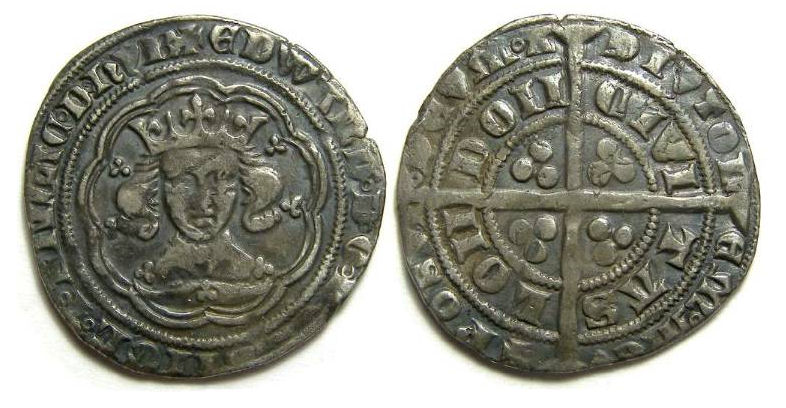
EDWARD IV, First reign, 1461-1470
Edward IV actually had two reigns. The first was from
1461 to October of 1470. From October of 1470 to April of 1471 Henry VI
of the House of Lancaster was restored to the throne and then in April
of 1471 Edward IV began his second reign that was to last until 1483.
THE HOUSE OF TUDOR
HENRY VII, 1485-1509
|