 |
 |
ANCIENT ROMAN COINS - Imperial
|
|||||||||||||

|
(Reference: S=Sear Roman Coins and Their Values (2000 edtion), RSC=Roman Silver Coins, RIC=Roman Imperial Coinage, MILNE=Catalogue of Alexandrian coins; GIC=Greek Imperial Coinage by Seaby) |
|
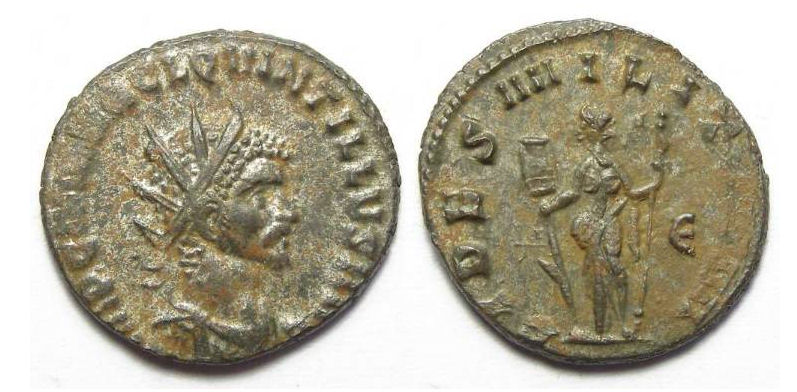 Quintillus, AD 270. AE antoninianus SOLD
Order
# 4662
|
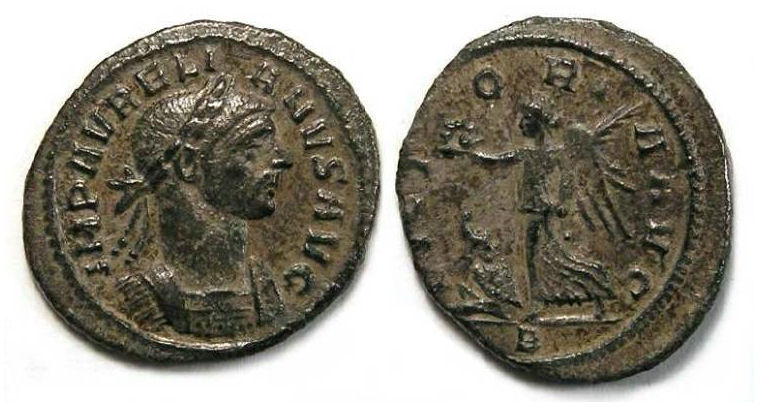 Aurelian, AD 270-275. Bronze denarius.
SOLD
Order
# 1741
|
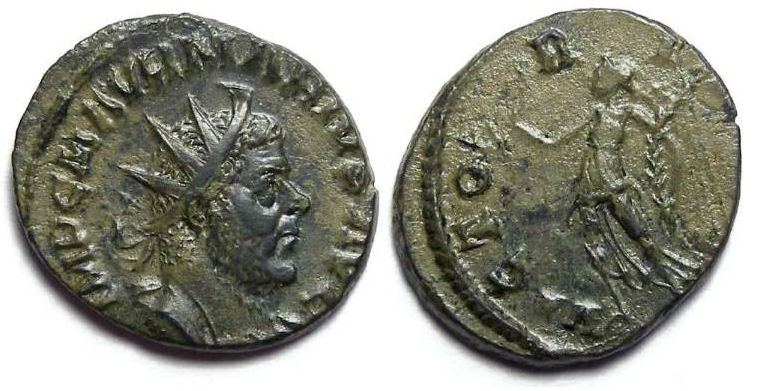 Marius. AD 269. AE antoninianus. At a glance one could confuse this coin with Postumus, as both Postumus and Marius have similar portraits and the part of the obverse inscription visible could be MVS P F AVG with the first part of the M off the flan. However, Postumus never issued this reverse type, so the coin can only be a Marius.
SOLD
Order
# 4427
|
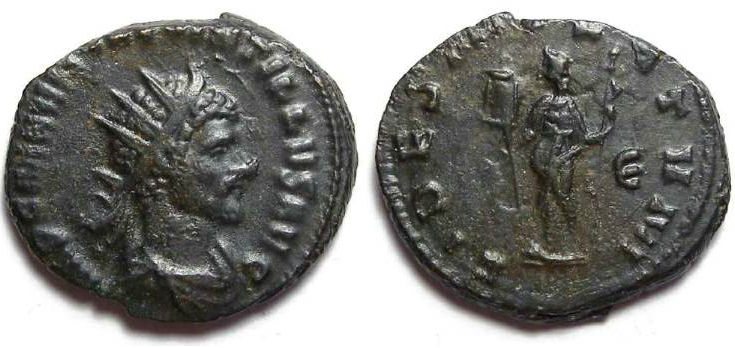 Quintillus,
AD 270. AE antoninianus
SOLD
Order
# 4430
|
|
(Reference: S=Sear Roman Coins and Their Values (2000 edtion), RSC=Roman Silver Coins, RIC=Roman Imperial Coinage, MILNE=Catalogue of Alexandrian coins; GIC=Greek Imperial Coinage by Seaby) |
|
ALL PRICES ARE IN US DOLLARS
CANADIAN ORDERS MUST ADD GST/HST TO ALL PRICES
FOR ADDITIONAL ANCIENT COINS WE HAVE AVAILABLE
PLEASE SEE OUR VCOINS STORE
www.vcoins.com/calgarycoinNext page of Roman Coins
Top of Page


THE GALLIC EMPIREPOSTUMUS, AD 260-269In the fall of AD 260, Postumus, then Governor of Lower Germany, was proclaimed Emperor by his troops. The Emperor in Rome, in this case Gallienus, would normally have immediately marched against the usurper, but was preoccupied with a war on the Danube front. Postumus was smart enough not to force his hand by marching on Rome, and ended up with several years to consolidate his power over the Western Empire and turn it into the Gallic Empire, composed of Britain, Gaul, Germany and Spain. The Gallic Empire remained almost intact until, after the death of Postumus in AD 269 and the brief rule of Marius (probably less than three months), the title of Augustus fell upon Victorinus. Spain refused to recognize him and rejoined the regular Empire, now ruled by Claudius II. Control of the Gallic Empire passed to Tetricus in AD 271, when Victorinus was killed by a man whose wife he tried to seduce ("rape" may be a more accurate term). In AD 274, Rome was ruled by Aurelian, who invaded the Gallic Empire and successfully restored it to Roman control. It is interesting to note that Tetricus, rather than being put to death (the usual Roman way of dealing with such things), was rewarded with a senior administrative post in Italy. This would tend to indicate that he was working with Aurelian towards reunification. PERIOD OF RECOVERY (sort of)This was still a time of chaos but under rulers like Claudius II, Aurelians and Probus conditions stabilized and began to improve. VABALATHUS, AD 271-272During the reign of Gallienus, control of the Eastern Provinces from Asia Minor to Egypt fell to Odeneathus and Zenobia in Palmyra. Odeneathus was murdered in AD 266, at which time Zenobia took full control, using her son Vabalathus as a figurehead. There is confusion about the relationship between Vabalathus and Rome, with some disputing that Vabalathus held any allegiance to Rome. The numismatic evidence indicates that there were strong ties. Vabalathus was granted the title "DUX ROMANORUM" in AD 166, indicating a degree of acceptance and cooperation with Rome. He does not appear to have issued any independent coinage, which one would expect if he were asserting independence. In AD 270 coins were struck with a radiate bust of Aurelian on the obverse and a laureate bust of Vabalathus on the reverse, indicating that Vabalathus recognized the authority of Aurelian as his emperor. These coins are often described as having Vabalathus on the obverse, but Aurelian's radiate crown and use of the title Augustus, clearly indicate he is Emperor and thus on the obverse. Vabalathus rebelled in AD 271, issuing coins showing himself radiate with the title AUGUSTUS. The reverses of these coins are interesting as they use the inscription "VICTORIA AVG" with a single G. The practice of using GG to indicate more than one emperor was already well established, so Vabalathus was declaring himself sole Emperor of Rome. Aurelian immediately marched against him, taking Vabalathus and Zenobia back to Rome as prisoners. Unfortunately, the coins of Vabalathus as Augustus are very rare. TACITUS, AD 275-276Following the murder of Aurelian, the Senate selected Tacitus as his replacement. Even though he was 75 years old, he went to join the army in Thrace where he succeeded in putting down a Gothic invasion. Unfortunately, he died soon after. PROBUS, AD 276-282Probus was a soldier who rose through the ranks to the highest levels and, upon the death of Tacitus, was proclaimed Emperor by his troops. He appears to have been a fairly good leader who tried to revive the Roman economy but was murdered by his own troops when he required them to work on public works in place of military duties. CARINUS, AD 282-283 |
Top of Page Copyright © 1997-2005 R & T Enterprises Ltd. |
 |
 |
 |
 |