



I offer this reference guide to Chinese coins with the hope of promoting greater understanding and appreciation these coins but please note THIS IS NOT A LIST OF COINS OFFERED FOR SALE.
Images represent the types and may be larger or smaller than the actual coins.
MEDIEVAL CHINESE COINS
THE SUI, T'ANG AND POST TANG DYNASTIES
SUI DYNASTY
AD 581 - 618
Many references list the first year of Sui as AD 589, but that is the date Sui unified China. Yang Chien, adopting the name Wen, established Sui in AD 581. As an official of Northern Zhou he had married the last emperor's daughter to become uncle to the heir, whom he forced to abdicate in his favor. In only nine years he expanded his territory until China was once again unified in AD 589.
EMPERORS OF SUI
| Wen Ti also known as Yang Chien | AD 581 - 605 |
| Yang Ti | AD 604 - 617 |
| Kong Ti You | AD 618 |
| Kong Ti T'ang | AD 618 |
Emperor Wen died in AD 604 with the traditional areas of China unified. His son, Yang Ti, continued the expansion with campaigns in both Vietnam and Korea but was killed in AD 617. The house of Chien had lost control of their empire, and a number of rebels vied for power, with Li Yuan and his son Li Shih-min (future Emperors of T'ang) gaining the upper hand.
Our list of Sui emperors is derived from Mitchiner (Oriental Coins and Their Values, Volume 1, page 699) but there is some confusion over the identity of Kong Ti You and Kong Ti T'ang. We assume these are Li Yuan and Li Shih-min, first emperors of T'ang, but are unclear as to why Mitchiner lists them as Emperors of Sui, as they appear to have established the T'ang Dynasty as soon as they were in control.
Emperor WEN
AD 581-604
At the establishment of Sui, the fiduciary coins of Northern Zhou and Ch'en were in use and the economy is recorded as having been in a poor state. Wen, showing an insight into basic economics, immediately re-introduced Wu shu on the traditional standard of 0.5 grams per shu but with a very identifiable straight-armed style on the character "WU", and unusual broad rims.
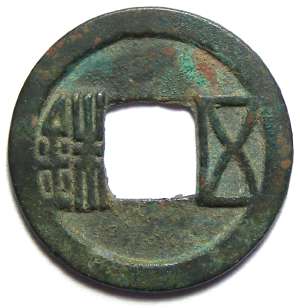
S-253, "WU SHU" with very straight arms on "WU" and wide well-finished rims. From 11 specimens we found an average weight of 2.65 grams and a size of 2.9 mm.
F $5.00 VF $8.00Today these coins are very common and must have been cast in immense numbers. While they are traditionally assigned only to Emperor Wen, we see no reason to believe the issue stopped at the time of his death. It is more likely they continued to be cast during the next thirteen years while Yang Ti ruled Sui.
The fabric is unlike any earlier coins but shared with the vast majority of later coins. The rims are broad and flat, while earlier coins usually have thin rounded rims. Even on high-grade specimens the characters are fast topped at exactly the same height as the rims, while earlier coins usually have thin round tops and can be any height relative to the rims (although usually lower).
The basic fabric of a coin is dictated by the minting techniques used to produce it. What we are seeing with this issue is an entirely new casting technology. For a basic discussion of this technique see our writeup under the Northern Sung Dynasty.
TANG DYNASTY
AD 618 to 907
The death of Yang Ti of Sui resulted in a civil war from which Li Yuan (of Western Wei) and his son Li Shih-min arose victorious, establishing the T'ang dynasty and extending the unification of China for another 300 years. Li Yuan, adopting the title T'ang Kao Tsu, ruled from AD 618-626 then abdicated in favor of his son Li Shih-min who adopted the title T'ai Tsung and ruled from AD 627 to 649. Both were able rules under whom T'ang began its rise to greatness. The next 300 years was a time of relative calm, prosperity and enlightenment with the cultural arts dominating over the military arts.
EMPERORS OF T'ANG
| Kao Tsu also known as Li Yuan |
AD 618 - 626 |
| T'ai Tsung also known as Li Shih-min |
AD 627-649 |
| Kao Tsung | AD 649-683 |
| Chung Tsung | AD 684-690 |
| Wu Tsu-t'ien Empress |
AD 690-705 |
| Chung Tsung 2nd reign |
AD 705-710 |
| Juei Tsung | AD 710-712 |
| Li Lung-Chi also known as Hsuan Tsung Ming Hsuan) |
AD 712-756 |
| ????? son of Li Lung-chi |
AD 756 |
| Su Tsung (full control) (nominal control) |
AD 756-757 AD 758-761 |
| Shih Su-ming rebel |
AD 757-761 |
| Tai Tsung | AD 762-779 |
| Te Tsung | AD 780-805 |
| Hien Tsung | AD 806-820 |
| Mu Tsung | AD 821-824 |
| ????? | AD 824-827 |
| Wen Tsung | AD 827-841 |
| Wu Tsung | AD 841-846 |
| Siuan Tsung | AD 847-855 |
| ????? | AD 856-859 |
| Yi Tsung | AD 860-873 |
| Hi Tsung | AD 874-888 |
| Chao Tsung | AD 889-904 |
| Chou We through puppet emperor Ngai Tsung |
AD 905-907 |
Considering the almost 300 years and over 20 emperors of the T'ang Dynasty, the coinage is fairly conservative with only a few distinctive issues. For the most part, the standard K'ai-yuan type was all that circulated. For those emperors that issued coins, or emperors with important historical interest, a discussion follows.
Emperor LI YUAN
AD 618-626
Reign title: T'ang Kao Tsu, AD 618-626
The K'ai-yuan coinage, usually attributed to T'ANG KAO TSU, was cast almost continuously throughout the 300 years of T'ang rule, with the only major change the addition of mint marks in AD 841.
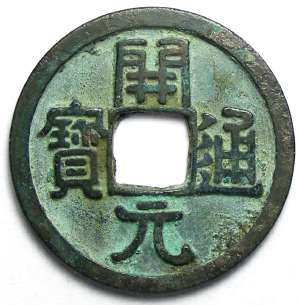
S-312+. Bronze 1 cash. Obverse: "K'AI-YUAN T'UNG-PAO" (Currency of the K'ai-yuan period). Reverse blank. There are three major variations of the character "Yuan". Average (17 specimens) 25 mm, 4.1 grams.
F $2.50 VF $4.00 XF $6.50S-406. Iron 1 cash. Obverse: "K'AI-YUAN T'UNG-PAO" (Currency of the K'ai-yuan period). Reverse blank. Schjoth's sepecimen was 24 mm, 4.02 grams. Rare and of uncertain date.
Value not established.
The general fabric and style of K'ai-yuan was the same as that introduced with the Wu shu of the Sui dynasty, but at an average of between 3.0 and 4.0 grams they are heavier. Wu (5) Shu was no longer expressed on the coins, but K'ai-yuans are Wu Shus by another name, cast to the official weight standard of 0.65 grams per shu rather than the coinage standard of 0.50 grams, an experiment seen earlier on the Ssu-shu issue of Emperor Wen, introduced in AD 430, as well as several other issues of that period. This was an enlightened move as, with no profit in casting full weight coins, counterfeiting was only profitable when light-weight coins were cast, which are more difficult to pass. The experiment must have worked as light-weight examples are seldom encountered. The economic stability thus created probably contributed greatly to the success of the T'ang Dynasty.
We do not actually know what the new denomination was called when first introduced, but it may have simply been known as a "K'ai-yuan". We know that some future dynasties called it that and even issued larger coins with the denomination designated in multiple "K'ai-yuan", but today this is the denomination we call the "Cash", which remained the basic denomination of China until the late 19th century.
There are hundreds of minor varieties, from subtle differences in calligraphy to various small crescents, lines and dots on the reverses. These differences probably identified specific issues, but the meanings of these codes have probably been lost forever. We are compiling a list of the major varieties in the hope that some pattern will emerge, but there is no guarantee of success.
S-312 variety with a star-shaped hole. "K'AI-YUAN T'UNG-PAO". Reverse: blank. The star-shaped hole is created by turning the center hole 45 degrees with respect to the inner rim. This occurs on so many different issues that it must be intentional, but the meaning is uncertain. Sometimes the star hole is combined with reverse symbols, in which case the example is worth a small premium.
F $6.00 VF $8.00 XF $10.00K'AI-YUAN - SINGLE REVERSE CHARACTER
S-315+. Bronze 1 cash. Obverse: "K'AI-YUAN T'UNG-PAO". Reverse: single crescent, line or dots in any of various positions. We have no records of relative rarity for the varieties, so at the this time cannot assign any differences in value.
F $4.00 VF $6.00 XF $8.00The exact position of these marks can vary from coin to coin, and we cannot be certain a crescent tilting slightly left or right is intentional or simply a minor shift in position. It is likely many types exist for each of the major calligraphy variations of "YUAN", which is certainly of significance. Our research in this area is just beginning and it is far too early to draw any conclusions as to the meanings.
| TOP LEFT | TOP | TOP RIGHT |
| none noted | crescent up | crescent up |
| crescent up sl left | ||
| crescent up sl right | ||
| crescent down | ||
| crescent down sl right | ||
| dot |
| LEFT | RIGHT |
| crescent right | crescent right |
| crescent left | crescent left |
| vertical bar | vertical bar |
| BOTTOM LEFT | BOTTOM | BOTTOM RIGHT |
| crescent down | crescent down | crescent down |
| crescent up | ||
| crescent left | crescent left | |
| crescent sl left | ||
| crescent sl right |
* sl left or right - tilts in that direction.
* the vertical bar may actually be a crescent with a very shallow curve.
I have not yet recorded an example with a single symbol in just top left corner but as all other positions exist with at least a crescent I would expect one may eventually show up.
K'AI-YUAN - TWO REVERSE CHARACTERS
S-335+. Bronze 1 cash. "K'AI-YUAN T'UNG-PAO". Reverse: two symbols (crescents, dots or lines) in various positions (less common than single-symbol types). I have handled one variety with crescents at top and bottom. The listed values are for that type. Some of the other types are scarcer.
F $12.00 VF $14.00 XF $18.00| TOP AND BOTTOM | |
| thin crescent up | thin crescent down |
| thick crescent up | thick crescent down |
| vertical bar | vertical bar |
| TWO AT TOP |
| dot inside crescent up |
| LEFT AND RIGHT | |
| thin crescent left | thin crescent right |
| thick crescent left | thick crescent right |
| crescent left | dot |
| TOP AND RIGHT | |
| crescent up | crescent right |
| TOP LEFT AND TOP RIGHT | |
| crescent 45 degree left | crescent 45 degree right |
Schjoth lists a few examples with small dots in various positions on the obverse. We assume these to be casting defects of little significance and will include them only if we find out otherwise.
Emperor KAO TSUNG
AD 649-683
Kao Tsung, son of T'ai Tsung, extended Chinese control over much of Korea and part of Manchuria. He defeated the Japanese fleet, ending Japanese influence on the mainland for many years. The later years of his reign saw his father's concubine, Wu Tsu-t'ien, asserting power, probably ruling from behind the scenes. She proved ruthless, eventually seizing power in her own name (AD 705-710).
Title: Ch'ien-feng, AD 666-??
The K'ai-yuan was probably the basic coinage of this period, but another issue was cast.
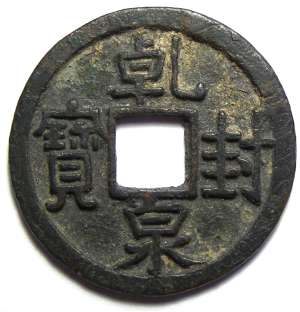
S-350-351. Bronze 10 cash. Obverse: "CH'IEN-FENG CH'UAN-PAO" (Currency of the Ch'ien-feng period). Reverse: blank. Average (3 specimens) 4.68 grams, 25.4 mm, slightly larger and heavier than the normal K'ai-yuans.
VF $135.00I have not found out why this fiduciary 10 cash was cast, but the experiment seems to have failed with these coins being cast only briefly in AD 666.
Rebel Emperor SHIH SU-MING
AD 757-761
The rebel Shih Su-ming declared himself Emperor in AD 757 after killing Li Lung-chi's son. He controlled a large area including the T'ang capital at Lo-yang, may have held more power than the official T'ang Emperor. As such, one could consider him to be the real ruler of T'ang during this short period period, during which he issued some interesting coins.
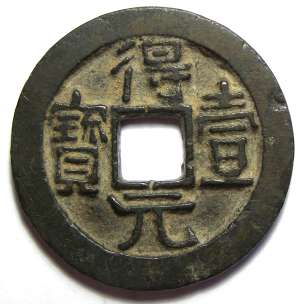
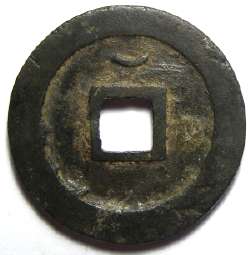
S-407, FD-747. Bronze value 100 cash. Obverse: "TE-YI YUAN-PAO" (the currency of unity). Reverse: crescent opening upwards at the top. Average (3 specimens) 35.9 mm, 18.98 grams (but the weights vary quite a bit).
F $125.00 VF $175.00| IMAGE NOT YET AVAILABLE S-407 |
FD-747, as S-407 but reverse blank. Bronze value 100 cash. Obverse: "TE-YI YUAN-PAO" (the currency of unity). Reverse: Blank. 35.5 mm. The one specimen we have handled of this type weighed 11.9 grams.
F $110.00 VF $145.00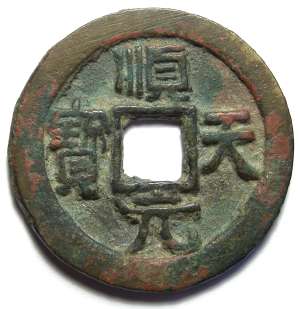
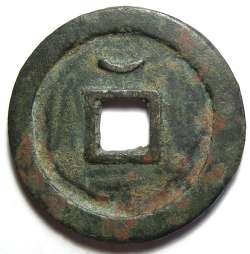
S-409, Bronze value 100 cash. Obverse: "SHUN-T'IEN YUAN PAO" (a currency agreeable to heaven). Reverse: crescent opening upwards at the top. Average (4 specimens) 36.5 mm, 20.12 grams.
F $65.00 VF $85.00 XF $110.00At 36-37 mm and about 20 grams these are both fiduciary issues, circulating at 20 times the value in their copper content.
Schjoth reports an example of this type (S-410) with an incuse "WANG" on the reverse. We have never seen one, and consider the use of an incuse character on coin like this to be suspect. It is possible the character was engraved into the reverse privately, long after the coin was cast.
Emperor SU TSUNG
AD 756-762
While the rebel Shih Su-ming ruled much of China, the legitimate T'ang emperor Su Tsung worked to restore order. In 758 he cast high denomination fiduciary coins to finance the war, but they proved a financial disaster.
Reign title: CH'IEN-YUAN, AD 758-762
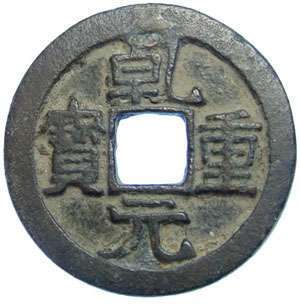
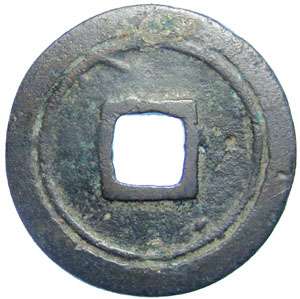
S-355. Bronze 50 cash (?). Obverse: "CH'IEN-YUAN CHUNG-PAO" (Heavy currency of Ch'ien-yuan). Reverse: blank except for double rims and on this one what appears to be a flaw rather than an intentional mark in the upper left. Average (6 specimens) 35 mm, 14.6 grams.
F $25.00 VF $35.00 XF $48.00At 35 mm and averaging around 14.6 grams, these contain only 4 cash worth of metal but were issued with a circulating value of 50 cash. This resulted in inflation and wide spread counterfeiting of lower weight coins, caused great hardship. The coins were quickly devalued to 30 cash, which did not solve these problem but must have been a nightmare for anyone in possession of them from prior to the devaluation.
S-356-7. Bronze 50 cash ?. Obverse: "CH'IEN-YUAN CHUNG-PAO" (Heavy currency of Ch'ien-yuan). Reverse: crescent and double rims. 33 mm. Schjoth's two specimens weighed 10.73 and 12.92 grams. It is unclear if these were still valued at 50 cash, or were issued at the reduced 30 cash denomination.
We have not yet established a value for this type.S-358. Bronze 50 cash (?). Obverse: "CH'IEN-YUAN CHUNG-PAO" (Heavy currency of Ch'ien-yuan). Reverse: "CHI" (?) and double rims. 33 mm. Schjoth's specimen weighted only 7.92 grams while Mitchiner's (#3398) was 13.5 grams. There is some question if the character on the back is really "CHI", as on some specimens it is not solid and sometimes described as a cloud or even a bird.
I have not yet established a value for this scarce typeThe effects of coinage debasement can be seen throughout history. One need only look around today's world to see how leaving the gold standard (effectively token coinage replacing silver and gold) has resulted in inflation in every country on eatch, and major economic devastation in many countries. The saying "those who do not learn from history are doomed to repeat it" certainly applies here.
By AD 759, smaller versions were cast of this coinage was cast, at first at a five cash (30 mm, 7.5 grams) denomination, which was later devalued to devalued to two cash reflecting it's true metal value of 2 cash.
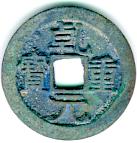
S-352. Bronze 5 or 2 cash. Obverse: "CH'IEN-YUAN CHUNG-PAO". Reverse: blank. Average (4 specimens) 30 mm, 7.92 grams.
F $12.00 VF $17.00 XF $27.00There is also a rare series within this issue with what is sometimes referred to as an Auspicious Cloud on the reverse. At this point, we have not been able to determine the true reason or meaning behind these rare coins.
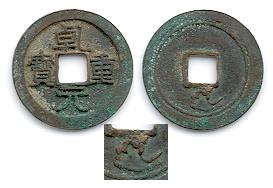
Shangi Encyclopedia #684. Bronze 5 or 2 cash. Obverse: "CH'IEN-YUAN CHUNG-PAO" (Heavy currency of Ch'ien-yuan). Reverse: Auspicious Cloud at the bottom, double rims. The only specimen we have handled of this type was 31 mm, 7.1 grams.
gVF $450.00Finally some time around AD 760 the Ch'ien-Yuan Chung-pao coinage was issued as a one cash denomination, ending this brief experiment in feduciary coinage.
S-353. Bronze 1 cash. Obverse: "CH'IEN-YUAN CHUNG-PAO". Reverse: blank with single rim. Average (2 specimens) 24.5 mm, 3.42 grams.
VG $5.00 F $7.50 VF $12.50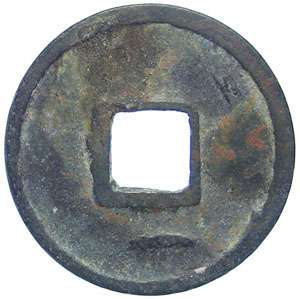
S-361-3. Bronze 1 cash. Obverse: "CH'IEN-YUAN CHUNG-PAO". Reverse: single rim and crescent (several varieties are known with the crescents in various positions. 24-25 mm, 3 to 3.5 grams).
VG $6.50 F $10.00 VF $15.00S-364. Bronze 1 cash. Obverse: "CH'IEN-YUAN CHUNG-PAO". Reverse: a character possibly reading "YEN" and a single rim. Schjoth speculates this type was cast at Yen-chou-fu in Shantung.
We have not yet established a value for this typeSoon after these 1 cash Ch'ien-Yuan Chung-pao coins were issued, they were discontinued in favour of a return to the earlier Kai-yuan coinage, which helped re-introduced which re-established some degree economic stability. By AD 762 the rebel Emperor Shih Su-ming had been defeated and the capital of Lo-yang was was once again under the control of the rightful emperor Su Tsung. But soon after Su Tsung also died and the T'ang entered a period of decline during which real power shifting to the Court eunuchs.
Emperor TE TSUNG
AD 780-805
S-365. White brass 10 cash. Obverse: "K'AI-YUAN T'UNG PAO". Reverse: blank. Schjoth (page 23) reports that in the 1st year of Chien-Chung, at Kuangtung mint, large K'ai-yuan coins were cast of white brass. We have never seen one of these, but he lists a specimen of 41 mm weighing 24.65 grams. This is at the lowest acceptable weight for a 10 cash, indicating this was not a fiduciary coinage.
We cannot suggest a value for such a coin at this time.Emperor WU TSUNG
AD 841-846
Reign title: HUI-CH'ANG, AD 841 - ?
Schjoth notes (page 23) in the first year of Hui-ch'ang (AD 841) many Buddhist monasteries were destroyed. The copper bells and images were melted and cast into coins. Li Shen, revenue commissioner of Yang-chou, received permission to place the character "ch'ang", short for Hui-ch'ang, on the reverse. It is likely this was done at other mints as well.
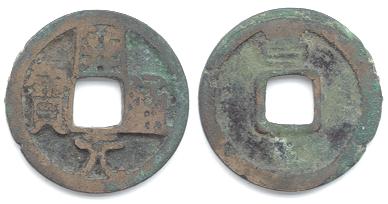
S-366. Bronze 1 cash. Obverse: "K'AI-YUAN T'UNG-PAO". Reverse: "Ch'ang" (indicating a coin struck in the year "Hui-ch'ang" (AD 841). This seems to be the only dated coin of the T'ang dynasty.
VG $4.00 F $12.50 VF $17.50As with almost all K'ai Yuan coins with reverse characters, the reverse character will be somewhat weaker than the rest of the coin on this type (as explained below). We hope to replace this illustration with a better one when an example comes available.
K'AI-YUANS WITH MINT MARKS
Late in AD 841 it was decided to replace "Ch'ang" marks indicating the mint of issue. These mint marks were hand stamped into each mould, after impressing the main coin, with the result that they are often stamped deeper into the mould than the balance of the coin, becoming the high point on the coin and subject to the most wear. Others were poorly impressed and difficult to read on even the highest grade specimens. Only occasionally is one encountered with the mint mark as clear as the obverse, so our valuations assume the mint mark to be one grade lower than that of the obverse. Especially weak or strong mint marks affect the values accordingly.
| S-367 | Ching (at top) Ching-chao in Lo-yang |
not yet determined |
| S-368 | Ching (at top) (star hole) Ching-chao in Lo-yang |
F $14.00 VF $20.00 |
| S-369 | Ching (at top) (crescent below) Ching-chao in Lo-yang |
F $10.00 VF $16.00 |
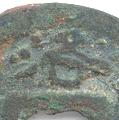 S-370-371 |
Lo (at top) S-370 - round hole Lo-yang in Honan |
F $12.50 VF $17.50 |
S-370-371 |
Lo (at top) S-371star hole Lo-yang in Honan |
F $14.00 VF $20.00 |
| S-372 | Yi at top Hsi-ch'uan (Ch'eng-tu in Szechuan) |
F $12.50 |
| S-373 | Lan at right Lan-t'ien (Hsi-an-fu in Shansi) |
F $12.50 VF $17.50 |
| S-377 | Lan at left crescent at top Lan-t'ien Hsi-an-fu in Shansi |
not yet determined |
| S-380 | Hsiang at top Hsiang-chou in Chihli |
F $12.50 VF $17.50 |
| S-381 | Hsiang at right Hsiang-chou in Chihli |
not yet determined |
| S-382 | Ching (at right) Ching-chou in Hupei |
not yet determined |
| S-383 | Yueh at bottom Yueh-chou in Chekiang |
VG $7.00 F $12.50 VF $17.50 |
| S-384 | Hsuan at left Hsuan-chou in Anhui |
F $15.00 VF $22.50 |
| S-385 | Hung at top Lin-chiang Fu in Kiangsi |
F $12.50 |
| S-386 | Hung sideways at right Lin-chiang Fu in Kiangsi |
not yet determined |
| S-387 | Hung sideways at right crescent at top Lin-chiang Fu in Kiangsi |
not yet determined |
| S-388 | Hung sideways at left crescent at top Lin-chiang Fu in Kiangsi |
not yet determined |
| S-389 | Hung upside down at bottom Lin-chiang Fu in Kiangsi |
not yet determined |
| S-390 | T'an at left Ch'ang-shu in Hunan |
F $12.50 VF $17.50 |
| S-391 | Yen at top Yen-chou Fu in Shantung |
not yet determined |
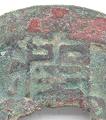 S-393-394 |
Jun at top Chinkiang in Kiangsu |
VG $7.00 F $12.50 VF $17.50 |
| S-395 | O-chou at top Wu-ch'ang in Hupei |
not yet determined |
| S-396 | P'ing at top P'ing-chou Yung-p'ing fu in Chihli |
VF $80.00 |
| S-397 | P'ing at top crescent at bottom P'ing-chou Yung-p'ing fu in Chihli |
not yet determined |
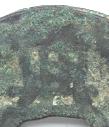 S-398 |
Hsing at top Feng-hsiang Fu in Shansi |
VG $7.00 F $12.50 VF $17.50 |
| S-399 | Liang at bottom Liang-chou in North Hupei |
not yet determined |
| S-400 | Kuang at right Kuang-chou Fu in Kuangtung |
not yet determined |
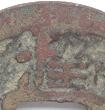 S-402-3 |
Tzu at top several variations Tung-ch'uan Fu in Szechuan |
F $12.50 VF $17.50 |
| S-404 | Tan at top Tan-chou in Shensi |
F $99.50 |
| FD-734 | Gui at top uncertain mint |
F $50.00 |
These coins are all bronze 1 cash with "K'AI-YUAN T'UNG-PAO" on the obverse and are about 24 mm and between 3 and 4 grams.
We assume, but are not certain, that the K'ai-yuans with blank or symbol reverses were not cast once the mint mark came into use. The mint mark issues probably continued until the end of the T'ang Period.
Chao Tsung, the last real T'ang emperor, was assassinated by Chou Wen in AD 904. After placing Ngai Tsung on the throne as a puppet emperor, Chou Wen was in control but in AD 907 he deposed Ngai Tsung, establishing himself as Emperor of his new Posterior Liang Dynasty and bringing the period of T'ang to a close.
PERIOD OF THE FIVE DYNASTIES
AND TEN KINGDOMS
The fall of T'ang plunged China into turmoil, with power shifted through a series of dynasties, culminating in the establishment of the Northern Sung dynasty. Direct transfer of power from T'ang to Northern Sung involved five dynasties, but at least another 10 dynasties existed and influenced the history of this period.
Only some of the roughly fifteen dynasties are known to have issued coins, but the numismatic history of this period is rich and complex. There are many very rare issues that are not listed in the standard reference books, including some which have not yet been fully identified. We have started by listing only the more well-known issues, but when time permits we will be including more of the rare ones.
The following outline gives the sequence of events that led to the establishment of the Northern Sung Dynasty. It is beyond the scope of this site to include a detailed history.
| AD 907 | The last T'ang Emperor is killed, and Chu Wen establishes the Posterior Liang. Taking advantage of the resulting confusion, Li K'o Yang establishes the rival Posterior T'ang dynasty. Both dynasties are caught up in internal power struggles. Chun Wang becomes the second emperor when he assassinates his own father in AD 914. |
| AD 923 | The Posterior Liang Dynasty ends as Chun Wang is overthrown by Lo Tsun Hsu, son of the Posterior T'ang emperor Li K'o Yang. Lo Tsun Hsu becomes Emperor of Posterior T'ang in AD 927. |
| AD 936 | Posterior Chin begins when Shih ching T'ang, a Turkish general in the Posterior T'ang army, conducts a coup from within, with the help of the Khitan border tribe. |
| AD 947 | After eleven years of receiving annual tribute for their help in establishing the Posterior Chin dynasty, the Khitan disposed of Shih Chin T'ang, leaving the Posterior Chin throne vacant. Another Turkish general, Liu Chih Yuan, using the title Kao Tsu, established the Posterior Han. Fearing the Khitan, he immediately declared war and defeated them, but died the following year leaving his son on the throne (we have not found his name). |
| AD 950 | A coalition of generals killed Liu Chih Yuan's son, taking control of Posterior Han. |
| AD 951 | The leader of the coalition, Kou Wei, established the Posterior Zhou dynasty. Power transferred, in AD 954, to Kou Wei (his adopted son) who was in turn killed in AD 959, by his chief General Chao K'ung Yin. |
| AD 960 | Chao K'uang Yin took the reign title T'ai Tsu, as first Emperor of the Northern Sung Dynasty. |
Some of the additional dynasties that existed during this period were:
Liao (AD 907-1125)Anterior Shu (AD 907-960/976)
Southern Han (AD 917-942)
Northern Han (AD 950-976/997)
Southern Tang (AD 907-978)
and Ch'u (AD 930-970's)
POSTERIOR HAN DYNASY
Emperor KAO TSU
AD 947-948
"Kao Tsu" was also the name adopted by the first T'ang Emperor. We have to assume this name was chosen to imply a connection to the family T'ang, thus establishing his right to rule. This name was also adopted by the first emperors of Anterior Shu, Posterior Liang and Posterior Chin, presumably for the same reason.
There is a record (Schjoth page 25) that in AD 947 mints were set up at the Posterior Han capital. In order to cast enough coins to pay the army, all copper was called in. This also had the result of suppressing counterfeiting by removing the raw materials from the hands of the counterfeiters.
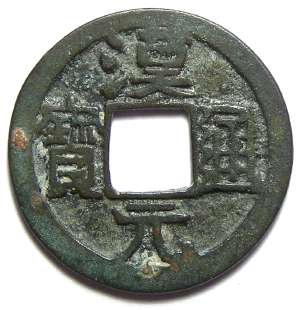
S-411. Bronze 1 cash. Obverse: "HAN-YUAN T'UNG-PAO". Reverse: blank. 24 mm. 2.94 grams. Schjoth's specimen appears to have a dot in the lower right of the obverse.
VF $45.00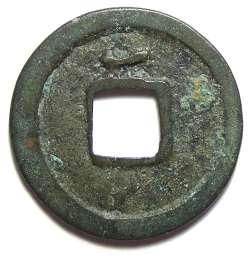
S-412-3. Bronze 1 cash. Obverse: "HAN-YUAN T'UNG-PAO". Reverse: crescent (S-412 with crescent at top, S-413 with crescent at bottom). Average (2 specimens) 24.1 mm. 3.57 grams.
F $75.00 VF $100.00"Han-yuan" is a reference to the Han Dynasty, not a reign title. Issuing coins with this type of inscription is fairly common from about this time until the Northern Sung period. Schjoth had four specimens which averaged 3.48 grams, the same standard established during the T'ang Dynasty.
ANTERIOR SHU DYNASTY
Emperor KAO TSU
AD 907-918
"Kao Tsu" was also the name adopted by the first T'ang Emperor. We have to assume this name was chosen to imply a connection to the family T'ang, thus establishing his right to rule. This name was also adopted by the first emperors of Posterior Liang and Posterior Chin and Posterior Han, presumably for the same reason.
| IMAGE NOT YET AVAILABLE S-435 |
S-435. Bronze 1 cash. Obverse: "TA-SHU T'UNG-PAO". Reverse: blank. 24 mm. Schjoth's specimen weighed 3.15 grams. We have not handled one of these and cannot provide a value at this time.
"Ta-shu" is not a reign title, but rather a reference to the "Great Shu" Dynasty. For some reason Schjoth does not attribute this coin to any particular emperor, but there is a pattern all through this period where the first issue of each dynasty has a reference of this nature rather than a reign title. We can see no reason not to attribute this coin to the earliest issue of Kao Tsu, probably in AD 907.
Reign title: T'UNG-CHENG, AD 911-912
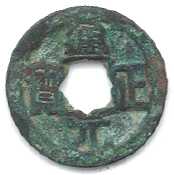
S-429. Bronze 1 cash. Obverse: "T'UNG-CHENG YUAN-PAO". Reverse: crescent at top, dot at bottom. Average (2 specimens) 3.18 grams, 22.8 mm. We have seen specimens both with and without the star hole in the center.
F $125.00 VF $185.00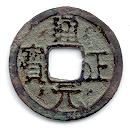
FD-771, as S-429 but reverse blank. Obverse: "T'UNG-CHENG YUAN-PAO". Reverse: blank. The specimen we recently handled was 23.5 mm, 2.65 grams and had very poorly developed reverse rims.
VF $185.00Reign title: T'IEN-HAN, AD 912-913
Kao Tsu adopted the reign title T'ien-han in AD 912 and at the same time temporarily changed the name of the Dynasty to Han. The name was changed back within a year.
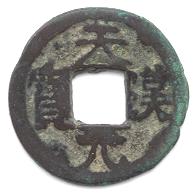
S-430. Bronze 1 cash. Obverse: "T'IEN-HAN YUAN-PAO". Reverse: crescent at top. Average (4 specimens) 23 mm (range 22.5 to 24.0), 2.65 grams (range 2.0 to 3.1 grams). These tend to be somewhat crudely cast with a fairly broad range in size and weight.
F $55.00 VF $75.00Reign title: KUANG-T'IEN, AD 913-915
| IMAGE NOT YET AVAILABLE S-431 |
S-431-2. Bronze 1 cash. Obverse: "KUANG-T'IEN YUAN-PAO". Reverse: blank. 24 mm. Schjoth's specimen weighed 3.49 grams. From specimens of this type that we have recently handled, it appears that they type was fairly crudely and somewhat weakly cast.
F $45.00 VF $65.00Emperor WANG YEN
AD 918-925
Reign title: CH'IEN-TE, AD 918-924
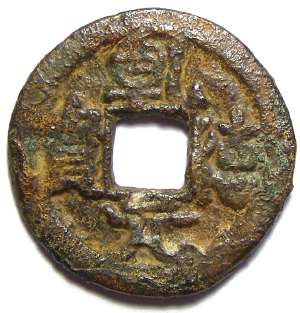
S-433. Bronze 1 cash. Obverse: "CH'IEN-TE YUAN-PAO". Reverse: blank. 24 mm. Schjoth's specimen weighed 3.04 grams.
VG $12.50 F $22.50| IMAGE NOT YET AVAILABLE |
S-not listed. Hartill-not listed. FD-not listed by mention in his comments about #775). Iron 1 cash. Obverse: "CH'IEN-TE YUAN-PAO". Reverse: blank. Average (1 specimen) 24.2 mm, 3.77 grams (the specimen illustrated above is of this iron coin.
F $75.00 (estimated only)Reign title: HSIEN-K'ANG, AD 924-925
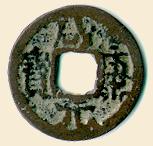
S-434, Bronze 1 cash. Obverse: "HSIEN-K'ANG YUAN-PAO". Reverse: blank. Average (3 specimens) 24 mm, 3.07 grams. Schjoth (page 26) reports that these tend to be very poorly cast and quite ugly coins. We have never seen a really nice one.
VG $60.00 F $75.00 gF $100.00SOUTHERN HAN DYNASTY
Emperor: LIU YEN
AD 917-942
Reign title: CH'EIN-HENG, AD 917-942
Most coins of this reign title are of lead, with a fabric that suggests they are die struck, possibly with wooden dies, as they do not look at all like cast coins, with characters that are both very angular and shallow. There are two major variations on these coins that one occassionally see's:
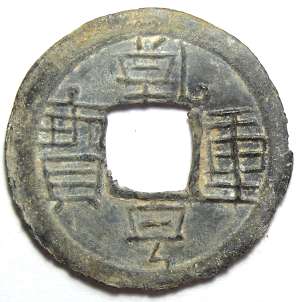
S-436 to 438, 1 cash made of Lead, "CH'IEN-HENG CHUNG-PAO", reverse: blank. Average 25.9 mm, 3.90 grams (These vary a little as Schjoth had three specimens ranging from 23 to 28 mm, averaging 3.7 grams).
F $19.50 VF $30.00 XF $40.00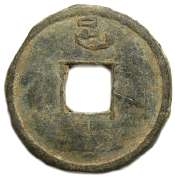
FD-828, Lead 1 cash. Obverse: "CH'IEN-HENG CHUNG-PAO". Reverse: "YONG" probably a mint mark. 25 mm, average (7 specimens) 4.2 grams.
F $22.50 VF $32.50Although we have never seen one, Fisher's Ding lists three examples of the "Ch'ien-heng" coins in bronze, as FD 829 to 831, where they are listed as being rare. The lead issues are normally seen grading VF or better, but are sometimes weakly cast (or struck). This suggests they saw little circulation, as any amount of circulation would quickly wear out a lead coin. It is doubtful people would have wanted to accept such an unusual issue that was obviously fiduciary.
SOUTHERN T'ANG DYNASTY
AD 937-978
The Southern T'ang Dynasty was one of the "Five Kingdoms" established during the turmoil following the fall of T'ang Dynasty. Controlling a large portion of China from their capital in Nanking, the dynasty was fairly successful, lasting until AD 978 when it was finally over run by T'ai Tsu who had established the Northern Sung Dynasty some 18 years earlier. Southern T'ang coins do not have reign titles on them, but we have listed the titles under which each type was cast. No coins were issued by the first Southern T'ang Emperor Lieh Tsu (AD 937 to 943) or under Yuan Tsung (AD 943 to 961) until about AD 955, so it is likely T'ang Dynasty Kai Yuan coins were still in use.
Emperor Yuan Tsung
AD 943-961
Reign title: Li Kung, AD 955 to 961
| IMAGE NOT YET AVAILABLE S-439 |
S-439. Bronze 10 cash. Obverse: "YUNG-T'UNG CH'UAN-HUO" (meaning Eternal Circulation Coin). Reverse: blank. This is a large coin at about 33 mm with Schjoth's specimen weighing 14.48 grams. This is a rare type and we have never actually seen, and cannot currently provide a value for it. Variations on it exist in orthodox and seal scripts, and they are known in both bronze and lead. all variations are rare.
Li Kuang was fighting wars of expansion in Southern China, which caused a strain on the treasury. At the suggestion of minister Chung Mo, these fiduciary 10 cash coins were cast using 40% of official weight a full value 10 cash. As very few fiduciary coins had been issued in the previous 300 years, people were not used to the concept and would have refused to accept them, resulting in even further financial trouble for the treasury. Schjoth (page 26) quotes an old record of them having been quickly withdrawn, with the minister who suggesting issuing them (Chung Mo) incurring the displeasure of the Emperor, which probably means he was executed. They were replaced with the full value bronze 1 cash coins below.
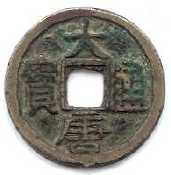
S-440. Bronze 1 cash. Obverse: "TA-T'ANG T'UNG-PAO" in orthodox script (meaning Great T'ang currency). Reverse: blank. Schjoth's specimen weighed 2.16 grams and was about 21 mm, however a recent specimen we handled (illustrated above) was 4.45 grams and 23.7 mm. We are not yet sure if these are two different issues or (and more likely) Schjoth's specimen may have been an light weight counterfeit of that time.
F $55.00 VF $85.00The "Ta-T'ang" inscription would be expected on the earliest issues of the dynasty, usually the first or second year following it's establishment, but in this case it is the second issue following the unsuccessful fiduciary 10 cash coins. Most major references indicate these were issued about AD 960 which is the year the Northern Sung dynasty was established and these may be a propaganda statement announcing the Southern T'ang was still strong in spite of the rise of the Sung.
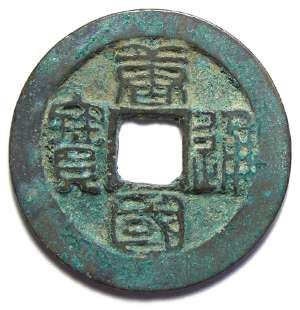
S-441-442. Bronze 1 cash. Obverse: "T'ANG-KUO T'UNG-PAO" in seal script (meaning T'ang Kingdom Currency). Reverse: blank. Average 24-25 mm, average about 3.34 grams (based on 23 examples). This is a consistently well cast issue with clear characters.
VG $3.00 F $5.50 VF $9.50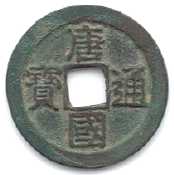
S-445. Bronze 1 cash. Obverse: "T'ANG-KUO T'UNG-PAO" in orthodox script (meaning T'ang Kingdom Currency). Reverse: blank. 23-24 mm. Average (2 specimens) 3.77 grams, 25 mm. This type is normally fairly well cast.
VF $42.50Schjoth had two specimens, one of 2.2 grams and the other of 3.34 grams (our last specimens was 4.2 grams). It is highly likely the smaller specimen was a contemporary counterfeit and we have not included it in the average weight calculations.
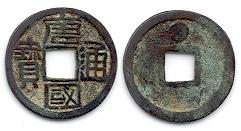
FD-816, S-not listed. Bronze 1 cash. Obverse: "T'ANG-KUO T'UNG-PAO" in orthodox script. Reverse: large dot. The specimen we recently handled as 23 mm and 3.15 grams.
VF $135.00The T'ang Kuo coins would probably be issued immediately after the Ta-T'ang coins, placing their first appearance in AD 961. On page 26, Schjoth records that that due to a money shortage these T'ang-kuo were valued at 1/2 Kai-yuan, which makes no sense as they are the same size and weight as a Kai-yuan. In a time time of shortage it would make much more sense if they were issued at a value of two Kai-yuan. Schjoth had an example with "WU" on the reverse (#443) which if genuine would suggest the intended denomination was 5 shu, which is a Kai-yuan, however there is reason to doubt the authenticity of that example and we have decided to leave it out of our listing.
Emperor LI YU
AD 961-978
The T'ang Kuo coins in seal script are far too common to be only a one year issue in AD 961, and it is likely were continued during the first year to two of Li Yu, until he replaced them with his Kai yuan coinage.
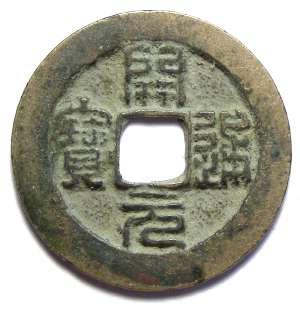
S-446, "KAI-YUAN T'UNG-PAO" in seal script (meaning "The Inaugural coinage"). This is a clear reference to the Kai-Yuan coins of the T'ang Dynasty, and shows they were issued at the Kai-Yuan denomination (5 shu). Reverse: blank. 25 mm, average (17 examples) 3.3 grams
F $5.00 VF $8.50 XF $12.00The old records indicate that 40% of Li's issues were of iron, but these are seldom seen today.
POSTERIOR ZHOU DYNASTY
AD 951-960
Emperor SHIH TSUNG
AD 954-959
Because of a shortage of copper, in the second year of this reign (AD 955) Shih Tsung confiscated the bronze objects from 3360 monasteries, including all the images of Buddha, and cast them into coins. Many of these coins, being cast from melted-down images of Buddha and now are used as charms for midwives. The following year he ordered all publicly owned bronze to be turned in and forbade the casting of any bronze objects other than for official purposes, copying an order given in AD 947 by Emperor Kao Tsu of the Posterior Han Dynasty.
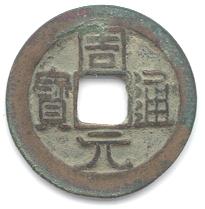
S-414, Bronze 1 cash. Obverse: "ZHOU-YUAN T'UNG-PAO". Reverse: blank. We have seen examples with star holes. Average (5 specimens) 3.83 grams and 24.5 mm (we have seen a range from 23.5 to 25.2 mm).
VG $12.00 F $16.00 VF $22.00Shih Tsung does not appear to have adopted a reign title. The "Zhou-yuan" inscription simply refers to the Zhou dynasty. This is a practice common to several dynasties in this era.
S-415-26. Bronze 1 cash. Obverse: "ZHOU-YUAN T'UNG-PAO". Reverse: crescent, bar or dot in any one of several positions. We have only seen a few of the types, but assume they are all of about the same value.
F $22.00 VF $37.50The following variations have been noted:
| TOP | none noted | ||
| TOP RIGHT | crescent | ||
| RIGHT | crescent | bar | dot |
| BOTTOM RIGHT | crescent | ||
| BOTTOM | crescent | bar | |
| BOTTOM LEFT | crescent | ||
| LEFT | crescent | bar | dot |
| TOP LEFT | crescent |
S-427. Bronze 1 cash. Obverse: "ZHOU-YUAN T'UNG-PAO". Reverse: crescent at the top and a dot at the bottom.
We cannot provide a value for this variety at this timeS-428. Bronze 1 cash. Obverse: "ZHOU-YUAN T'UNG-PAO". Reverse: "MI" at the top. This is thought to be a mint mark for Mi-yuan at Shun-t'ien Fu in Chihli.
We cannot provide a value for this variety at this time, but it should be worth more than the other types.Schjoth had 15 examples from this series. The lightest one weighed 2.37 grams and the heaviest 4.61 grams, but the average was 3.28 grams.
CH'U DYNASTY
AD 930 TO ca AD 970
Ch'u was founded by Ma Yin, who was the governor of Hunan and part of Kuangsi during the late T'ang Dynasty and allied himself with Che Wen as the Posterior Liang Dynasty was established at the overthrow of T'ang. In AD 930 Ma Wen established the Ch'u Dynasty when he revolted against the Posterior Liang, but he died the same year. His Dynasty continued until absorbed by the Northern Sung in about AD 970, but we have found little further information about it.
| IMAGE NOT YET AVAILABLE S-447 |
S-447. Bronze 10 cash (?). Obverse: "T'IEN TS'E FU PAO". Reverse: "YIN" (probably a reference to Ma Yin). This is a large coin of 42 mm. Schjoth's example weighed 18.36 grams. Based on other coins from this era it is likely a fiduciary denomination of 10 cash was intended. We cannot provide a value for this type at this time.
| IMAGE NOT YET AVAILABLE FD-787 |
FD-787. Iron 10 cash (?). Obverse: "T'IEN TS'E FU PAO". Reverse: blank. This is a large coin of 42 mm. Weight not available. The denomination of this coin is not certain, but it is likely a fiduciary 10 cash. We cannot provide a value for this type at this time, but it is very rare.
Ma Yin held the title of "the Chief Commander of T'ien Ts'e". The obverse legend of these coins, and the reverse of the following, refer to this.
| IMAGE NOT YET AVAILABLE S-448 |
S-448. Bronze 10 cash (?). Obverse: "CH'IEN-FENG CH'UAN-PAO". Reverse: "T'IEN". This is a large coin of 38 mm. Schjoth's example weighed 29.04 grams and is listed as bronze, but the size and weight suggest either iron, or an iron-bronze alloy is more likely. Iron was cheaper than bronze, an alloy of bronze and iron, at this weight, could have about the same metal value as S-447 above. We cannot provide a value, but this is a very rare type.
| IMAGE NOT YET AVAILABLE FD-791 |
FD-791. Iron 10 cash (?). Obverse: "CH'IEN-FENG CH'UAN-PAO". Reverse: "T'IEN". This is a large coin of 38 mm. No weight is available at this time. We cannot provide a value, but this is a very rare type.
Ding Fubao lists a number of variations on the coinage of Ma Yin, most of them cast in Iron. The Ch'u dynasty was centered in Hunan, an area rich in iron, hence the large number of iron issues from this dynasty. Unfortunately this is a very rare series, seldom offered for sale.
UNCERTAIN DYNASTY
Recently a group of iron spade moneys, based on the bronze spades of the Hsin Dynasty of Wang Mang came on the market. It is not certain which dynasty was responsible for issuing them, but it is reasonably certain they date to the Five Dynasties period in the 10th century AD. Prior to this group, only one of the three types was known and it is the only type in the common literature, listed in Hartill, Ding Fu Pao, and the Shanghai Encylopedia :
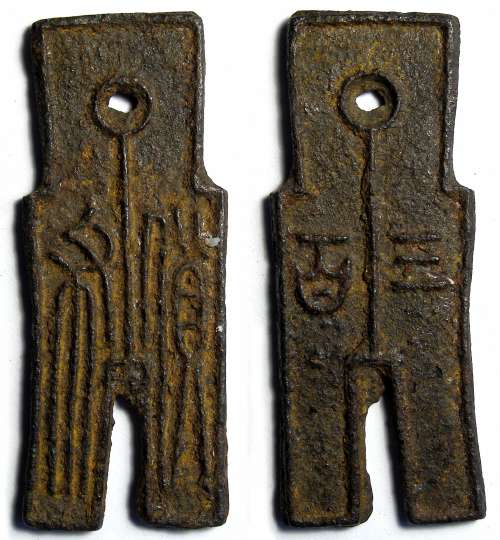
Unknown to Schjoth, but listed as FD-842. Iron value 300 spade. Obverse: "HUO PU" copied directly from the Huo Pu reverse coins of Wang Mang (S-148). Reverse: "SAN-PAI" (300), based on the value 300 spades of Wang Mang.
F $185.00 VF $275.00The hoard that came on the market contain two additional types not recorded in the standard reference books :
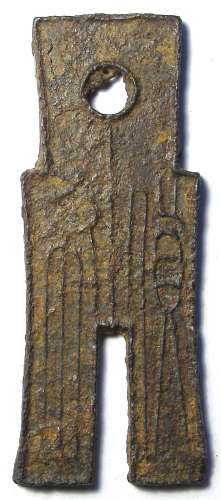
Possibly representing a value 100 coin. Obverse: "HUO PU" copied directly from the Huo Pu reverse coins of Wang Mang (S-148), as as on the value 300 spade type above. Reverse: blank. The last time I saw these sell was some years ago at:
Fine around $125 VF around $200 rangebut please see my comments about them below.
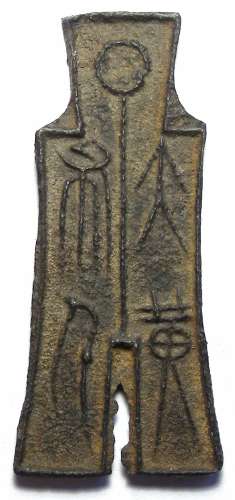
Iron, value 1000. Obverse: "TA-PU HUANG-CH'IEN". Reverse: blank. Based on the value 1000 spade of Wang Mang (S-147). Reverse is blank. >The last time I saw these sell was some years ago at:
Fine about $125 VF about $200 rangebut please see my comments about them below.
The denominations of the value 300 and value 1000 spades are obvious, as it is stated on the coins. The denomination of the possible value 100 spade is not not certain, but these appear to be part of a series for which 100, 300 and 1000 cash round coins were issued (reference FD-838-845), which we will list here at some future date.
There is a great deal of controversy over these coins and the hoard they are reported to have come from. As I commented above, prior to this group only the value 300 type was known to exist, so when this group came on the market the are fakes, with the two new types being modern fantasy coins. What I do know is there were numbers of very low quality examples, including damaged and some fragmentary examples. The value 1000 example above was an exceptional quality one, but the value 100 example is more typical of what they looked like, and as you can see, it has a rather convincing look of an old iron coin. Having seen a number of these coins up close, I lean toward the hoard being a genuine hoard with two of previously un-known denominations, but iron is a very easy metal to artificially age, and proving authenticity on any iron coin is difficult at best. The true status of these coins is at this time uncertain and may remain so for some time to come.

Northern Sung Dynasty
Copyright © 1997 - 2025 R & T Enterprises Ltd.