



I offer this reference guide to Chinese coins with the hope of promoting greater understanding and appreciation these coins but please note THIS IS NOT A LIST OF COINS OFFERED FOR SALE.
Images represent the types and may be larger or smaller than the actual coins.
INFORMATION NEEDED FOR
UNDERSTANDING EARLY CHINESE COINS
The coinage of early China is not well understood, although things have improved signficantly in recent years. This site puts forward our observations and ideas that have evolved over time from many different sources, combining them with ideas put forward by other numismatists. Some of our theories will almost certainly eventually be proven wrong and will have to be revised (some already have been), and it is our hope to keep moving forward towards a genuine understanding of this complex series. We will be happy to hear from anyone who wishes to express their opinions on this subject, or can provide us with information that we are not aware of.
WHAT QUALIFIES AS A TRUE COIN
A true coin, as compared to a primitive money, must meet three criteria. First, it must bear the mark of the issuing authority. Secondly, it must contain an intrinsic value bearing some relationship to the circulating value, and while that intrinsic value can be less than the circulating value if it falls too far below the item becomes a token rather than a coin. The third it must have an understood denomination so that it need not be weighed at every transaction, otherwise it is only a bullion item.
ANCIENT RECORDS
Official ancient records are of little help in this series, as few survived the Ch'in Dynasty's attempt (ca. 221 BC) to erase earlier history which included earlier writings. Some records have survived are inscriptions on bronze ritual vessels indicating how they were paid for thus giving glimpses into the monetary system of the time, but in most cases the readings are subject to several interpretations with their true meanings uncertain.
MODERN RESEARCH
(19th century to recent)
Many books and articles about ancient Chinese coins have been published, but there is little agreement between them. It is likely no one researcher has the full truth, but reading them is still useful. Until recently EARLY CHINESE COINAGE by WANG YU-CH'UAN (ANS Numismatic notes & Monographs #122, 1951, republished by Durst in 1980) was probably the most useful, but CAST CHINESE COINS by David Hartill (Trafford Publishing, 2005) was far surpassed it and we highly recommend it to anyone that wants far more detail on this series than we intend to provide on this website.
MODERN ARCHEOLOGY
Modern archeology is in its infancy in China, but rapidly improving. It provides significant new information on where the coins are found, and thus presumed to have been minted. But as yet there have not been enough documented excavations containing these types of coins, which can be accurately dated so as to help define the dates of the coins (usually the coins date the excavation). This is is changing and one day we will be able to define the dates of the various types more closely.
CALLIGRAPHY
Calligraphy forms evolved rapidly during the Zhou period, but many coins bear archaic calligraphy forms long out of fashion by the time the coins were cast. The same character can appear on two related issues in almost unrelated (to western eyes) forms, and in many cases these archaic characters cannot be translated with absolute certainty. Calligraphy style should be viewed as somewhat unreliable as a technique for dating the coins, and not used to override other evidence.
CLASSIFICATION SYSTEMS
Understanding coinage of this period is almost impossible using the traditional classification systems with knife, spade, cowry imitation, and early round coins under the single heading of the Zhou Dynasty and thus giving the impression of a single complex currency system. Zhou was just the most powerful of several large states that existed side by side, each of which was responsible for a different type of coinage. Since we began building this website in 1997, more information about this has come to light and we are in the process of adding that information and restructuring the site to better show how the system worked.
WEIGHT STANDARDS
Ancient Chinese coins appear to have been issued at weights based on multiples of the shu. Dr. Woo has recently brought to our attention a group of Zhou Dynasty bronze weights on which the official weight of a shu was 0.65 grams, with 24 shu to a Liang of 15.6 grams. However, these are trade weights used to weight out goods to those standards, and when it comes to coins they do not translate directly to the expected weights of coins cast to related denominations.
Many Zhou period coins have characters indicating denominations Liangs, but when we weigh the coins they seen to average about 0.5 grams per shu (see Wang, Early Chinese Coins, pages 138-139) which is only about 77% of the official weight of a shu. This shows a seniorage system similar that to used in medieval Europe, where coins are made to a weight below their circulating value, with the profit made from the difference used to off-set the cost of minting, and sometimes show a small profit to the minting authority. So with respect to coins, a shu is roughly 0.5 grams and a Liang 12 grams.
The casting techniques used to mint Chinese coins did not allow exact weight control of individual coins, so the ancient mint masters were concerned with average weight of a large numbers of coins rather than the exact weight of each individual coin. To determine the intended weight standard of a particular series of coins one must average the weights a large numbers of specimens. We have noted certain trends within the standards of various types of coins, and at this point we believe the system can be summarized as follows :
Spades Coins are denominated in multiples of 6 shu with issues 72 shu or 3 Liang (36 grams), 48 shu or 2 Liang (24 grams), 24 shu or 1 Liang (12 grams) and 12 shu or 1/2 Liang (6 grams). Not all types were issued in all denominations but the denominations for each type will be discussed further down).
Knife Coins are denominated in a system based on multiples of 10 shu although the main denomination for thin knifes as 30 shu (about 15 grams). We have not yet examined enough of the Heavy Knifes of the State of Chi to work out there intended denominations, but will work on that later.
Early round coins With round holes seem to follow the knife money system based on multiples of 10 shu with most issued at 20 shu (10 grams).
Cowry imitation coins do not appear to have any typical weight standard, as the weights on them can very considerably. They were probably denominated as equivalent in value of an actual cowry shell, regardless of weight, but this is by no means certain.
DENOMINATION NAMES
Spade money had a variety of denominations, often multiple denominations circulated side by side, so we see some types with denominations names on them. While the weight standard is based on the Shu and the Liang, on the coins we see two names for this unit. Some do say "Liang" on them, but others have the character for "Jin" on them. It is important to understand that a JIN" is equivalent to a "LIANG", and the only difference is in which term was used on what types.
As yet we have not determined a name for the intended denomination of Knife money, as none of them seem to have denomination marks on them. As there is appears to be only one denomination for them, there was no need to indicated it on them.
Round coins are much more complicated, because it depends on where they are from. Some were issued in spade issuing areas and are denominated in "Liang" or "Jin" just as the spades were. Others were issued in Knife issuing areas and like the knifes do not have a denomination indicated, although some have the character "HUA" which I believe simply means "money". This is something that needs a lot more research.
MONETARY UNITS vs. WEIGHTS
The earlier coins were cast to weight standards in a direct relationship with the denominations, so if you weighted a coin at 12 grams it was almost certain a 1 Liang (or 1 Jin) denomination. During the Chin Dynasty, sometime around 250 BC, this changed and be begin to see coins issued with denomination marks that bare no relationship to the actual weight of the coin. This is best seen on the Ban liang (1/2 Liang) coins of the State of Chin which can vary in weight considerably but the earliest large diameter issues weigh at least 6 grams (and often significantly more), but the size and weight gradually declined and by the time they were last issued in the Han Dynasty are often seen at 3 grams or even less, but still with the Ban Liang denomination on them.
ZHOU DYNASTY
1122-255 BC
If the reader has not already done so, we recommend reading our comments above in order to understand a little about how this series of coins function as monetary units, before proceeding with this section.
"Zhou Dynasty" is the usual name for this period during which the early Chinese coins were made. It is technically accurate but does not best describe the political situation in China at the time, as China was composed a of independent feudal states which was also each it's own Dynasty, which were loosely affiliated with the State of Zhou acting as a central hub of government. When the Zhou conquered Shang in about 1122 BC, they were very powerful and did ruled over the other states, but by 7th and 6th centuries BC Zhou had lost most of it's real power and it's position as the central hub of government was more as a figure head, with no genuine power over the others. Real power was split between the other feudal states, who were often at war with each other which is why this later Zhou period is also known as the period of the Warring States. This the period during which Chinese coinage first developed.
Some of these Warring States appear to have retained minting authority in their central governments, while others appear to have relegated it to the local level of cities or even clans. To some extend we can now sort to many of the major coin types as to which state issued it, although many issues remain uncertain. We are now in the process of re-organizing this page to better reflect this organization of the coins, and will continue to work on that as more information comes available. As this re-organization is not yet complete, some of what follows will seem more confusing than it will when we are finished.
The currency of the Zhou Dynasty can be divided into three basic periods.
The first, which will not be discussed in any significant detail on this list, is the pre-coinage period when various types of primitive money were used before coins were invented. Primitive money simply means objects used as mediums of exchange, which are not true coins. These can include things like farm tools (knifes, spades, etc), shells (cowry shells were popular for this) and things like bolts of cloth. Since use of coins begins in different parts of China at different times, there is no clear date as to when this ends, and to complicate things there is good evidence that coins did not totally displace primitive moneys as a medium of exchange until at least into the Han Dynasty period. In his work on early Chinese coinage, Wang Yu-Ch'uan discusses evidence of cowry shells as a form of currency as early as the late Shang Dynasty, and the exchange tables of Wang Mang in the early 1st century AD including many types of primitive money's including things like tortoise shells.
The second period is a period of independent coinage, where each of the major states that made coins had a fairly unique form to them. Wang (per his map on page 254 of Early Chinese Coinage) maintains originated in different parts of China with spade money in the Shantung Peninsula and south of the Yellow River Valley, Knife money in the Yellow River Valley, and Cowry imitation money just north of the Yangtze river. His evidence for this appears to be generally sound, although his dating probably in-accurate, and things were more complex than that as the Spades and Knife money areas can be further subdivided into specific shapes of knifes and spades issued by specific states, which will be discussed in more detail below. This period probably starts in the 6th or 7th century BC, but not in all places at once. It was a gradual process to begin with, but ended much more abruptly some time in the 4th century BC.
The third is one of coinage unification, which appears to have happened some time around the middle of the 4th century BC. During this period, most of the spade making regions gave up their distinctive spade forms, and adopted minor variations of the thing 1/2 and 1 Jin flat foot spades. The knife making regions adopted minor variations on the "ming" knife forms. This is also the period during which the first round coins appear. These changes probably allowed for wider circulation of coinage, with coins from different states and cities being able to move freely through other regions where similar coins were being made and used. This period only ends when the Zhou dynast comes to an end around 255 BC.
THE PERIOD OF INDEPENDANT COINAGE.
COWRY SHELLS
By the Shang Dynasty and continuing into the Zhou Dynasty, actual cowry shells were used as a form of money but they fall more into the catagory of "primative money" than true coins. Their use far pre-dates the first true coins as shown by Wang on pages 64 and 65 of his book "Early Chinese Coinage" where he describes a bronze Tsun vessel bearing the inscription:
LORD OF CHU, YUAN, HAD THIS PRECIOUS VESSEL MADE. HE USED FOURTEEN P'ENG OF COWRIES. While this tells us cowry shells could be grouped together in a denomination known as a P'ENG and used to pay for things, the number or weight of cowries in a p'eng is not known. Further evidence indicating cowry shells were still a form of money in the first century AD can be seen where Wang Mang (AD 7-22) included cowry shells on his list of exchange rates between various currency objects.
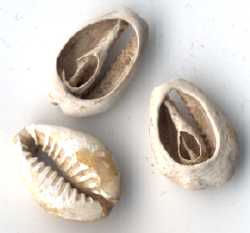
These very weather cowry shells came from a Shang Dynasty site. Note how the backs were broken, allowing them to be strung together, a feature often seen when cowery shells were as money by other cultures, even in fairly recent times.
typically about $12.00 eachAt some uncertain date, but probably early in the Zhou Dynasty period, carving imitations of cowry shells appear in various materials including bone, shell, and stone. There are also molding imitations of clay and bronze. It is likely cowry imitations arose from a shortage of actual shells, and may have been made and used over a long period of time. At this point, it does not appear to be possible to date them exactly.
CARVED COWRY IMITATIONS
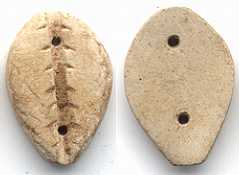
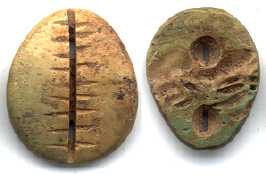
The example on the left is carved from clam shell and the one at the right from bone. They clearly show lines carved into the undersides that mimic the groves one sees on the undersides of actual cowry shells, and are pierced for stringing. Not all carved examples will show these lines, especially those carved from stone, but most do. It is important to note that these are not inscribed with the mark of any issuing authority and thus must be considered a form of Primitive money rather than true coins.
about $17.50 for bone, $25.00 for shell, $55.00 for stoneMetal examples in bronze and lead are worth more but there is too big a range depending on size and quality to place a value here.
Bone cowry imitations are commonly found stained green from burial with bronze, but I have not found any records of such excavated cowries that would tell us if this results from burial along side bronze coins, or possibly inside of bronze vessels, but I suspect burial in bronze vessels is the more likely explanation.
In the region between the Yellow and Yangtze rivers in the territory of the State of Chu, cowry imitations became even more stylized being cast in bronze with inscriptions that probably indicate an issuing authority. At that point they transform from a form of primitive money to a true coins.
BRONZE COWRY IMITATIONS
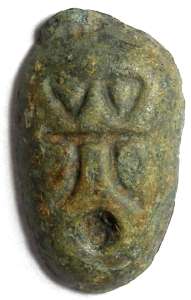
FD-4. Obverse : The character on these coins is traditionally read as a stylized form of "JIN", but that is very questionable and it is more likely a form of "BEI" which means shell. Reverse : blank. This type is sometimes called GHOST FACE MONEY as the calligraphy does resemble a human face with two eyes, a nose and a month. This is by far the commonest type in this series. The size and weight very considerably, but in a recent lot of 20 we found an average weight of 2.05 grams ranging in length from 14 to 18.5 mm, but in other groups we have seen them as small as 10 mm.
VG $15.00 F $20.00 VF $35.00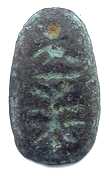
FD-6. Obverse : The reading of this is uncertain but might be "GE LIU ZHU" (ZHU being the modern form of SHU) which would mean something like "each six shu". This makes sense although only the heaviest examples weight the 3.0 grams that one would expect of a 6 shu coin. The calligraphy resembles the natural lines on the underside of a genuine cowry, which is probably intentional to indicate a value of a cowry, so here we have a clue that the value of a cowry shell may have been 6 shu when these coins were in use. This is the second commonest type in this series.
F $42.50 VF $65.00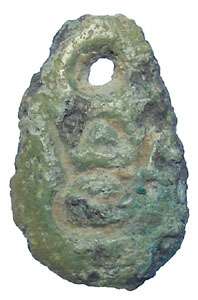
FD-5. Obverse : The reading of this is thought to be "JUN". The specimen illustrated is 1.4 grams, and 10.7 x 17.3 mm. This is the third commonest type in this series, but significantly scarcer than the previous two.
F $55.00 VF $85.00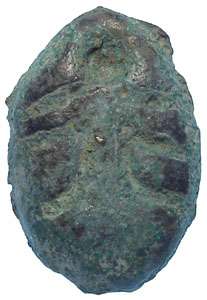
Shanghai Encyclopedia = 4170. Obverse : The reading of this is probably "HSINGUN" meaning crossroads or going or to act. The specimen illustrated is 3.75 grams, and 13.0 x 18.9 mm. This is one of the very rare types.
VALUE NOT YET DETERMINEDThese coins are commonly called "Ant-nose money" which derives from looking at these two common types together where the JIN (or BEI) appears to be a face with a prominent "NOSE", and the bottom of the "Ge Liu Zhu" resembles an ant.
There are at least seven distinct types of these inscribed cowry imitation coins, but only the two above are common. Two others are scarce, and the remaining three rare to extremely rare. We will provide illustrations of other types should they become available. The dating of this series is as yet uncertain, but it is possible one of the types in this series were the first true coins of early China.
The State of Chu did not issue any larger bronze coins during this period, but did issue some very unusual gold coins in the form of square or round inscriptions stamped into 3 to 5 mm thick sheets of gold, which name various cities in the state of Chu. I have not yet owned one of these to image for this site, and there is very little actually known about when they were issued and how they were used.
SPADE MONEY
HOLLOW HANDLED SPADES OF THE STATE OF ZHOU
The hollow handled spades of the Royal State of Zhou were probably the first true coins issued in China, at a time when Zhou was still the most powerful of the Warring states and formed the central government that controlled the other states during the Spring and Autumn period in the 6th and possibly 7th century BC. They are very close in form to the true spades used as primitive money slightly earlier, with a very shallow arch at the bottom and thus short pointed feet.
The date at which these first appear is very much in dispute. Wang mentions bronze vessels dating much earlier than 600 BC (possibly as early as 1000 BC) with dedications referring them having been paid for with "PU", so he believed the first spade coins came for that very early date. The problem is "PU" is also the name for bolts of cloth which were probably and early form of primitive money in China, those dedications probably describe those vessels having been paid with bolts of cloth. The use of "PU" for the spades probably means the early large spades represented a value equal to a bolt of cloth, although this is by no means certain. "PU" later came to be a generic name for spade money.
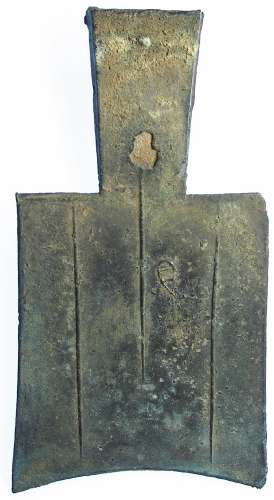
Early Period Hollow Handle Spade
FD-98. H-2.12. Obverse: "BEI" as a single character at upper just slightly right of center. The specimen illustrated is 51.7 mm wide across the feet, 94.7 mm long, and 26.55 grams (roughly 24 shu or 2 Liang).
F $450.00 VF $750.00(This value is for an intact specimen.)
Spades similar to the above come with many variations of character on them and were probably issued from the origins of spade money under Zhou in the 6th or 7th century BC, down to the 5th century BC. The inscriptions becoming more complex in the later issues.
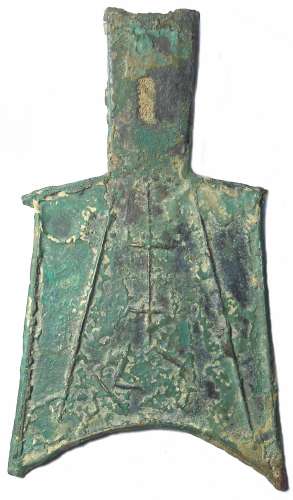
Later Period Hollow Handle Spade
FD-23. Obverse: "WU", a single character at the bottom slightly left of center. This appears to be the commonest variety of the hollow-handled spades. The specimen illustrated is 48.5 mm wide across the feet, 83.5 mm long, and 23.9 grams (about 48 shu or 2 liang)
F $450.00 VF $600.00(The valuation is for an intact specimens.)
The Shanghai Encyclopedia lists about 500 variations of hollow handles spades (including both the States of Zhou and Zhao issues). While some of the inscriptions appear to be mint names, 500 is many times the number of potential minting authorities, and most are probably series marks within a limited number of mints. A few seem to be denomination marks, but most were probably codes to indicate indicated mints, mint masters, dates, or a combination of such things. The key to their meaning is probably lost forever. For a much more in depth discussion of these inscriptions in English, it would be best to refer to the book "Cast Coins of China" by David Hartill.
While the state of Zhou was powerful early on and issued a wide variety of these hollow handled spades (most of which are individually very rare types), they lost most of their power during this period, and it appears they may have stopped issuing coins in any sigificant numbers by the middle of the Warring States period, just as some of the other Warring state began to issue coins in large numbers and a wide variety of types.
POINTED FOOT SPADES OF STATE OF JIN AND ZHAO
The central but most northerly part of the Yellow River region was controlled by the State of Jin which later become the State of Zhao. We do not yet know the date at which this change occurred, and while it is certain the later coins of this region were issued by the State of Zhao, the earliest issues may have been under the state of Jin.
The earliest coins of this region were hollow handle spades somewhat similar to those of the State of Zhou, but with much longer, more pointed feet. These are probably contemporary with with the hollow handled spades the State of Zhou, most likely dating to either the middle or later part of that period. I suspect they are ca. 450 to 400 BC, and while this is by no means certain, an earlier date would require a large time gap between these and the later flat pointed foot spades, and that seems un-likely. Most examples of this type have no marks indicating an issuing authority, suggesting more a form a primitive money than a true coin, but a large hoard found in 1995 (see Hartill page 17) contained many examples with marks and those are true coins.
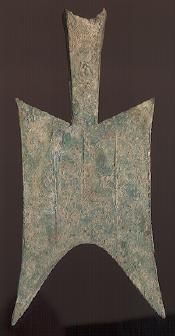
Early Hollow Handled Spade
Schjoth-43. No inscriptions to give any indication of a mint or issuing authority. 127.5 x 67 mm (widest point). 32.1 grams. The weight of this issue varies somewhat, with Schjoth's specimen at 36.93 grams and Mitchiner's at 39 grams, both of which were incomplete. But it would appears that the actual weight of bronze was intended to be about 36 grams, which is 72 shu or 3 Liang (3 Jin).
VF $1850.00(The price is for an intact specimen, and specimens with damaged feet would be much lower priced.)
The very long pointed feet, combined with the weakness at the attachment of the handle, make these very fragile. Their large size also would have made them somewhat impractical to carry around and use in general circulation. Most likely they were used for very specific purposes or large transactions, with general commerce still via the barter system. Probably by the end of the 5th century BC, and certainly by the mid-fourth century BC the State of Zhao redesigned it's coins to the more practical flat pointed foot spades listed below.
There are two denominations commonly seen for the flat pointed foot spades, with the 1/2 Jin (ca. 6 grams) being far more common than the 1 Jin (ca. 12 grams) examples. The 1 jin examples are also far larger than the 1/2 jin, making the denominations easy to tell a part.
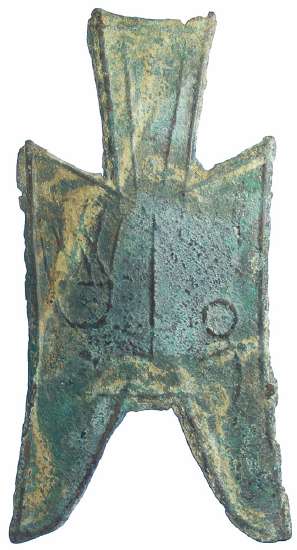
One Jin Flat Pointed Foot Spade
FD-120. H-3.78. This is a fairly large spade at 83.8 mm long and 45.0 mm across the widest point, 14.75 grams (slightly heavier than the intended 24 shu or 1 Jin). The inscriptions reads "JIN YANG" with JIN being a denomination mark, and Yang probably a reference to a mint.
VF $1500.00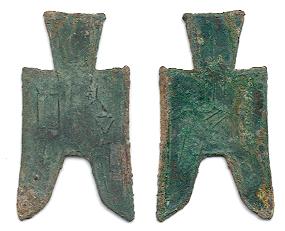
Half Jin Flat Pointed Foot Spade
FD-143 variety with obverse characters reversed. Obverse: "SHANGQIU". Reverse: uncertain character. 53 x 30 mm. This specimen weighs 6.4 grams (appears to intend a 12 shu or 1/2 Liang (1/2 Jin) standard). The characters on these are in very low relief and do not come out well on the image.
gF $125.00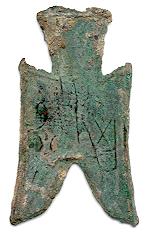
FD-124. Obverse: "JINYANG". Reverse: uncertain character. 55 x 33 mm. This specimen weighs 6.5 grams (appears to intend a (appears to intend a 12 shu or 1/2 Liang (1/2 Jin) standard).
F $115.00There is a wide variety of these, and they are fairly common showing they were issued in fairly large numbers over a significant period of time. This is probably the time during which coins came into much more common use as a medium of exchange in general commerce, although it is very likely the barter system was still in wide spread use as well.
Hartill dates these to ca. 350 to 250 BC, which is contemporary with the thin square foot spades that we list further below under the heading of "THE PERIOD OF UNIFIED COINAGE". A problem I see with this, is that these coin are very specific to the State of Zhao (earlier called the State of Jin) and do not seem to belong under that heading. Since Zhao issued many types of thin square foot spades in that period, I believe these flat pointed foot spades probably begin when Zhao stops issueing hollow handled spades some time around 400 BC, and end ever Zhao begain to issue square foot spades some time after 350 BC (they are sometimes found with square foot spades, but that does not mean they were not minted at an earlier period and just still circulating). Perhaps one day these dates can be narrowed down a little closer.
HEAVY FLAT SPADES OF THE STATE OF LIANG (Wei)
Around 400 BC flat spades revolutionized the spade currency. Unlike the hollow-handled spades which required a complex multi-piece mold with a casting core in the handle, the flat spades required only a simple two-piece mold, allowing for larger mintages in shorter periods of time. They were sturdy, easier to store and were cast in the three denominations of 1/2, 1 and 2 "jin", making them very suitable for use in everyday transactions. Most of the the early issues name the city of Anyi which was the State of Liang capital early in this period. The later issues usually name the city of Liang to which the capital of the stater of Liang was moved later in the period. There are some very scarce types which name other cities. The denomination can be expressed either directly in jin, or as fractions of the LI with 100 to the LI equal a Jin. This is probably the period when coins came into common use over a wide area of China. Early flat foot spades were called "CH'IEN, which later became a generic term for all types of money.
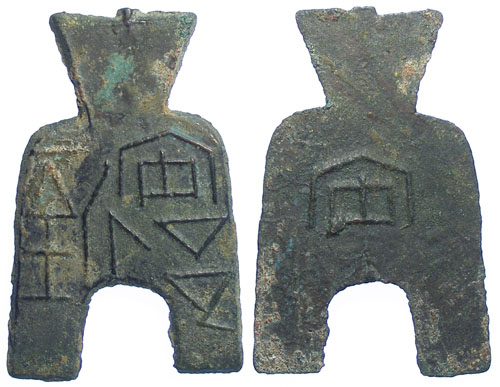
FD-300, H-3.3. (Value 1). Obverse: "AN YI YI JIN", meaning Anyi 1 Jin. Reverse: "AN". This is one of the few heavy spades with a character (mint mark??) on the reverse. The specimen illustrated is 55.0 x 35.3 mm, 12.31 grams.
F $245.00 VF $350.00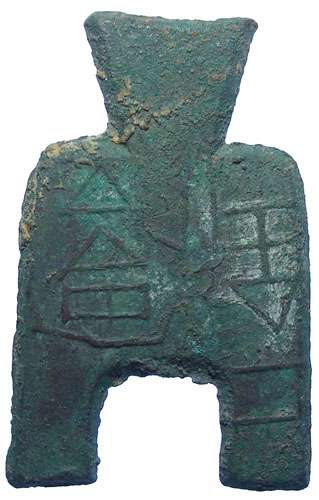
S-1. FD-301 H-3.8. Obverse: "AN YI ER JIN", meaning Anyi 2 Jin. This is one of the commonest heavy flat spades with a typical layout to the inscription. Average (3 specimens) 40.3 x 63.4 mm, 26.7 grams (the weights and sizes can very, and we recently weighed one at 32.4 grams)
F $195.00 VF $295.00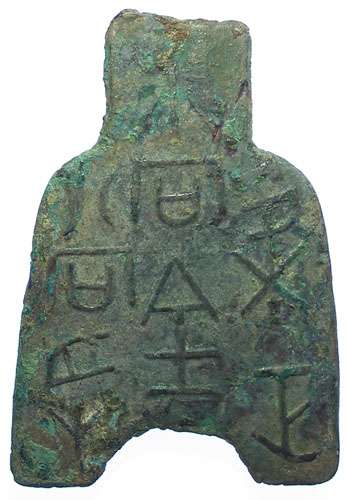
FD-304, H-3.44. Shallow arch type. Obverse: "LIANG ZHENG BI BAI DANG LIE", meaning "Liang regular coin 100 to a lie" (1 Jin). The specimen illustrated is 59.8 x 40.6 mm, 14.76 grams. These were issued from the State of Liang, probably late in the series after the Capital of the Liang state was moved from Anyi to a new city called Liang.
F $325.00 VF $450.00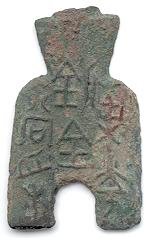
As FD-306 but the reverse is blank. Please note that this type is the same size as the others in this series, and it is only our image that is smaller. H-3.48. High arch type. Obverse: "LIANG ZHENG BI BAI DANG LIE", meaning "Liang regular coin 100 to a lie" (1 Jin). The specimen illustrated is 57.2 x 34.5 mm, 13.9 grams. These were issued from the State of Liang, probably late in the series after the Capital of the Liang state was moved from Anyi to a new city called Liang.
F $275.00 VF $375.00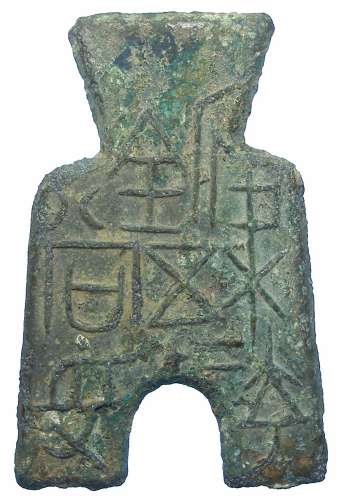
FD-307. H-3.48. Obverse: "LIANG ZHENG JIN WU SHI('ER) DANG LEI", meaning "Liang heavy Jin of 50 to a lie" (2 Jin). It was probably understood by the people who used these the "heavy Jin" indicuted a double Jin coin. The specimen illustrated is 38.8 x 58.0 mm, 22.62 grams. These very in size and weight somewhat. These were issued from the State of Liang.
F $295.00 VF $425.00"AN-YI" |
A mint designation. ANYI was a city in central China that was part of the Liang (Wei) dynasty during the 4th century BC but had been under the Ch'in dynasty earlier. |
| LIANG | A mint designation. LIANG was a city in the state of Liang (Wei) to which the capital was moved later in the 4th century BC. |
| BAN JIN or ER BAI DANG LIE | Denomination marks indicating a value of 1/2 Jin or 200 to the Lie. |
| YI JIN or BAI DANG LIE | Denomination marks indicating a value of 1 Jin or 100 to the Lei. |
| ER JIN or WU SHI DANG LIE | Denomination marks indicating a value of 2 Jin or 50 to the Lei. |
There are a variety of other heavy flat arched foot spades that seem to be from the State of Liang which name cities other than Anyi or Liang. Some have simple inscriptions that just name the city but not the denomination, which others also include marks of denomination. At this point these are not well understood and it is possibly some of them are from other states (some might be from the state of Han), or exactly how they fit into the chronology of this series.
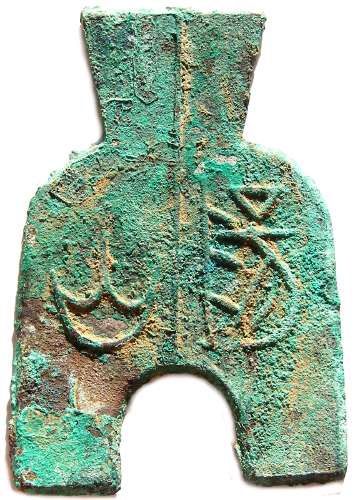
FD-311, H-3.26. Obverse: "SHAN YANG". Shan Yang is probably a city name somewhere in the States of Liang or Han. This is a slightly unusual type for a heavy square foot spade in that there is no denomination indicated, although this type is known in the three sizes for 2, 1 and 1/2 Jin. This specimen is the larger 2 Jin although at 58.2 x 40.5 mm, 16.64 grams, it is only slightly heavier than the 1 Jin coins from Anyi and Liang.
F $750.00, VF $1000.00The evolution of spade forms is complex with many types and many lines of development to follow. This part of this site will take a long time to develop and for now only the most common types are included.
THE PERIOD OF UNIFIED COINAGE.
THIN SQUARE FOOT SPADES
It appears that around 350 BC, and continuing down to the end of the Zhou period in 255 BC, the currency of China begins to unify in form, and we see thinner square foot spades appearing in an extensive series bearing a variety of mint names, showing very similar coins were made accross a number of the Warring States, with only minor variations in form. At this point we are making no attempt to sort them out into their particular states of issue, although we might attempt to do so at some future date.
Most spades in this series weight between 5 and 7 grams, with some double unites in the 10 to 12 gram range, but the average is in the 6 gram range for the smaller examples and around 12 grams for the larger ones, showing they were issued with the intended denominations of 1/2 and 1 Jin. some large examples with sharp corners can weight as much as 14 gram, but it is not yet clear if they were intended to be 30 shu or if they are just heavier than average but intended at 24 shu (1 Jin).
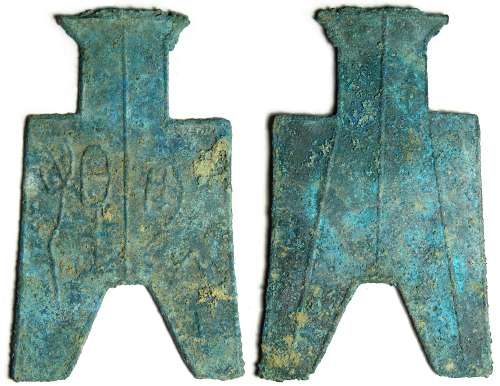
"LARGE SPADE WITH EARS"
FD-286, H-3-173. Obverse: "YU JIN NEI". YU may be a city name in either the state of Liang or Han, with JIN NEI probably means "metal money". This is a very rare type of large spade with sharp corners (ears) at the top. This specimen was 57.6 x 42.0 mm, and 10.7 grams.
F $1500.00, VF $2450.00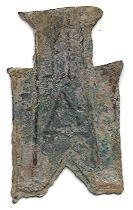
SMALL SPADE WITH EARS
FD-282. Obverse: "GONG". The specimen illustrated is 48 x 30 mm and weighs 5.4 grams.
F $115.00 VF $175.00These thin square foot spades with "ears" clearly belong to the same series as the coin below, but their exact relationship to the more common shape without "ears" is not yet certain. There are a few other types known with this configuration but different characters on them.
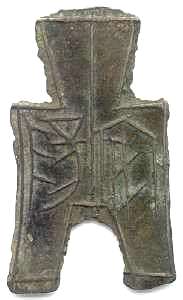
S-13-23 variety. Obverse: "AN YANG". An-yang probably a city name and may be the current Chang-te in Honan province, but this is not certain and there may have been a number of cities by that name at the time. Schjoth notes that prior to 257 BC An-yang was called Ning-hsin-chung. This is probably the most common square foot spade, and it exists at two weight standards with the regular one averaging about 6 grams, and a heavier averaging about 12 grams (usually weakly cast). We have also seen one at 15.99 grams which could be either a light triple standard or very heavy double standard.
SINGLE (ca. 6 grams) F $55.00 VF $75.00DOUBLE (ca. 12 grams) F $75.00 VF $110.00
These thin square foot spades appear to come from a number of different mints, but very little variation in form and weight, which suggests a single central authority with the intent they could circulate freely between the different cities. We have noted that hoards often turn up with mixed types, which seems to support this theory.
The most likely central authority to have that much control would be the state of Ch'in, but only after they were well into the process of unifying China in the 3rd century BC. According to Schjoth, the Historical Records of Ssu-ma Chien state the city of An-yang received that name in the 50th year of Prince Chao Hsiang of Ch'in, which is 257 BC. An-yang spades are by far the most common type in this series, and if there were minted in that same An-yang (which is likely but not 100% certain) they have to be Ch'in period coins, possible providing us with a general time frame for the entire thin square foot spade series.
Wang (page 20) disputes this dating, indicating two cities named An-yang that pre-date 257 BC, suggesting these coins belong to one of those cities. Our current research has turned up only two other coins with the An-yang mint mark. The first is a round-shouldered round foot spade with three holes which Wang lists as a very late issue, and the second is a very rare heavy knife which Wang lists as a very early issue, but which we believe is actually a very late issue (note our discussion of heavy knifes below). If no further evidence for earlier coins of An-yang comes to light, and only coins of after 257 BC are known, we feel Schjoth's interpretation is the more reasonable one.
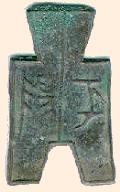
S-7-12 variety, "P'ING YANG". This is a regular sized square foot spade and the second most common type.
F $55.00 VF $75.00NOT YET AVAILABLE
S-28-29, "CHAI-YANG"
F $55.00 VF $75.00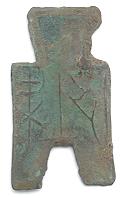
S-31-33 variety, "CH'ENG YI". The specimen illustrated is weakly cast on the top right character.
F $47.50 VF $65.00NOT YET AVAILABLE
S-36-37, "HSIANG-YUAN"
F $55.00 VF $75.00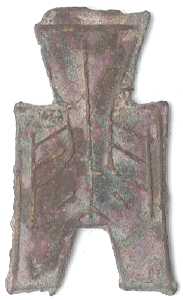
S-38. Obverse: "KUAN". Kuan appears go be short for Kuan-chung in the Shansi area.
F $55.00 VF $75.00
The "KUAN" character also occurs on a pointed rounded-back knife (reference Shanghai Encyclopedia #2793 and 2794) indicating a possible connection between the two series.
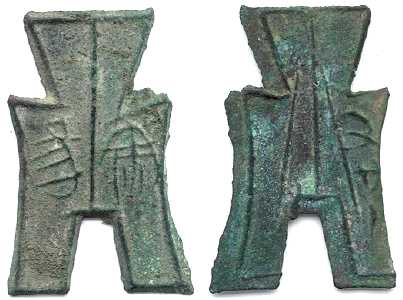
FD-167. Obverse : "TAO-YANG" in seal script (some have read it as a seal script version of "AN-YANG"). Reverse : two character inscription that we have not yet translated. The specimen illustrated is 46.9 x 21.0 mm, 9.11 grams (seem to have been intended to circulate as a double unit).
VALUE NOT YET DETERMINEDIMAGE NOT YET AVAILABLE
As FD-167 but blank reverse. Obverse : "TAO-YANG" in seal script, but some have read it as a seal script version of "AN-YANG". Reverse : blank.
F $52.50
FD-178, COOLE-1532. Obverse: "YIN PING". This issue is smaller, more robust and has more well developed rims than usual, suggesting that it may be a late variation of the square foot spade.
VF $120.00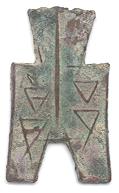
FD-209 variety (bottom right character slightly different style). Obverse: "LANG". Some believe that the characters on this type should be read as "ZHENG".
aVF $115.00SMALL SQUARE FOOT SPADES
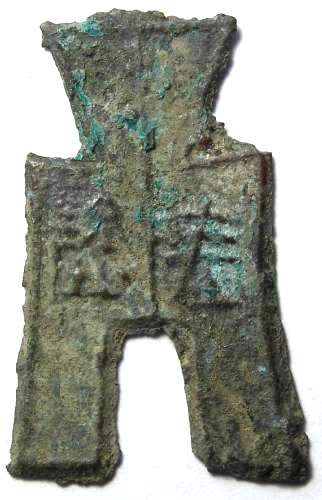
Reference: FD-178. Obverse : "PING YIN" (although some read it as YIN PING). Reverse : blank. A fairly small light weight type with the specimen illustrated on 38.0 x 24.0 mm (at the foot) and weighing 4.15 grams.
VF $125.00The calligraphy on this type is very similar to some of the early Han dynasty square holed round coins (see Schjoth #68), which along with a weight standard that does not fit with other Zhou and Ch'in period spades, suggests this may be a very late issue, possibly of the early Han Dynasty just after 200 BC.
LONG SQUARE FOOT SPADES
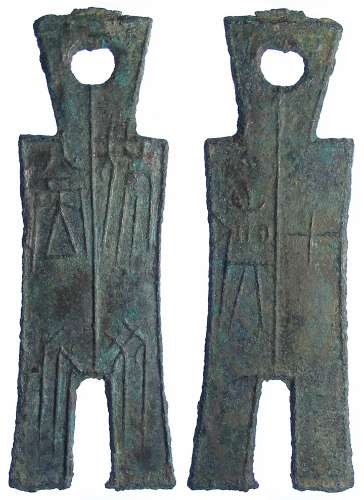
Reference: FD-289. Obverse : The exact reading of the obverse inscription is in dispute, but may read "SHU BU DANG JIN" meaning "special spade valued at a Jin. Reverse : reads "SHI HUO" meaning "ten huo" with "huo" probably meaning an ant nose type coin. These spades are thick and robust with well developed rims all the way around, with a large round hole in the top. The specimen illustrated is 105 X 36.6 mm (at the foot) and weighs 35.55 grams.
VF $975.00These spade coins appear to be of fairly late date, probably during the very last years of the Zhou warring states period, into the Chin and possibly into the early Han period. They are found mostly in the area controlled by the State of Chu, but a few have been found in the area of the State of Han although those might have gotten there by trade. A few have been found buried with Ant Nose coins. They appear to the proto-type of the later Wang Mang Spades.
KNIFE COINS
The knife money of the Shantung Peninsula is far less complex than the spade money, but is still poorly understood. PLEASE NOTE THAT WE HAVE NOT YET UNIFIED OUR DISCUSSION OF KNIFE MONEY INTO OUR RE-ORGANIZATION OF THIS SITE. SOME OF THE KNIFE MONEY WILL LATER BE MOVED INTO THE DISCUSSION OF INDPENDANT COINAGE, AND OTHERS WILL UNDER THE HEADING OF UNIFIED COINAGE. THIS IS SOMETHING WE WILL BE WORKING ON IN THE NEAR FUTURE.
The monetary designation of knife money is "HOU", derived from a character meaning "to change" or "to exchange in trade". It is fairly easy to see how this meaning could become a denomination of money. Later, when the early round coins first appeared, the unit of "HOU" came to be used as a more general denomination.
POINTED KNIVES
We assume the pointed knifes, with a smooth curve down the back, are the earliest form of knife money. They have the closest style to genuine knives, and like the early hollow-handled spades often appear without inscriptions, although the inscriptions are normally weak or difficult to see on most specimens. The casting and calligraphy are similar to the hollow-handled spades. This leads us to believe they first appeared at about the time of the inscribed hollow-handled spades and overlap with the heavy flat spades, probably in the late 5th century BC.
Although most pointed knives look very similar, there are actually a number of distinctive variations in the blade shapes that are almost certainly different issues. At this point we cannot go into the details of this, but a some future date we will try to add more information about them. There is a very good listing of them in the Shanghai Encylopedia.

S-62 to 65 variety. The price is for an intact specimen, but these are often found with the tip broken. The one illustrated has a very clear character, which is unusual for these. The actual size of this specimen in about 160 mm, 15.6 grams. The prices are for examples with clear characters. Many examples have no visible or very weak characters and are worth about half.
F $115.00 VF $160.00
S-62 to 65 variety. This exact type is listed in the Shanghai Encyclopedia as #2733. The price is for an intact specimen, but these are often found with the tip broken. The actual size of this specimen in about 153 x 21.5 mm, 15.6 grams. The prices are for examples with clear characters. Many examples have no visible or very weak characters and are worth about half.
F $115.00 VF $160.00We have not done much work on these yet, but it appears that the characters on them may be mint names. We have not noted any with indications of denomination, but based on 5 intact specimens we have recent weighed, they seem to average about 15.8 grams (high of 17.0 and low of 14.2 grams), indicating a probable standard 30 shu, about the same as the Ming Knives. This places them in the same denomination set as the mint knives and suggests these are the fore-runners of them. We recently had a specimen of SH-2772 that weighed 23.92 grams but we believe it was an anomaly.
MING KNIVES
The "Ming" knifes probably followed next, but they are still a bit of a mystery. The fabric is similar to common square-foot spades except that the inscriptions give no indications of mint names. All bear the character "Ming" on one side, which Wang (page 166) suggests is made up of the characters for "sun" and "moon", meaning "bright". These are by far the most common of all knife money and must have been cast in vast numbers, and are found over a wide area of Northern China and as far away as Northern Korea.

S-51-61, This exact type is Hartill 5ca. Ming type. Obverse: "MING". There are many different inscriptions that can occur on the reverse of these, which need much more study. Pricing this depends on must of the grade, but on the boldness of the characters, which can be very weak up to very bold. These prices assume good metal with no significant chips or cracks:
If WeakF $60.00 VF $100.00 XF $175.00
If Bold (as the one above)
F $120.00 VF $200.00 XF $275.00
Long ago we noted that there were two distinct shapes of ming knifes, the first of which has a distinctly angled back, and the second with a mildly curved back. The exact significance of this is uncertain, but it is possible that the mildly curved back varieties are the earliest, having evolved from the pointed curved back knifes. A partial hoard of these that we obtained recently, had both types well represented.
Wang (page 170) points out that the curved-back ming knifes can be further divided into two distinct inscription varieties. The first variety has a mint name and monetary designation on the reverse. The second variety has reverse inscriptions which do no appear to have a relationship to mints or denominations. It appears that these two varieties are probably roughly contemporary but from different districts.
All of the angle-back specimens have the second type of inscription without mint name or monetary designation.
Dating ming knifes is a little problematical, but we suspect that they appear in the very late Zhou, probably at the end of the 4th century BC and continue down to and possibly after the unification under the Ch'in.
The ming knifes that we have checked have an average weight of about 15-16 grams and it appears that the intended denomination may have been 30 shu. This is heavier than the pointed knifes, suggesting a new denomination system (see our discussion of weight standards). Unfortunately all of the specimens we have been able to check are of the angle-back variety and we do not yet know if the curved-back varieties fall into the same standard. We will investigate this soon.
STRAIGHT KNIVES
The more stylized straight knifes, with characters on one side may be contemporary with the later Ming knifes, probably ca. 300 to 250 BC. There are not as many variations on these as there are Ming knifes, and the characters on them normally indicated numbers and what may be mint names. This the series is not yet well understood and much more research is needed on this series.

Hartill 4.68. Obverse: "Gan Dan Bi". Reverse: Blank. This specimen is 132.4 mm x 15.3 mm (longest and widest points) and 9.42 grams. The hole in the hands is distinctly almond shaped which is typical of these.
F $125.00 VF $195.00
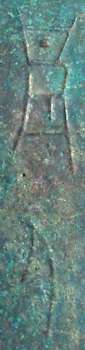 | GAN DAN - probably a mint name |
| BI - coin |

FD-346 variety. Obverse: 2 characters. The hole in the handle is usually fairly small and sometimes almond shaped. The characters are generally weakly cast and difficult to make out.
F $85.00 VF $120.00HEAVY KNIFES, STATE OF CHI
The large heavy knifes may be the most misunderstood part of this series. In most early references they described as the earliest knife form, going back to before 600 BC, but this seems un-likely as they are a highly evolved form with fairly complex inscriptions, and must actually date very date in the series. In Hartill's book (Cast Chinese Coins) he dates them to between 400 and 220 BC, which makes them fairly late in the knife money series. I personally suspect the dates might even have to be moved up a little on that, which I will discuss below. With the exception of the three-character Ch'i knifes, most heavy knifes are rare to extremely rare.
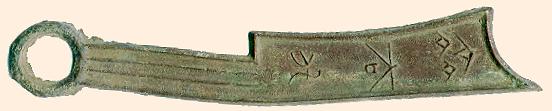
S-45-50. Obverse: Three characters reading "CH'I FA HUO" which loosely translates to "The authorized currency of Ch'i". The reverse generally has a single character, but there are a number of different types known. There is some variation in the weights of these, but they seem to average around 48 grams. The specimen shown is somewhat sharper than normal, but these usually are fairly nice.
F $195.00 VF $275.00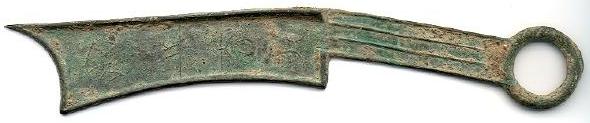
FD-253. Obverse: Four characters reading "CH'I CHIH FA HUO", Reverse: The reverse generally has a single character, but there are a number of different types known. The specimen shown is typical with low relief characters, is 185 mm x 30 mm (longest and widest points), 27 mm across the ring handle and 33.95 grams.
F $475.00 VF $650.00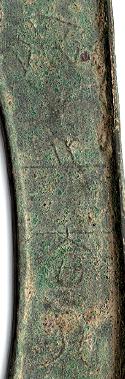 | CH'I - state of Ch'i |
| CHIH - genuine or legal | |
| FA HUO - money |
The dating of these coins will probably remain uncertain until archeological evidence can provide some answers, but the coins themselves do give us some clues.
We feel that it is significant no uninscribed, or even simple inscriptions are known for these forms as they are for the very early hollow-handle spades, pointed knifes and cowry imitations. As these heavy knifes first appear with full developed complex inscriptions including a mint name and indication of a monetary unit, it would seem they must dates later than those hollow-handled and heavy flat spades, almost certain later than 400 BC.
While rims are present on many ancient coins, they are usually low and thin, while these coins have thick and high rims for where there are no parallel on other knife and spade coins, with the closest thing seeming to to be the early round coins of "I" (a city in the Ch'i territory) which are certainly of a very late date and suggest they might even be later Chin or even early Han issues down to around 200 BC or possibly even slightly later. They also seem to be the most finely cast of all ancient Chinese knife and spade coins, but of the specimens that we have seen, none showed significant wear suggesting some purpose other than a general circulating coinage.
When we consider all these features of these coins, we are led to believe they may have been made for ceremonial purposes such as presentations or burial. This seems consistent with the use of the state mane of Ch'i as a "mint" designation, rather than one of the cities in Ch'i as is the usual pattern for knife and spade coins, and they may in fact have been were cast at a very late date, probably after 300 BC.
EARLY ROUND COINS
This is an area we have just begun to study. Most of the types are seldom encountered, and with the exception of four types we have handled very few of these coins. Wang (Early Chinese Coinage, pages 187 to 205) is the best study we have seen on these and much of our information is based on his work. Wang's one fault is in not giving enough consideration to weight standards. Fortunately he has provided some information about weights, which we will attempt to interpret with respect to our own theories.
Early round coins can be divided into two major types. Those with round holes are found in areas associated with spade money. Square-hole types are found in areas associated with knife money. At this point, we believe that these two types evolved independently at different times.
ROUND-HOLED ROUND COINS
Early round coins with round holes can be divided into two major types. The first type are those with multiple-character inscriptions including both mint marks and monetary units, which share the following similarities with the heavy flat spades: 1) They occur in the two monetary units of liang and chin. 2) Similar style of the calligraphy. 3) Similar construction of the legends. 4) They are found in more than one denomination (1 and 1/2 liang and chin). 5) They never occur with any type of rims. This leads us to believe they evolved directly from these spades and are the earlier of the two types.
They differ from the spades in one important aspect. All the specimens we have been able to confirm fall into the weight system based on multiples of 10 shu with an average about 10 grams (20 shu) for the full units, and about 5 grams (10 shu) for the half units, while the heavy flat spades were cast to the weight standard based on multiples of 12 shu. This leads us to believe they we issued as a replacement for the heavy flat spades as the new weight system was adopted (see our discussion of the weight standards above). This suggests a date somewhere towards the end of the 4th century BC.
The second series of round-holed round coins are those with only a mint name, but no denomination. These are seen with either one-or two-character legends but in all other ways, including the weights, resemble the multi-character types. The use of only a mint name without monetary units is a characteristic shared with the square-foot spades which are cast to the same weight standard, in a close relationship between the two and suggest a date right around or just after 300 BC.
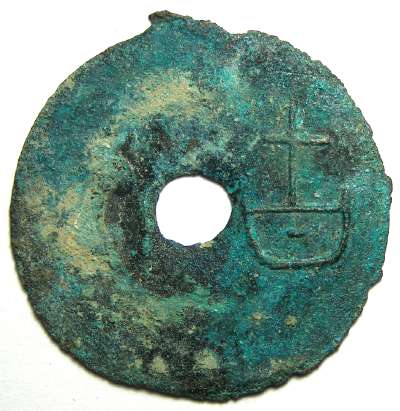
FD-371, SH---, H---, S---. Obverse: "JI". JI was a city in the state of Yan. This is a rarity of the highest order, and the only reference I have found it in is Fisher's Dings where it is listed as "price not determined". Average (1 specimen) 41.2 mm, 10.05 grams.
I can only guess at a value for something this rare, but probably somewhere in the $7500.00 rangeThere is dispute over this particular type. Until recently the only known example was that listed by Ding in his 1938 work, and we believe that specimen is in the Chinese national collections. Because of it's rarity that specimen has been considered by many to be a fantasy issue. Recently this second specimen came to our attention and we can find no reason to believe it is not a genuine ancient example. But I am sure the controversy will continue.
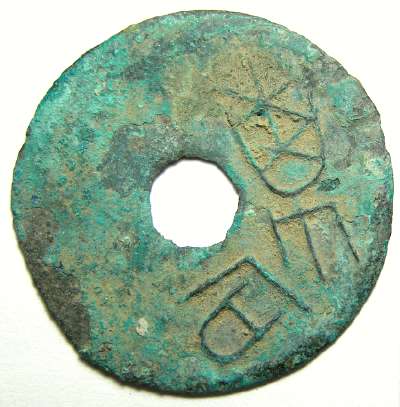
FD-372, SH-4074 variety, H-6.10. Obverse: "LISHI". Li Shi was a city in the state of Zhao. The SH example had an extra star above the top character, but both of the FD examples and the Hartill example, have a single star as on this coin. RARE. Average (1 specimen) 34.8 mm, 3.50 grams.
XF $2500.00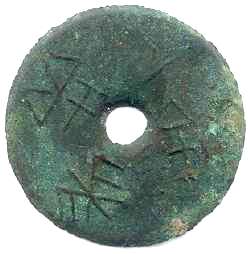
FD-375 variety, SH-4058, H-6.6. Obverse: "CHANG YUAN YI JIN" meaning Chang yuan 1 Jin. Hartill notes that the reading is now through to be Qi Yuan, which was a city in the state of Liang. This is the most common of the multi-character early round coins with round holes, but is by no means a common coin. Average (1 specimen) 38.5 mm, 12.23 grams.
XF $1750.00
S-73, Obverse: "YUAN" as a single character on the right. Yuan was a city in the state of Liang. This is the most common of all round coins with round holes. Average (3 specimens) 42 mm (range 41.2 to 43 mm), 9.93 grams (range 8.8 to 10.7 grams).
F $150.00 VF $275.00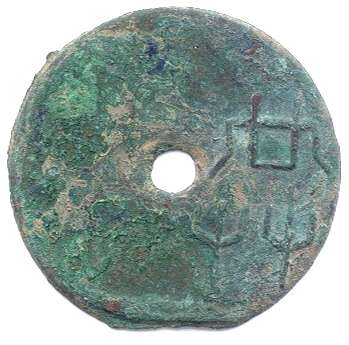
S-75, Obverse: "KUNG" as a single character on the right. Kung or Gong was a city in the state of Liang. This is the second most common early round coin with round hole. Average (3 specimens) 42 mm (range 41.2 to 43 mm), 9.57 grams (range 8.7 to 10.5).
F $475.00 VF $650.00 XF $950.00With the exception of the mintmark-only Yuan and Kung types, round-holed coins are exceptionally rare and must have been cast in very limited quantities over a relatively short period of time. We have found good evidence that the Kung and Yuan types are contemporary with each other, and probably circulated side by side, because the Kung type illustrated above has the rather interesting feature of a Yuan type imprinted in the patination on the reverse, proving they were buried togeather in the same hoard. Click here for an image of that reverse imprint..
Our best interpretation of these coins is that they were a short-lived unsuccessful attempt to introduce round coins around 300 BC, but were rejected and replaced by square-foot spades.
Coins with Yuan and Kung mint marks provide us with an important clue to the sequence and dating of 4th and 3rd century BC coins. Kung issued heavy flat spades (ca. 12 grams, reference Shanghai Encyclopedia #1438, 1439), round coins with multiple-character inscriptions (ca. 10 grams, reference Wang plate LIII #3) and round coins with single-character inscriptions (ca. 10 grams, reference Schjoth-75). It is unlikely all three were issued at the same time, so we are probably looking at a sequence of issues which we believe occurred in the order listed. Yuan and Kung issued round coins with round holes and single-character inscriptions (ca. 10 grams, 42 mm), and Yuan also issued square-foot spades (ca. 5 grams, reference Schjoth-36, 37).
Taken together we get the following sequence: First, heavy flat spades. Second, a very short series of round-holed coins with mint and denomination marks. Third, another short series of round-holed coins with mint mark only. Fourth, the thin square-foot spades.
This is an idealized sequence as not all mints issued all of the types, and it is doubtful that they all changed types at the same times. Some smaller mints issued coins only occasionally and may not have been active during some of the stages. Other mints probably continued to issued heavy flat spades after others minted their first round coins, and then went straight to light square-foot spades without issuing any round coins.
We soon hope to do an in-depth study of early round coin weights. If any issue of these round-holed types turns up with a weight standard around 12 grams (24 shu), it would tie that issue more closely to the heavy flat spades and suggest an earlier date. If no heavy series is found, it would confirm these were issued as the various cities changed standards from multiples of 24 shu (12 grams) to multiples of 20 shu (10 grams), which we believe occurred about 300 BC (see our discussion of weight standards). (Please remember that the weight of any one specimen would prove nothing, as individual coins can vary considerably. Only the average weight of numbers of specimens of the same type is significant).
EARLY ROUND COINS
SQUARE-HOLED ROUND COINS
Early square-holed round coins seem to be found exclusively in areas associated with knife money. They come in two distinct series, the relatively common "MING" types that appear to be related to the ming knifes, and the much scarcer "I" series which seem to represent the issues of a single mint called "I". The only inscriptions they have is their monetary designation of "HUO", a character which has come to mean "knife money", but which had also become a unit of denomination by the time these coins were issued.
Dating this series is difficult, although it is likely that they are much later than the round hole coins with which they have very little in common and are probably not related. It is possible, and for the "I" types even probable, that they were cast in the late Ch'in or Han periods and should not be included in this discussion of Zhou period coins. It is also likely that the earliest Pan Liang coins (currently discussed under the Ch'in Dynasty) predate the Ming and "I" round coins and should be included here.
The Ming Huo and the smaller Yi Huo coins appear to be derived from the Ming knifes, although it is not certain that even these two issues belong together.
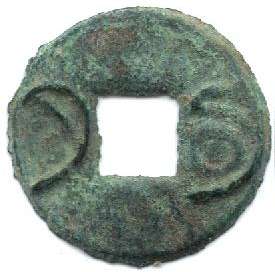
S-76. Round coin with square hole. Obverse: "MING HUO". Reverse: blank. Average (3 specimens) 24 mm (they tend to be off round) and 2.48 grams.
F $85.00 VF $105.00 XF $135.00The Ming Huo are robust castings with slightly crude characters and no rims. There is little doubt the character "Ming" is the same as on the ming knifes, although the meaning is still a mystery. There has been debate over the character "HUO" on these, but Wang makes a good case for this reading. What is less clear is how "HUO" is meant to be interpreted. It may imply these coins were equivalent to a ming knife (or some implied fraction thereof), in which case they could have been issued alongside or just after the knife series, at the end of the Zhou period. "HUO" could also be meant as a monetary unit (as it clearly is on the Yi huo coins) in which case these were probably issued long after the ming knifes, probably during the early Han dynasty. This is something that will probably only be answered by the study of hoard evidence.
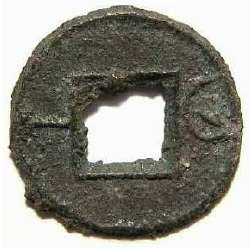
S-77-8 variety. Early round coin with square hole Obverse: "YI-HUO" (one knife). Note the outer and inner rims. Average (11 specimens) 19 mm, 1.53 grams. These tend to be slightly weakly cast with rough surfaces.
F $22.50 VF $29.50 XF $45.00At first glance the YI-HUO appear to be small versions of the MING-HUO coins and are listed that way in most numismatic references. However the Ming-Huo are completely rimless will the YI-HUO have a distinct outer and sometimes an inner rim. These rims, along with the inscription translating to "one knife" suggest these are a later issue of the Ming-Huo coinage at a lower weight standard. The rims show a strong similarity to the rimmed Pan Liang coins which appear to have been issued between 136 and 117 BC during the Han period and it is possible these are contemporary with that issue. "Yi Huo", meaning "1 knife" and clearly shows "Huo" used as a monetary unit.
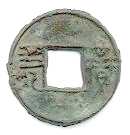
S-68. Early round coin with square hole Obverse: "I SSU HUO" (I four Huo). Note the strongly developed outer and less developed inner rims. Average (2 specimen) 30 mm. 6.65 grams.
F $195.00 VF $295.00This "I" series of square-holed round coins is very simple, being composed of a single basic type issued in the four denominations of 1, 2, 4 and 6 huo. Here again "HUO" is used as a monetary unit rather than a term for knife money. This is another series for which the dating is uncertain (somewhere between late Zhou and early Han) and we would be very interested in hearing the details of any hoard in which these are found alongside other coins.
Much of the current literature lists the character for "I" as a variation on the character "Pao" (money), to which it does have a strong resemblance. Wang (pages 188, 189) makes a convincing argument for the proper reading as the city name "I", the ancient county seat of the county of Han in the state of Ch'i, a site just northwest of Shou-kuang in the northeast of Shantung province.
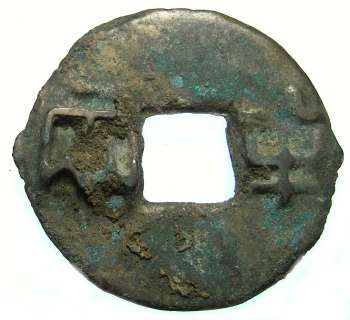
LARGE BAN LIANG (over 38 mm). Obverse: "BAN LIANG". Reverse : blank. These large specimens vary considerably in weight, from less than 8 grams to over 20 grams, but to date them this early they must be at least 38 mm. The value listed is for specimens over 38 mm, but in the 10 gram range, with heavier ones worth more.
VF $145.00It is fairly certain that the Ban Liang coinage was issued by the state of Chin, with the earliest Ban Liangs issued by Chin as one of the Warring States of the Zhou Dynasty period, probably about 300 BC. The size, weight, and casting characteristics of these very large examples suggest they are contemporary with the early round coins, with round holes from other states which are listed above. Ban Liangs of smaller size and lower weight were to become the principle coin of China later, after the Chin conquered the other Warring states to unify China during the 3rd century BC. Those coins will be discussed in the next section of this website under the Chin and Han dynasties.

Chin, Han and Wang Mang.
Copyright © 1997 - 2025 R & T Enterprises Ltd.