



ANCIENT CHINESE COINAGE
255 BC TO AD 221
I offer this reference guide to Chinese coins with the hope of promoting greater understanding and appreciation these coins but please note THIS IS NOT A LIST OF COINS OFFERED FOR SALE.
Images represent the types and may be larger or smaller than the actual coins.
CH'IN DYNASTY
255 - 206 BC
Ch'in existed as a feudal state under the Zhou since before 1000 BC, casting coins which are currently listed under Zhou, starting about 400 BC. Traditionally the Ch'in Dynasty is listed as beginning in 255 BC when Ch'in conquered the Zhou dynasty whoever some date it to 221 BC when Ch'in unifying all China, but note this unified China was much smaller than the China we know today. The Ch'in rulers probably would have used about 325 BC when Duke Hsuan Wen adopted the title of Emperor after defeating the state of Wen and withdrew Ch'in allegiance to Zhou.
KNOWN RULERS OF CH'IN
| Duke Hsiao * | 361-338 BC |
| Duke Hsuan Wen known as Emperor Hsuan Wen after 325 BC | 337-310 BC |
| Emperor Wu | 310-307 BC |
| Emperor Chao Siang | 306-251 BC |
| Emperor Cheng known as Emperor Ch'in Shih Huang after 221 BC | 250-210 BC |
| Emperor Ti | 221-210 BC |
| Emperor Eri Shih Huang Tii | 209-207 BC |
* "Duke" is the closest title we have found for the early rulers of Ch'in.
It is commonly accepted that in 221 BC, at the time of the unification, Ch'in introduced the Pan (pronounced "Ban") Liang coinage, discontinuing knife and spade coinage. This is by no means certain and I find it difficult to accept, believing the coinage of this period is more complex and knife and spade coinage was phased out gradually. I previously discussed the possibility that some Square-Foot Spades and early Square-Holed Round Coins were cast under the Ch'in, but I also believe the earliest Pan Liang were cast before 221 BC.
THE PAN LIANG COINAGE OF CHIN
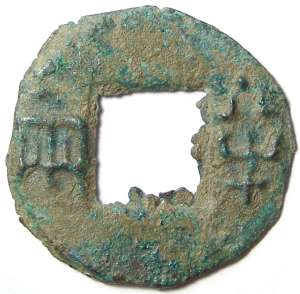
During the Zhou period, there had been a direct connection between the "Liang as a weight" (12 grams when applied to coinage) and the Liang as a coin denomination. About the time the Chin Dynasty established control over China (and possibly a little earlier), the Pan Liang (or 1/2 Liang) coinage was introduced at this weight standard (about 6 grams), but very quickly the connection between the weight and the monetary unite ceased to apply.
This series is difficult to classify, with specimens occurring at weights from 2 to 18 grams (but rarely over 12 grams), and diameters from 14 to over 34 mm. Having examined a number of Pan Liang hoards, I found most specimens within a single hoard will be of uniform diameter but the weight can vary significantly. This had lead us to believe the coins diameter is the important factor in determining the period or issue. While the AVERAGE weight of an issue is closely tied to the diameter, the weights of individual specimens can vary so much (up to 200%) as to be almost meaningless (see our earlier discussion of weights).
Unfortunately, not enough dateable hoard or archeological evidence currently exists to work out the exact classification of the Pan Liang series, but the Records of Han provide a clue, stating that heavy Pan Liang were cast until about 187 BC. I believe this refers to the larger specimens (over 30 mm) which range between 6 and 12 grams but averaging 7 to 8 grams or 15 shu. This is exactly 1/2 the weight of a ming style knife, and it maybe these were first introduced as a half unit of those knife coins, during the late Zhou period.
This could make the earliest issues contemporaries of the Ming-Huo Round Coin Series, but since they were cast to the heavy standard down to 180 BC, it may not be possible to differentiate between the Zhou, Ch'in and early Han dynasty issues. Much research is needed on this area.
Most references suggest that the large Pan Liang coins were the principle coinage of the Chin Dynasty, but a problem arose; they are rather scarce, in fact they have a higher scarcity than ming knifes and square foot spades. If they really had been the principle coinage of China for over 75 years, they should be fairly common. This takes us back to our earlier theory that square-foot spades, and possibly ming knifes, were still in use throughout much of the Ch'in period, and may in fact have been the principle coinage of Ch'in.
S-79-81, FD-385/6. Obverse: "PAN LIANG". Reverse: blank. These come in a wide variety of weights, ranging from about 9 grams to as high as 18 grams. Examples this size are scarce and like other Pan Liang coins, the heavier specimens are most prized by collectors so sell for more, even through all were probably part of the same issue.
It is likely 34+ mm Pan Liang coins are the earliest issues and may date to when the Chin Dynasty was a sub-dynasty under the Zhou. While specimens of this larger issue weighing over and under 12 grams probably date to the same period, many collectors value the heavier specimens more highly.
Under 12 grams: F $45.00 VF $65.00
30 TO 32 MM, (average 31 mm)
S-82-84. Obverse: "PAN LIANG". Reverse: blank. Average (4 specimens) 6.38 grams (range 4 to 12 grams). Collectors prize the heavier specimens, so the weight does affect the value in the market, but when these coins were in use it probably was not a factor in their circulating values. Specimens over 12 grams exist and command a premium price, but they are rare. The official records of Han suggest coins of this size were made continuously through later Chin and early Han so probably cannot assign them specifically to one or the other.
10 to 12 grams: F $65.00 VF $100.008 to 10 grams: F $50.00 VF $75.00
4 to 8 grams: F $30.00 VF $45.00
Pan Liangs under 30 mm can safely be assigned to the Western Han Dynasty and are discussed under that heading.
It seems likely the Ch'in government would have had a method of determining the mint and period of issue of any given coin, as such systems appear to have been in place on other coins for over 100 years. No mint marks occur on these coins, but it is unreasonable to assume all were cast at a single mint. The many calligraphy variations probably hold the key to this puzzle but with no official records extant, it is unlikely this will ever be fully understood.
Physical characteristics of Pan Liang are simple and consistent long throughout the Ch'in and Han periods. All have the two characters "Pan" and "Liang" flanking a square hole (many minor calligraphy variations exist), and the reverse is always blank. The edges are generally sharp and unfinished, with a rough area where the casting sprew was broken off. With the exception of some very late issues (Han period), none have inner or outer rims. They appear to have been cast in reusable carved stone (steatite) molds, several of which still exist today.
CIVIL WAR OF 206-202 BC
According to Michael Mitchiner (in Oriental Coins and their Values, The Ancient & Classical World, page 684), the suicide of Erh Shih Huang Ti (last Emperor of Ch'in) in 206 BC, resulted in a civil war in which a series of rebels fought for control of China. The most important of these rebels were Hiang-yu and Liu-peng. The Western Han dynasty does not actually begin until Liu-peng arose the victor, declaring himself Emperor of Han in BC 202.
No specific coins can be assigned to this period and it is likely a coinage based on the Ch'in types would have been continued.
WESTERN HAN DYNASTY
The House of Han ruled all China for almost four hundred years. The traditional starting date for Han rule is 206 BC but, as discussed above, 202 BC may be more accurate. They were first known as the Western Han, ruling from Ch'ang-an in Shansi Province. Broken only by the brief interregnum of Wang Mang's Hsin dynasty of AD 9 to 22, the Western Han lasted until AD 25 when the capital was moved to Lo-yang (in Honan Province) and the name was changed to Eastern Han.
EMPERORS OF WESTERN HAN
| Rebel Liu-peng | BC 206-203 |
| Kao Tsu formerly Rebel Liu-peng | 202-196 BC |
| Hui Ti with Lu Hou as regent | 195-187 BC |
| Empress Kao also known as Lu Hou | 187-180 BC |
| Wen Ti | 179-157 BC |
| King Ti | 156-141 BC |
| Wu Ti | 140-87 BC |
| Chao Ti | 86-74 BC |
| Hsuan Ti | 73-49 BC |
| Yuan Ti | 48-33 BC |
| Ch'eng Ti | 32-5 BC |
| Ngai Ti | 6-1 BC |
| P'ing Ti Wang Mang as regent | AD 1-6 |
| Ju Tze Ying Wang Mang as acting Emperor | AD 7-8 |
| Rebel Wang Mang | AD 9-22 |
| Kuang Wu Ti also know as Liu* | AD 22-25 |
*Liu was the last Emperor of Western Han
and the first emperor of Eastern Han.
PAN LIANG COINAGE OF THE HAN PERIOD
There is little doubt that the Pan Liang were the principle coins circulating at the start of the Han Dynasty, but the dating and proper classification of these coins has long been in dispute. However, the historical Record of Han Wu-ti (as recorded by Schjoth page 7-8) gives an outline of how this coinage developed during the Han period, and I have found the coins to be consistent with this record.
| YEAR | THE HISTORICAL RECORD OF HAN WU-TI |
| Prior to 187 BC | Down to the reign of Empress Kao (187-180 BC), Pan Liang of 12 shu circulated alongside illicitly cast lightweight Pan Liang, called elm-leaves. |
| 187-180 BC | During the reign of Empress Kao (187-180 BC) the Pan Liang was reduced to a weight of 8 shu. |
| 179 BC | Emperor Hsiao Wen reduced the Pan Liang to 4 shu. |
| 140 BC | Emperor Wu issued a new coinage called the "San-shu" (3 shu). |
| 136 BC | Emperor Wu withdrew the San-shu, replacing it with a Pan Liang of 3 shu. |
| 118 BC | The Pan Liang were withdrawn and replaced with the totally new Wu-shu (5 shu) coinage. |
Some researchers have dismissed the ancient records as nonfactual as they have difficulty matching the average weight of coins encountered, with those records. I think those researchers are forgetting that there are two possible weights meant by a shu, the first an official weight as a weight at 0.65 grams per shu, the second the weight a coin of that number of shu would weight at 0.5 grams per shu ( these official records to match the coins I see) as per this chart :
| PERIOD OF ISSUE | INDICATION IN OLD RECORDS | WEIGHT AT 0.65 GRAMS PER SHU | WEIGHT AT 0.5 GRAM PER SHU |
| Beginning of Han | 12 shu | 7.8 grams | 6.0 grams |
| Reform of 187 BC | 8 shu | 5.2 grams | 4.0 grams |
| Reform of 179 BC | 4 shu | 2.6 grams | 2.0 grams |
| Reform of 136 BC | 3 shu | 1.95 grams | 1.5 grams |
If you were to assume HAN WU-TI was using the 0.5 gram standard to which coins were actually made, his records do not match what is observed on actual coins. But if he used the official weight standard of a 0.65 gram shu, his records are consistent with the weight of actual coins observed. It is very possible he got the dates right as well. It is also important to remember that Chinese coins of this period are not of consistent weight, but they are of fairly consistent sizes. It is the average weight of large numbers of coins within one size range that must be considered, and based on that I get the following chart :
OFFICIAL HAN DYNASTY PAN LIANGS
Coins in this size range seem to average slightly lower than expected at 6.38 grams but very considerably from 4 to 12 grams. It is likely lighter examples are illicit castings and should not be included in the averages, while many of the heaviest ones would have been melted in ancient times because of their high weights but it appears they were not suggesting they were early issues. These are likely Later Chin or the earliest part of the Han period.
|
Coins in the 26 to 27 mm range average about 5 grams, very close to that expected. This suggest coins of this size were issued in the Han period and unlikely to have been issued as early as the Chin Dynasty.. F $6.00 VF $9.50 |
The Ban Liang coins in the 23 to 25 mm that are without outer rims average about 2.5 grams. These are the most common of all the ban liang types as they were made for the longest period, suggesting a date in the middle of the Ban Lian period. F $5.00 VF $7.50 |
Ban Liang coins around 24 mm but with outer rims are lighter than those without rims, averaging close to a1.95 grams standard. These are probably the last ban liang coins that were replaced by the Wu Shu coinage in 117 BC. F $5.50 VF $7.00 XF $10.00 |
This chart shows is that while the records of HAN WU-TI are probably accurate for the average weight of coins in particular periods, we cannot use those weights to date individual coins as there is too much variation between individual specimens. The sizes are much more consistent so the key to dating Ban Liang coins is the diameter, not the weight.
BAN LIANG ATYPICAL VARIATIONS
ELM LEAF BAN LIANGS
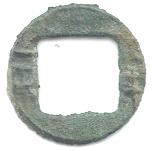
S-85-87 variety. Obverse: "PAN LIANG". Reverse: blank. These vary in size from about 12 to 18 mm, but are all very light weight and crudely cast. A recent group I had of 18 mm specimens averaged 0.45 grams each (which included the example illustrated). The prices very depending on the size and weight, and in this case smaller is better.
12 to 15 mm F $27.50 VF $32.5015 to 18 mm F $17.50 VF $25.00
Generally crudely cast, it is likely these are contemporary counterfeits and are often included with the coins referred to in the official Han records as dating before 180 BC. It is also likely light-weight illicit castings occurred throughout the Pan Liang period and I am not certain it is safe to assume them all date pre-180 BC.
BAN LIANG WITH RIMS
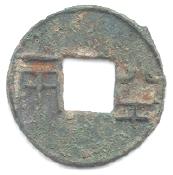
The Pan Liang coins with outer and sometimes inner rims (often poorly formed) tend to be lighter than those without any evidence of rims, usually around 2 grams. But they are in the roughly 24 mm size range. As discussed on the table above, they should be dated to the period following the coinage reform of 136 BC. Further evidence for this dating exists in the San Shu coinage discussed below.
F $5.50 VF $7.00 XF $10.00There are also a number of Pan Liang with odd variations that are fairly interesting but about which little is actually known. I will record here the varieties that come through our hands, but if you are interested in these there is a long list of them in Cooles work on this series.
BAN LIANG WITH REVERSED INSCRIPTIONS
S-96-98 variety. "LIANG PAN". On occasion I see pan liang coins with the inscriptions reversed (Schjoth has three specimens). They are too common to be simple errors, although we cannot rule out that they are contemporary counterfeits. A specimen I recently had was 23.5 mm and 2.25 grams, which is within the correct range for Ban Liang of the 179 to 136 BC period.
F $45.00 VF $75.00
BAN LIANG WITH EXTRA LINES
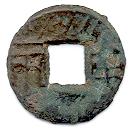
COOLE-9196. Obverse: "PAN LIANG" with four sloped lines at the top. Reverse: blank. One of the four sloped lines is weak, but they all look like they were put there intentionally and are definitely part of the original casting as they are in raised metal. The specimen illustrated is 24.5 mm, 2.8 grams.
VF $65.00
SAN-SHU COINAGE
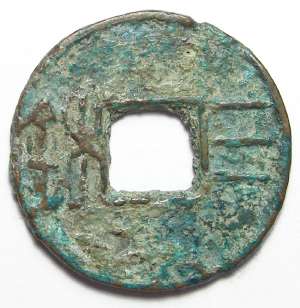
S-103. Obverse: "SAN-SHU" (3 shu) with a poorly developed outer rim. Reverse: blank. 22.5 mm. Average (3 specimens) weight 2.91 grams Size 23.4 mm. There is some variation on the size and weight of these.
VF $235.00The official records of Han say these San Shu (3 shu) coins were cast by Emperor Wu starting in the first year of his reign title Chien-yuan which is 136 BC during the period of the Ban Liang last Ban Liang coins without rims. The two specimens I have so far located averaged 2.55 grams, which is the same weight standard as those coins.
It would appear that Emperor Wu was attempted a coinage reform to replace the Ban Liang with a new monetary unit with one that actually named the Shu, but cast to the same standard as the already existing Ban Liang. The rarity of these coins show it was a short lived and failed experiment, and it is not difficult to see why. "SAN-SHU" (3 shu) implies a weight of 1.95 grams at the official weight standard of a shu, and 1.5 grams normal weight a coin of 3 shu. But they average about 2.5 grams which is the weight of a 5 shu coin. Thus they had a higher bullion value than their circulating value, making them ready targets for people to melt to profit from the excess copper in them. Emperor Wu may have done this thinking it would make them popular and thus would circulate, but got the opposite result (popular but would not circulate).
We have no knowledge of how long they were issued for. Their rarity could be because they were withdrawn immediately and the old Ban Liang re-issued at the 2.5 gram standard without rims for the next four years. It is also possible they were the principle coinage down to 140 BC when the lighter Ban Liang with rims was introduced, and their rarity due to excessive melting for their bullion value.
I originally thought these 3 shu coins were without rims, but a specimen recently in our hands (illustrated) had a very poorly developed outer rim on the obverse, similar to the rims on the Ban Liang reform of 140 BC, suggesting that developed directly from these. Thus I suspect it more likely they were issued from 136 to 140 BC but were melted in large numbers and are thus rare.
WU SHU COINAGE
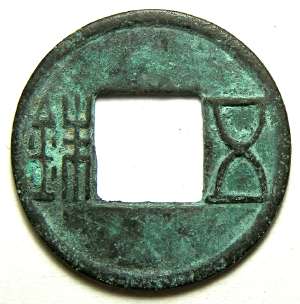
The record of Han Wu-ti says that in the fifth year of Yuan-shou (118 BC) the light weight Pan-liangs with rims were replaced by the Wu Shu (5 shu). Unlike the crude Pan Liang, Wu Shu were better cast with finished edges usually leaving no trace of the casting sprew, well developed outer rims on both sides and a inner rim on the reverse, and finer calligraphy of a more modern style. They average 2.5 grams which is a return to the weight standard of the Ban Liang of the 179 to 136 BC period, and which is exactly weight a 5 shu coins should weight (using the 0.5 grams per shu standard for coins). For the next three hundred years the diameter is very consistent at about 26 mm. Because of their very long period of issue, with very little change in the coins, they are very common today.
S-257, the generic, commonest Wu Shu type. Obverse: "WU SHU". Reverse: blank. Average 26 mm, 2.5 grams.
VG $2.00 F $3.00 VF $5.00
Most reference books list the standard Wu-Shu as having been cast continuously from about 118 BC until the start of the T'ang Dynasty in about AD 617. While I agree that coins of the Wu-Shu denomination were cast at various time throughout this period, it is our opinion that the basic standard Wu-Shu as illustrated above were probably only issued until the end of the Eastern Han Dynasty in about AD 220, and that all of the Wu-Shu issued after that date are of distinctly different styles and types. Our evidence for this is complex and is discussed throughout the page on this site devoted to the period between AD 220 and AD 600, but you will have to read the entire page to gain an understanding of it.
WU SHU VARIETIES
Most of the Wu Shu coins one comes across are the very generic type listed above, and one cannot date them exactly (they may have been made for up to about 700 years). It is beyond the scope of this site to list all the subtle varieties of the Wu Shu coinage, but I will list some of the major ones below as they come our way. Like the generic type, most cannot be dated accurately, however there are a few that can be and for these click on the Dynasty's name to link to that listing.
S-257, commonest Wu Shu type with a plain obverse inner hole, but with small but very distinctive evidence of the casting sprews remaining on the edges in two spots. This is simply a coin with improperly finished edges, but it is unusual and gives good evidence that this type was cast in "TREE" form. I have only noticed one of these.
VF $15.00
S-115, Wu Shu with a rim on the upper edge of the inner hole on the obverse.
VG $10.00 F $15.00 VF $25.00A mold for this type with a upper rim on the inner hole was found (reference Schjoth page 9) dated to the 2nd year of Shen-chio (60 BC), leaving little doubt this was an issue of Emperor Hsuan (73-49 BC).
S-258. Wu Shu with a small raised half dot on the lower inner-rim of the obverse.
VF $7.50 XF $9.50In March of 1998, I purchased part of a Wu Shu hoard which contained examples of S-115 (rim on the upper edge of the inner hole) as well as examples of S-259 and S-258 (small and large half dots on the bottom edge of the inner hole). All of the coins were basically as cast, or close to it, with identical powdery green patination over-layered by a very fine brown clay. There is little double but that these coins all came from the same hoard and must have been cast and circulated at about the same time. If S-115 dates to about 60 BC, then these two types must be from that general period as well.
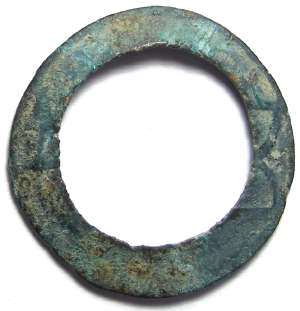
S-304, Wu Shu with the center punched out These are known as "Yen-huan" which means "thread rings". The specimen illustrated appears to have had the center cut out with a slightly irregular shaped punch used from the blank reverse side, and which has slightly dished the coin on that side. Average (6 specimen) 24.0 mm diameter, 16.1 mm inside diameter, 1.60 grams. It is not known exactly when or why these coins were cut down in this way, but the average weight on these suggest the possiblity of a 3 shu denomination.
VG $5.00 F $7.50 VF $10.00
WEI DYNASTY, AD 221-265. S-208-210, Bronze 5 shu. "WU SHU". 12.0 mm. Average about 0.75 grams. These diminutive coins have high rims which protect the characters, so these are seldom seen worn, but are sometimes softly cast. I have seen a few specimens with an intentional raised bump on the lower edge of the hole.
F $7.50 VF $17.00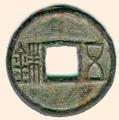
LIANG DYNASTY AD 502-557, issue of Emperor Liang Wu Ti. S-223. Bronze "WU SHU". Reverse: blank. This is the only Wu-shu variety with a full inner rim on the obverse.
F $22.50 VF $37.50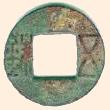
LIANG DYNASTY AD 502-557, issue of Emperor Liang Wu Ti.S-225. Bronze "WU SHU". Reverse: blank. This variety was cast with no rims at all and was known as the "Nu-ch'ien" (female cash).
F $22.50 VF $37.50LIANG DYNASTY AD 502-557, issue of Emperor Liang Wu Ti. S-227-231. Bronze "WU-SHU" with the left radical of "SHU" missing. Reverse: blank. Schjoth lists the type both with and without rims.
VF $60.00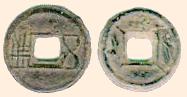
LIANG DYNASTY AD 502-557, issue of Emperor Liang Wu Ti. S-232. Iron "WU SHU". This variety was cast with full rims, and lines radiating from the corners on the reverse.
F $47.50 VF $69.50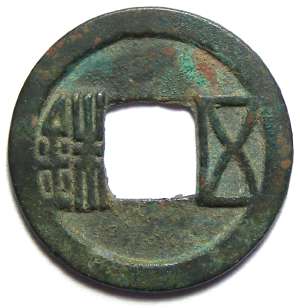
SUI DYNASTY, AD 581-618M Emperor WENS-253, "WU SHU" with very straight arms on "WU" and wide well-finished rims. From 10 specimens I found an average weight of 2.63 grams and a size of 2.8 mm.
F $5.00 VF $8.00This is just a few of the many Wu Shu varieties that were minted through out this period.
HSIEN WANG MANG, AD 7 to 23
The rule of Wang Mang was a very interesting time in Chinese history, but remember the old curse, "May you live in interesting times".
The exact dates and events that brought Wang Mang to power differ between references, but for the time being I am using mostly those given by Robert Tye in his essay WANG MANG (paperback, 20 pages) but in a few cases where noted other dates may be used. If you are interested in learning more about this period I recommend you track down and read his essay. Last I looked he still had a website and may have copies available.
Born about 47 BC into the most powerful family in China, a family that effectively ruled through a series of puppet Han emperors, Wang Mang held a series of high governmental posts until rising to Minister of War in 7 BC, but fell from favor and retired two years later.
Robert Tye records that in AD 3 Mang Mang became father-in-law to the Emperor, then in AD 6 was appointed regent to the child Emperor P'ing Ti. Michael Mitchiner (in Oriental Coins and their Values, The Ancient & Classical World) says Wang became regent to P'ing Ti in AD 1 replacing him with Ju Tze Yung in AD 7. Both agree in AD 9 (January 10 according to Tye) Wang declared himself Emperor establishing his "Hsin" (new) Dynasty.
The China of Wang Mang's time was one of extreme wealth overall yet most lived in extreme poverty. Wang set up a system very much like modern communism and used a series of monetary and economic reforms to confiscated the wealth of the elite, redistributing part among the common people. His first two coinage reforms, along with the nationalization of land in his economic reforms transfered the wealth of the elite to the state treasury where it remained until Mang's death at which time 150 tons of gold were found still in storage.
He tried with only partial success to abolish slavery, he nationalized land and distributed plots to those who wished to work it, and reformed the tax system to make it fair to all. He introduced a system attempting to regulate prices. His third coinage reform was intended to facilitate trade. None of this worked as he intended and his fourth and fifth reforms seem to have been an attempt to undo the damage.
Ultimately he created a nightmare of political and economic upheaval resulting in famines, anarchy and rebellions. The last years of his reign were a time of chaos during which it is estimated twenty-five million people died, about half China's population.
As with many aspects of the early years of Wang Mang, there is dispute over his reign titles, but so far I have found the following information which may not be fully accurate, but none of these titles appear on his coins.
| CHE-SHE ** | AD 7 to 8 | As acting Emperor of Han |
| HUANG-SHIH-CHU * or SHE-KIEN-KWA ** |
AD 9 to 14 | As Emperor of Hsin |
| T'IEN-FENG | AD 14 to 22 | As Emperor of Hsin |
*Tye **Mitchiner
WESTERN HAN ISSUES OF WANG MANG, AD 7 to 8
At the end of the Western Han Dynasty China was ruled by the family of Wang through a series of Han puppet emperors. There is dispute as to what happened in the first years of the first century AD, but it appears Wang Mang became regent for the child emperor P'ing Ti then in AD 7 he replaced P'ing Ti with the infant Ju Tze Yung, allowing Wang Mang go give himself the office of Acting Emperor (regent).
FIRST REFORM, introduced in AD 7
As acting Emperor he introduced his first of a series of coinage reforms with three new types. His intent was Wu Shu's would continue circulating for small transactions, but these to introduce a fiduciary (token) coinage to replace gold and silver in larger transactions. This was poorly received by a populous so Mang ordered that all gold be turned in and exchanged for the new coins. I have not found a record of the penalty for continuing to hold gold, but many of the aristocracy were executed at this time.
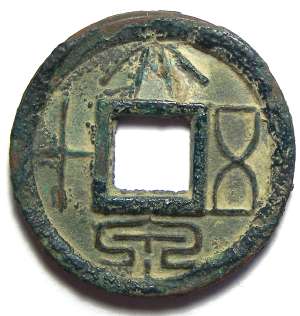
S-120+, "TA-CH'UAN WU-SHIH" (Great coin value 50). These are the only coins to circulate during all five of Wang's reforms, and today be very common. We see a great variety of sizes and weights, from about 1.5 to 10 grams. It is likely that the heavier specimens are the earliest and the lighter ones the latest, although specimens under 3 grams are likely contemporary counterfeits. There is a wide variation of calligraphy styles, probably indicating dates and mints, but this information has been lost to us. The high rims protect the coins from wear and these are seldom seen below a grade of VF.
As this type was used more later in his period it will be discussed again below with values.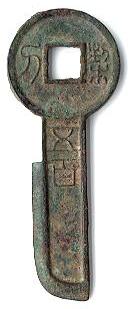
S-116, "CH'I TAO WU-PAI" (Ch'i knife five hundred), value 500 knife coin with the characters in raised bronze. About 75 mm long, 29 mm across the handle and 14 mm across the blade. Average weight (3 specimens) 19.4 grams (range from 18.4 to 20.3). The specimen imaged has been cleaned to reveal the glossy dark gray patina one often seen on Wang Mang coins.
VF $550.00 XF $750.00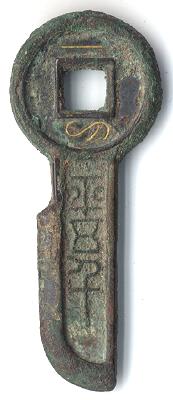
S-119, "YI-TAO P'ING WU-CHIEN" (One knife: value five thousand). The "YI-TAO" inscription on the handle is of inlaid gold. Valued at 5000 Wu Shu (25,000 shu). The specimen illustrated is 74 mm long by 15 mm across the blade and 27 mm across the handle. The weight of these varies considerable. The three specimens I have weighed range from 25.84 to 38.85 grams and average 31.41 grams.
F $1750.00 VF $3500.00At that time 5000 Wu Shu was equal to 1/2 cattie of gold. A cattie weighed about 120 grams, so these knifes were valued at about 60 grams (2 ounces) of pure gold. I have not been able to find a relative value for gold in ancient China, but in the same time frame in the Roman Empire, this would have been at least a year's wages to an average citizen.
These knife coins are sometimes referred to as key coins, and are very well cast, although on the value 500 the characters on the ring handle are sometimes weak. The edges are usually finished with slightly coarse file marks around the outside, but much finer file marks on the leading edge of the knife blade (as if the knife had been sharpened). Both types should be examined quite closely as good quality fakes exist. On the value 5000, genuine examples are often found with the gold inlays missing, but for which new inlays have been applied (such specimens are worth less). If the inlays are genuine, the patina should in part overlay them.
HSIN DYNASTY
Interregnum of Wang Mang, AD 9-23
SECOND REFORM, introduced AD 9
In AD 9, Mang de-monitized earlier Wu Shus and both the value 500 and 5000 knifes. The Ta-Ch'uan (great coin 50) round coins remained in use while he added a the smaller Hsiao-Ch'uan Chin-Yi valued at 1 Wu (5) Shu but with only 1 Shu worth of metal. Since the people had already been forced to turn in their gold in exchange for the high-value knife coins their de-monetization must have destroyed the wealth of many families.
With only two token denominations legally circulating, it appears at first people continued to use the earlier Wu Shu coins, not trusting the new currency. Mang Mang ordered anyone found holding earlier Wu-shus to be either banished or executed. He was obviously determined to see that the new coinage was accepted!
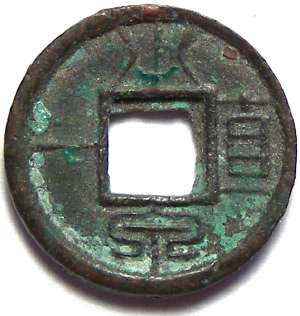
S-139-141, "HSIAO-CH'UAN CHIH-YI" (small coin value one). These are very small coins with very high rims and sharp characters but they occasionally show up cast from worn molds. These are seldom seem worn, so are graded according to visual appearance, which usually is most affected by casting quality and surface preservation. Schjoth lists these as rare, but this is certainly not true today. Average (11 specimens) 1.14 grams, 14.9 mm (but I have seen them from 14.0 to 15.5 mm, and about 1.0 to 1.32 grams).
F $12.00 VF $17.50 XF $22.50S-120+, "TA-CH'UAN WU-SHIH" (Great coin value 50). These are the only coins to circulate during all five of Wang's reforms, and today be very common. We see a great variety of sizes and weights, from about 1.5 to 10 grams. It is likely that the heavier specimens are the earliest and the lighter ones the latest, although specimens under 3 grams are likely contemporary counterfeits. There is a wide variation of calligraphy styles, probably indicating dates and mints, but this information has been lost to us. The high rims protect the coins from wear and these are seldom seen below a grade of VF.
| light (under 4 grams) | F $6.00 | VF $8.00 | XF $12.00 |
| normal (4-8 grams) | F $5.00 | VF $8.00 | XF $12.00 |
| heavy (8-10 grams) | F $8.00 | VF $10.00 | XF $15.00 |
| very heavy (over 10 grams) | F $15.00 | VF $20.00 | XF $30.00 |
It appears there was stil a major counterfeiting problem, as one would expect with these token coins containing so little value in their metal being forced to circulate at such high values. Wang Mang introduced the death penalty for counterfeiting although that does not appear to have solved the problem. It appears the death penalty did not stop the problem of counterfeiting, so a new approach was tried. The new penalty was confiscation of property, enslavement to the state for the counterfeiter, his family, and the entire families of his five nearest neighbors. I assume the theory was the neighbors should have some idea of what went on next door and would be likely to turn in the counterfeiter rather than risk themselves. There is no evidence that this worked.
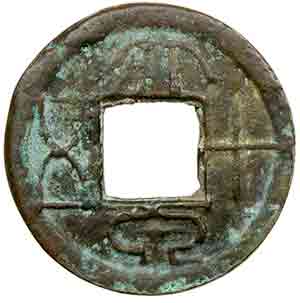
S-137, "TA-CH'UAN SHIH-WU", a variation on the Great coin value 50 type with with the Wu-Shih reversed. These is slightly cruder than the nomal Great Coin 50, with poorly formed rims, so I believe these are examples of counterfeits made at that time. Average (1 specimen) 6.33 grams, 26.5 mm.
F $75.00 VF $125.00 XF $225.00THIRD REFORM, introduced AD 10
With gold now outlawed and the high value knife money demonetized, large transactions must have been difficult. To facilitate trade a series of new small denominations round coins were added to those of the second reform, as 1, 10, 20, 30, 40 and 50 Wu Shu. Ten larger denominations were introduced in the form of spade money from 100 to 1000 Wu Shu by intervals of 100, bringing total number of denominations in useto sixteen:
| VALUE | INSCRIPTION | TYPE |
| 1 Wu Shu | HSIAO-CH'UAN CHIH-YI | ROUND COIN |
| 10 Wu Shu | YAO-CH'UAN YI SHIH | ROUND COIN |
| 20 Wu Shu | YU-CH'UAN ERH SHIH | ROUND COIN |
| 30 Wu Shu | CHUNG CH'UAN SAN SHIH | ROUND COIN |
| 40 Wu Shu | CHUANG CH'UAN SSU SHIH | ROUND COIN |
| 50 Wu Shu | TA-CH'UAN WU-SHIH | ROUND COIN |
| 100 Wu Shu | HSIAO-PU YI-PAI | SPADE COIN |
| 200 Wu Shu | YAO-PU ERH-PAI | SPADE COIN |
| 300 Wu Shu | YU-PU SAN-PAI | SPADE COIN |
| 400 Wu Shu | HSU-PU SSU-PAI | SPADE COIN |
| 500 Wu Shu | CHA-PU WU-PAI | SPADE COIN |
| 600 Wu Shu | CHUNG-PU LAI PAI | SPADE COIN |
| 700 Wu Shu | CHUANG-PU (7) PAI | SPADE COIN |
| 800 Wu Shu | TI-PU (8) PAI | SPADE COIN |
| 900 Wu Shu | TZU-PU (9) PAI | SPADE COIN |
| 1000 Wu Shu | TA-PU HUANG-CH'IEN | SPADE COIN |
With the exception of the two types from the previous reform, and the value 1000 spades, all coins of this reform are rare suggesting this was a very short-lived series in use possibly for only part of AD 10. There are several types for which I have never seen a genuine example, and cannot give any valuations or yet provide images. Fakes exist of all the rare types, so I recommend examining any specimens very closely.
The spade types are all found with and without a line extending from the hole to the upper rim, although the meaning of this line is uncertain. It may indicate two mints were operating, or that there were two different issues of these coins. These are poorly cast coin and usually seen with rather rough surfaces. Below are a few examples.
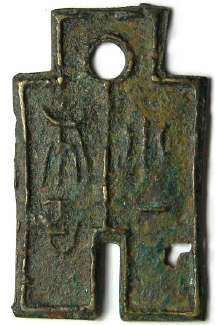
Hartill 9.20, Value 100 spade inscribed "XIAO BU YI-BAI" (meaning "small spade 100). Average (1 specimen) 32 x 20 mm, 5.46 grams (the specimen has a corrosion hole in it, so was probably just slightly heavier when cast).
VF with corrosion hole $265.00 VF $495.00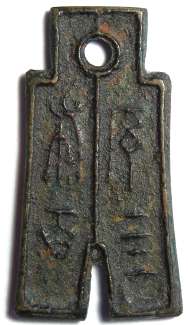
Hartill 9.23, Value 400 spade inscribed "XU BU SI BAI" (meaning ordered spade, 400). This type exists with and without a line extending from the hole to the upper rim (same value). This is a poorly cast issue, and usually seen with rather rough surfaces. Average (1 specimen) 28.1 x 20.4 mm, 7.51 grams.
VF $425.00 VF $575.00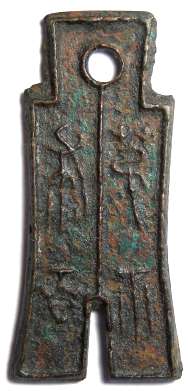
Hartill 9.27, Value 800 spade inscribed "DI BU BA BAI" (meaning Graduate Spade, 800). Average (1 specimen) 44.9 x 20.7 mm, 8.45 grams.
VF $425.00 VF $575.00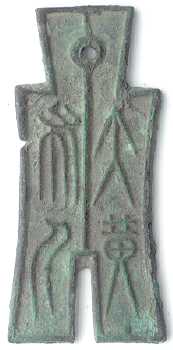
S-145-147, Value 1000 spade inscribed "TA-PU HUANG-CH'IEN". These are well cast with sharp characters. It appears that Mang's reign title at this time was "Huang-shih-chu". It is possible that the "Huang" on these coins is a reference to that title. Average (3 specimens) 57 x 25 mm, 12.01 grams (the weights vary slightly).
VF $55.00 XF $77.50The particular specimen illustrated has a slight casting flaw on the left edge, which will not be seen on most specimens (I pick it for the clarity of the characters)
Wang Mang compiled a list of values in Wu Shu for cowry shells, tortoise shells, silver and gold suggesting such items were used as currency up to his time, certainly during the late Western Han period but possibly all through the Zhou, Ch'in and Han dynasties. This does imply these items remained in circulation during Mang's reforms, rather as Robert Tye (page 14) speculates, these were rates to be paid in token currency when the old currency items were turned in. That best fits Wang Mang's overall methods.
| COWRY SHELL | UNDER 30 mm | 3 Wu Shu |
| COWRY SHELL | 30 to 60 mm | 5 Wu Shu |
| COWRY SHELL | 60 to 90 mm | 15 Wu Shu |
| COWRY SHELL | 90 to 120 mm | 25 Wu Shu |
| COWRY SHELL | over 120 mm | 108 Wu Shu |
| TORTOISE SHELL | 125 to 175 mm | 100 Wu Shu |
| TORTOISE SHELL | 175 to 230 mm | 300 Wu Shu |
| TORTOISE SHELL | 230 to 355 mm | 500 Wu Shu |
| TORTOISE SHELL | over 355 mm | 2160 Wu Shu |
| SILVER | 8 Taels (1/2 cattie)of Shu-shi | 1580 Wu Shu |
| SILVER | 8 Taels ordinary silver | 1000 Wu Shu |
| GOLD | 1 Cattie (120 grams) | 10,000 Wu Shu |
FOURTH REFORM
The experiment of the third reform was a failure, a fourth reform saw a return to the coinage of the second reform. The date of this reform is uncertain but most likely AD 10 to 14.
| VALUE | INSCRIPTION | TYPE |
| 1 Wu Shu | HSIAO-CH'UAN CHIH-YI | SMALL ROUND COIN |
| 50 Wu Shu | TA-CH'UAN WU-SHIH | ROUND COIN |
FIFTH REFORM, introduced in AD 14.
Wang Mang's 5th and last coinage reform saw two and possibly three new coins being added to the coins of the 4th reform. The first was the "Huo Ch'uan" valued at 1 Wu shu (5 shu) issued at five shu weight. The second was the "Huo-pu", a spade coin valued at 25 Wu Shu (125 shu). There is another fairly common coin called the "Pu-Ch'uan" not mentioned in the ancient records but appears to a third type in this series, possibly an early version of the Huo Ch'uan. These are all very well cast coins of fairly uniform size and weight and seldom show up in grades below VF.
While the Ta-Ch'uan Wu-Shih continued to circulate it had a reduced value of 5 shu. These coins are found in a variety of weights (discussed above) and it seems likely that the lighter examples were cast during this period.
| VALUE | INSCRIPTION | TYPE |
| 1 Wu Shu | HUO CH'UAN | ROUND COIN |
| 1 Wu Shu | PU-CH'UAN | ROUND COIN |
| 1 Wu Shu | TA-CH'UAN WU-SHIH | ROUND COIN |
| 25 Wu Shu | HUO-PU | SPADE COIN |
HUO CH'UAN COINAGE
The Huo-ch'uan coins are found with many minor varieties (Schjoth lists 21) and a few major ones. Some of the minor varieties may indicate mint marks, but many are probably illicit castings. The major varieties probably had meaning in the as to mints and dates but this information is now lost. There are far too many variations to go into here but I will include some more distinctive ones and a few representative examples.
It is possible, even likely, the Huo-ch'uan coins continued to be made and used during at least the early part of the Eastern Han Dynasty. While examining a recent group I noticed there seemed to be two sizes, one 21-22 mm and the other over 23 mm, suggesting two distinct issues possibly at different times, but there is not enough evidence yet form a firm conclusion.
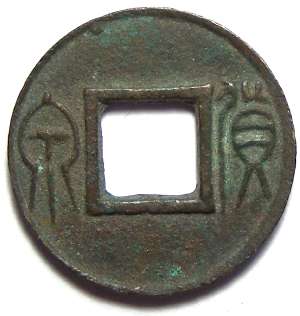
S-149 variety. Obverse: "Huo-Ch'uan". Reverse: blank. Average (20 specimens) 2.25 grams (range 2.0 to 3.45 grams), 22 mm (range 21 to 23.2 mm). Very well cast coins with finished rims.
F $4.00 VF $6.00 XF $10.00Schjoth & Coole not listed. Cut down "HUO-CH'UAN". These are well cast and clearly issues of Wang Mang, but have been cut down, removing the outer-rim and about 1/2 of the characters. The specimens I have examined range from 14.7 to 16.9 mm.
VF $8.00
FD-488. These are variations on S-149 that are very heavy, normally over 5 grams, and are about double the thickness of normal "HUO-CH'UAN" coins. There exact significance is not know, but they turn up on a regular basis suggesting they were made this way intentionally.
VF $17.50
I owned an example of this type with 4 rays extending from the corners of the inner obverse rim. It was 6.6 grams and 24.5 mm.
Coole-10111. Small "HUO-CH'UAN". The casting on these varies from slightly crude to quite good, but unlike the cut down examples they have full rims. The specimens I have examined range from 13.5 to 16.4 mm.
VF $8.00
I find it unlikely that these small and cut down Huo-Ch'uan could have circulated during Wang Mang's time but it makes some send they were used between the death of Wang Mang in AD 25 and the official demonitization of all his coins by AD 41.
PU CH'UAN COINAGE
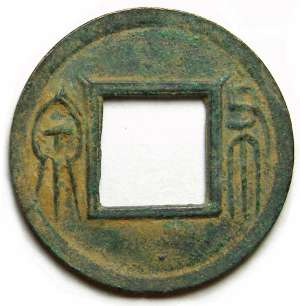
The Pu-Ch'uan coins exist with three major varieties, and while we may never know the meaning of these varieties, it is possible they indicate different mints. The specimens seem to vary between 25.5 and 26.5 mm and average (12 specimens) about 3.50 grams, there is considerable weight variation in these. All three types are of about equal rarity and of the same value. One seldom sees an example below a grade of VF, so these could not have continued to circulate for too long after they were minted.
S-175. Obverse: "PU CH'UAN" without any rays on the inner corners of the inner rim. Reverse: blank.
S-176. Obverse: "PU CH'UAN" with two rays extending from top corners of the inner rim. Reverse: blank.
S-177. Obvrse: "PU CH'UAN" with two rays extending from the bottom corners of the inner rim (as illusrated above). Reverse: blank.
all VF $10.00 XF $15.00Other minor varieties of this type exist. I had an example with no rays, but a dot on the obverse inner rim. These are very well make coins, with very well defined and finished rims. It appears they did not circulate a great deal because we have never seen a well worn specimen of this coinage (most specimens will be found in a grade of XF).
HUO-PU COINAGE
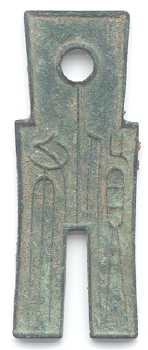
S-148, "HUO-PU", spade coin valued at 25 Wu-shu (125 shu). Average : 58.5 x 22.5 mm. 15.4 grams (12 specimens) but the weights do vary more than a gram either side of this.
These are the commonest of all spade coins, and must have been cast in very large numbers. They are attractive coins, very well cast with sharp calligraphy.
Most specimens of this type have edges that were file finished with file marks visible perpendicular to the coin, however about 20% of the specimens one encounters never had the edges finished, and a fine casting seam will be visible all the way around the edge.
VF $22.50 XF $32.00Wang Mang came to a very bad end. The Han raised an army of people displaced by Mang's reforms which on October 4 of AD 23 entered his capital of Ch'ang-an. Over a next few days of intense fighting Mang's troops were defeated, the palace was taken and Mang was hacked to pieces. The House of Han was once again on the throne.
It is interesting the coins of Mang's 5th reform must have met some acceptance as they continued to circulate for sixteen years after his death. Only in AD 40 or 41 were they fully demonetized and Wu Shu similar to those prior to Wang Mang were once again cast. This is probably why the coins of his 5th reform are so common today.
EASTERN HAN DYNASTY (AD 25-221)
In AD 22, a man connected to the House of Han and known as Liu, rebelled against and captured Wang Mang, re-establishing the Western Han Dynasty. As the last Emperor of the Western Han, Liu moved the capital to Lo-yang in Honan Province, at which time he also became the first Emperor of the Eastern Han and adopted the name Kuang Wu Ti.
EMPERORS OF EASTERN HAN
| Kuang Wu Ti also know as Liu* |
AD 25-57 |
| Ming Ti | AD 58-75 |
| Chang Ti | AD 76-88 |
| Ho Ti | AD 89-105 |
| Chang Ti | AD 106-107 |
| Ngan Ti | AD 107-124 |
| Chao Ti | AD 125-126 |
| Chuen Ti | AD 126-144 |
| Ch'ang Ti | AD 145-146 |
| Che Ti | AD 146-147 |
| Huan Ti | AD 147-167 |
| Ling Ti | AD 168-188 |
| Chao Ti | AD 189-190 |
| Min Ti | AD 190-190 |
| General Tung Cho through several puppets |
AD 190-192 |
| Courtier Ts'ao-ts'ao through a puppet |
AD 192-220 |
| Ts'ao-pei ** son of Ts'ao-ts'ao |
AD 220-221 |
* Liu was the last Emperor of Western Han and the first emperor of Eastern Han.
** Ts'ao-pei was the last Emperor of Han and first Emperor of the Wei dynasty.
Although this is a list of official Emperors of the Eastern Han, following Emperor Ming Ti, most were ineffective figure heads with real power in the hands of a bureaucracy of public officials, members of the courts and military generals. The most powerful of these appears to have been Ts'ao-ts'ao, who ruled through a puppet emperor (whose name is uncertain) but who was forced to give up his throne in favor of Ts'ao-pei, Ts'ao-ts'ao's son. As Ts'ao-pei was not of the House of Han, he quickly moved to establish the Wei Dynasty.
The Han dynasty did not exactly end in AD 221, as Liu Pie, a legitimate member of the House of Han opposed Ts'ao-pei, establishing himself in Szechuan Province as first Emperor of the Minor Han Dynasty. For the next 300 years, there was a member of the House of Han ruling some part of China under various dynastic names, probably ending in AD 589 with the fall of the Ch'en Dynasty.
Few innovations occurred in Eastern Han coinage. Wang Mang's last coinage continued to circulate, and may have continued to be cast, until about AD 41 when they were demonetized and the Wu Shu were re-introduced. Only two identifiable Wu Shu varieties can be shown to have been cast during the Eastern Han (from inscriptions on molds). For the most part only generic Wu Shus were cast, in the pattern used for almost 700 years.
Emperor KUANG-WU, AD 25-57
Reign title: Chien-wu, AD 25-57
The coins of Wang Mang continued to circulate until the 16th year of Chien-wu (AD 40). These coins are today more common than one would expect if they had only been cast during the last 8 years of Wang Mang. This suggests that they continued to be cast during the first 16 years of Kuang-Wu. After AD 40 the Wu Shu was re-introduced, but no specific varieties can be assigned to this period (Schjoth mentions a mold has been found with markings indicating it was used in the 20th year of Chien-wu (AD 44) (reference Schjoth page 13). The type is standard.
Emperor LING, AD 168 - 189
Reign title: Chung-ping, AD 184-189
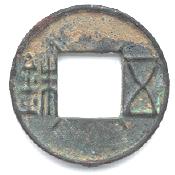
S-178a. Obverse: "WU SHU". Thought to have been issued in AD 186, the obverse has four rays extending from the corners of the central hole, and an inner rim only on the reverse. Reverse: blank. These coins are fairly common, but seldom grade below VF, suggesting a large issue with a short period of circulation. Average (8 specimens) 3.9 grams, 25.5 mm.
F $15.00 VF $25.00 XF $35.00S-179. Obverse: "WU SHU". Reverse: blank except similar to S-178a except that the four rays extending from the inner rim are on the reverse rather than the obverse. Average (9 specimens) 3.58 grams, 25.5 mm.
F $15.00 VF $25.00 XF $35.00
The rays extending from the inner rims on these coins are said to represent the four walls of a city. As of yet, I can find no reason to assume this is true. The use of rays radiating from the central hole, but with varying numbers of them, also occur on the Huo Chuan and Pu Chuan coins of Wang Mang.
On some recent groups of these, I noted the examples with rays on the obverse seemed to be slightly heavier and slightly higher grade than those with rays on the reverse. This tends to suggest that the reverse rays examples were an earlier issues than the rays on obverse type, but the sampling is still too small to be sure that this is a correct analysis.
REBEL TUNG CHO, ca AD 190
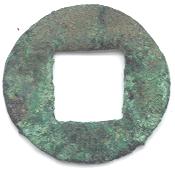
S-180. Obverse: blank. Reverse: blank. No rims on either side. Average (1 specimens) 1.23 grams, 21.5 mm. There is no way to grade this coinage, as there is nothing on it to wear (I just grade them all VF). The last specimen I handled looked distinctly like the outer edge was a cut edge, but the patination was intact over all surfaces.
VF $35.00There is a slightly cryptic notation on page 13 of Chinese Currency, by F Schjoth, where he writes "The records of this Emperor" (Emperor Hsien, the last ruler of Han, AD 189-220) "state that during the 1st year of Ch'u-p'ing (AD 190) the rebel Tung Cho did away with the Wu-shu coinage. He cast smaller coins and melted down for the purpose the bronze images and horses found at Ch'ang-an (Hsi-an Fu)". From this I believe he might be trying to say that the blank coins without rims (S-180 above) are the issue of the rebel Tung Cho.

period between from between the Han and Sui dynasties.
Copyright © 1997 - 2025 R & T Enterprises Ltd.