 |
 |
|
Grading Ancient CoinsGrade describes the wear or appearance of wear on a coin. Technical grading describes physical wear only so a coin with no wear but struck with worn dies and only exhibiting VF details would still be graded Mint State. Visual grading describes how a coin actually looks so the same coin would be graded VF. In my opinion the proper way to describe ancient coins combines technical and visual grading so the same coin would be described as "VF due to worn dies" or "VF as struck". MINT STATE - (Uncirculated)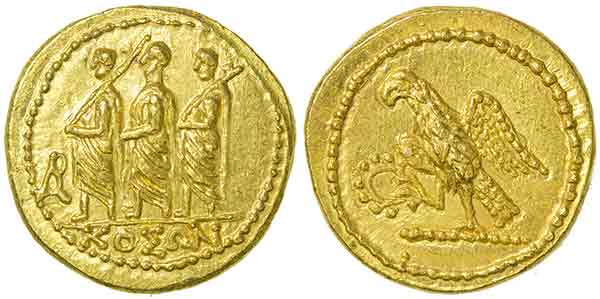
A coin is Mint state if it has no wear. All both major and minor details are as sharp as the day it was minted. This Koson stater previously discussed in the FDC page is a mint state coin. 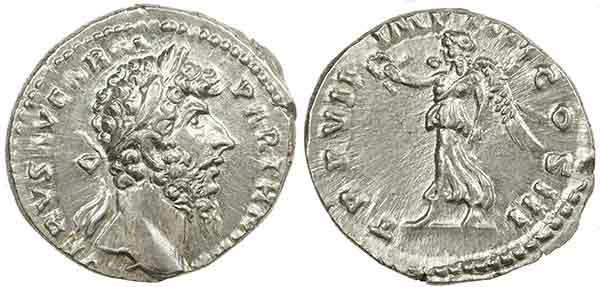
This Lucius Verus denarius is also mint state bit has the appearance of minor wear on the high point of the laurel due to minor striking weakness. One can see there is no physical wear as the high point on the reverse figure of Victory are very sharp. Parts of the border and inscription are off the edge so while this coin is Mint State but not of FDC quality. Judging any particular coin requires experience or research to understand how freshly minted examples of the type normally look. Lucius Verus denarii were stuck with finely engraved dies and usually have very sharp details. Koson staters were struck with crudely engraved dies with courser details. Relative to what is expected of these types; both the Koson and Lucius Verus are nice examples of mint state coins. EXTRA FINE (XF) or EXTREMELY FINE (EF)Extra Fine (XF) and Extremely Fine (EF) are interchangeable with some books using one and some the other, describing coins with only minor wear to the highest details with all other details remaining relatively sharp. About Uncirculated (AU) is a grade used for modern coins very near mint state, but good Extra Fine (gXF) or occasional near Mint State is preferred for ancient coins. 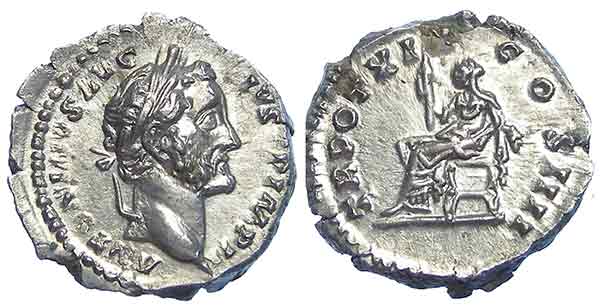
This Antoninus Pius denarius qualifies as gXF or Near Mint state on both sides. There is a trace of wear at the top of the laurel, with slightly more at the center of the reverse. It has a well-centered good strike but has a slightly ragged flan. When I sold this coin it was described as gXF on a ragged flan, which I priced as I would have an average XF on a good flan. 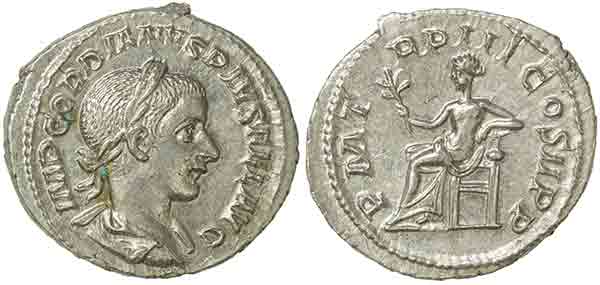
This Gordian III denarius is a typical grade of XF, with minor even wear. All minor and major details are still clear and there is a general crispness to the overall coin. No minor details blur together. 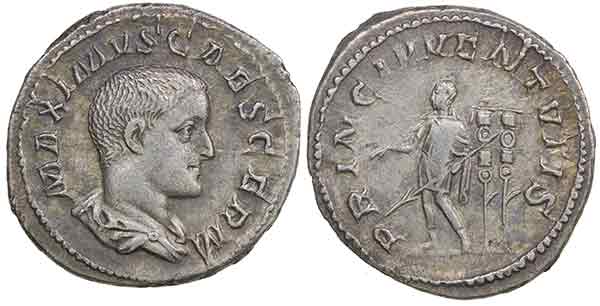
Coins tend to strike about the same on both sides so a weak area on the reverse as seen on this Maximus denarius will have a corresponding weakness directly opposite on the obverse. That holds true on this coin but the weakness on the obverse is on Maximus' cheek where there are no details so you don't notice it. Coins also tend to wear evenly on both sides, so we know the flat area at the center of the reverse is due to strike as there is no equivalent wear on the other side. The technical grade of this coin is XF but its visual grade is "XF/aVF due to a weak reverse strike". Most Roman coins are valued more according to their portrait quality unless they have a rare or important reverse. The portrait on this coin is very nice so the weaker reverse reduces the value to a little less than a well struck overall XF, but still more than a well struck average VF. VERY FINE - (VF)Very Fined describes a coin with significant wear to minor details but major details remain clear. At the lower end of VF smaller details such as laurel leaves show significant wear but only the highest leaves begin to merge. At the high end details such as laurel leaves show good separation. The grade of VF has a broad range with about Very Fine (aVF) or good Very Fine (gVF) are used to describe coins slightly more or less worn than a typical VF. 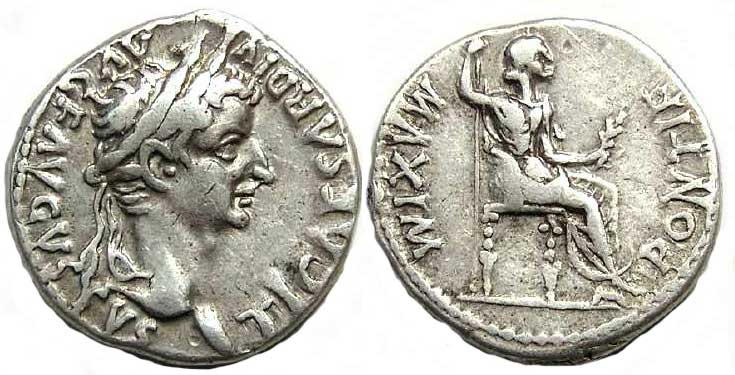
This Tiberius denarius grades average VF with the overall laurel wreath distinct but some individual leaves merging. There is significant wear to all high points but major details such as the laurel wreath outlines, jaw line, cheek edges and facial details remain clear. This type is normally found a little off-center, often with the TI for Tiberius off the edge. This specimen has full inscriptions on both sides which is unusual and raises the value a little above that of an average VF slightly more off-center. 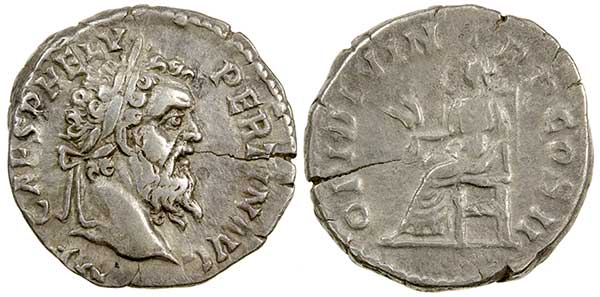
By technical grading this Pertinax denarius is a gVF, slightly less worn than the Tiberius denarius. The laurel leaves are complete with strong internal detail. The reverse has a visual appearance of Fine due to having been struck with a worn die so the proper visual grade is "gVF/Fine with a flan crack". It should be valued is the same or slightly less than an example in an average VF on both sides without a flan crack. 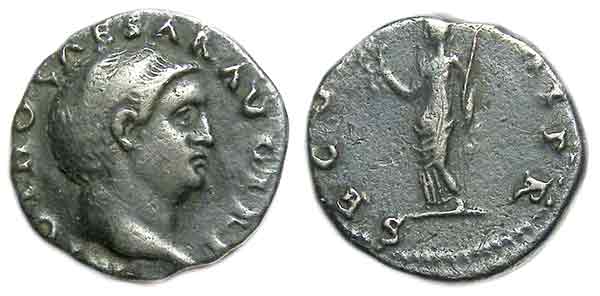
Some types such as this Otho denarius have high relief portraits that wear very quickly across the top. Most collectors make allowance for this so while the flat hair at the top of the head would be consistent with a grade of Fine on a normal relief coin, this coin would still be considered a VF. FINE - (F)The grade of Fine also has a very broad range and describes a coin with heavy wear with many minor details worn through but major details are still clear at all the highest points. 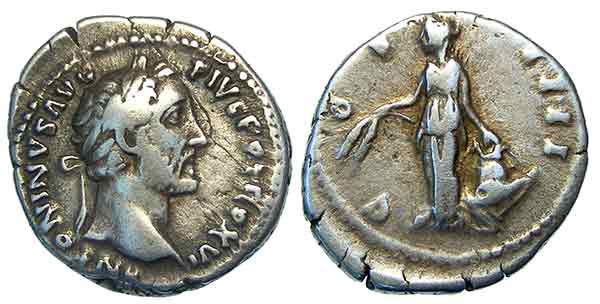
Grading a typical Fine (F) the laurel wreath on this Antoninus Pius denarius is completely worn through at the top and there is heavy wear to the beard. Half of the ear is worn off but the lower parts of the eye, nose, jaw line, and outer parts of the hair still clear. Major details such as the outline of the cheek are still clear. There is significant wear to the reverse but the overall design is still clear. The significant scratch in front of the portrait reduces the valued to a little less than an example grading average fine without a scratch. VERY GOOD (VG)Very Good (VG) describes a coin with most minor details is worn nearly smooth across the main center of the designs but details remain visible around the edges. Even major details may blur together. Inscriptions present on the flan will be worn but still legible. 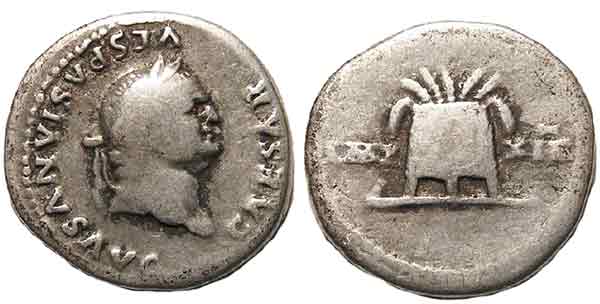
This Vespasian denarius grades a very average VG with portrait details present only around the edges and the hair merges into the forehead and cheek, but the deeper jaw line remains visible. Coins worn to VG are still collectable, but more to collectors interested in their historical context rather than their esthetics, and valued much lower than higher grade coins of the same types. Once worn to VG, minor problems with centering, strike and light damaged, have less effect. GOOD - (G)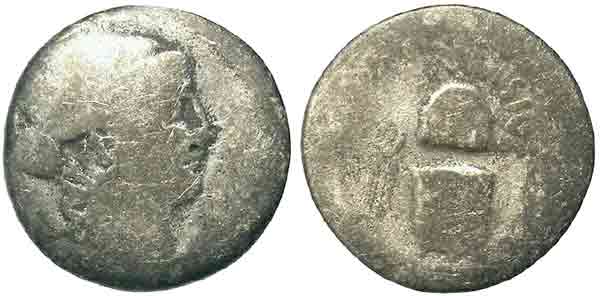
Good describes a coin with even major details worn through. The designs are little more than outlines and sometimes incomplete outlines. Inscriptions may be present but difficult to read. Identification to a general type should still be relatively easy, but attribution to a sub-variety defined by small details might not be possible. This T. Carisius denarius is a typical grade of Good. ISIV of CARISIVS is legible but main designs are just outlines. Coins like this are valued only for their historical interest with this particular type the only ancient coin to show minting equipment making it interesting to many collectors and giving it a value of about $40.00 versus the $600 or more a nice example of the type, and where an ordinary reverse of the same type might sell for $10.00 or less. FAIR (FR)FAIR describes a coin so worn that even the largest major details blur into the fields. Inscriptions are mostly gone and the coin may be very difficult to identify even to a general type, sometimes only as far as the general category of Roman but not the particular series. 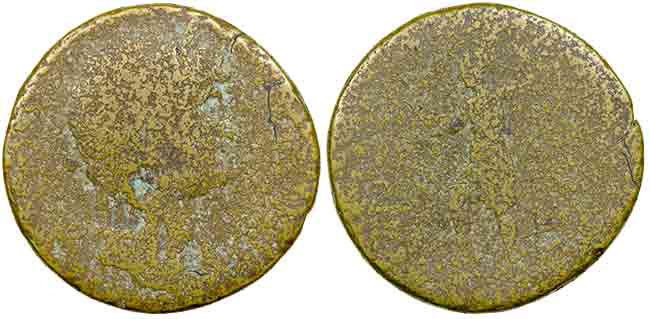
This Roman sestertius is worn to the point all that remains is an outline of a portrait and a standing figure on the reverse. No inscriptions remain and a novice collector might realize it is a Roman sestertius but not which Emperor. An collector experienced in this might recognize the outline of the portrait with is most likely Domitian, and the standing figure is most likely Minerva, but it is impossible to determine which of the which inscription variety this coin might have once had. A common coin like this in Fair is of little to no value. 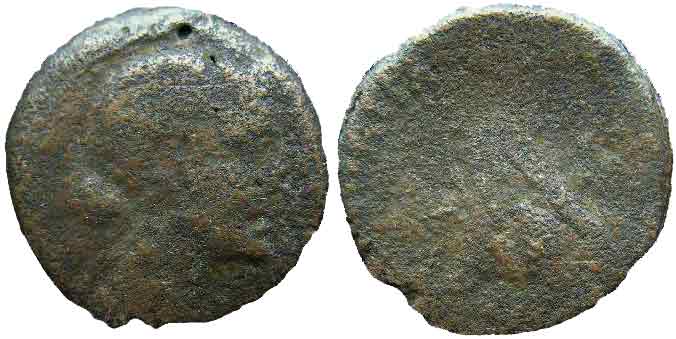
This Cleopatra VII bronze can be identified by the unique outline of her portrait. The obverse grades slightly closer to Good than Fair but the reverse is a typical Fair where you might not even realize it depicts an eagle unless already familiar with the type. It is not possible to determine if it is her 40 or 80 drachma as the denomination marks is worn off. As a a scarce and very popular historical type this examples still has some value but as a friend once said to me "Why would I want to own a coin, if I have to look it up in a book to find out what is on it". 
Next page: Conclusion Copyright © 2016 R & T Enterprises Ltd. |
 |
 |