
Fake Alexander the Great Tetradrachms from Ben Hur.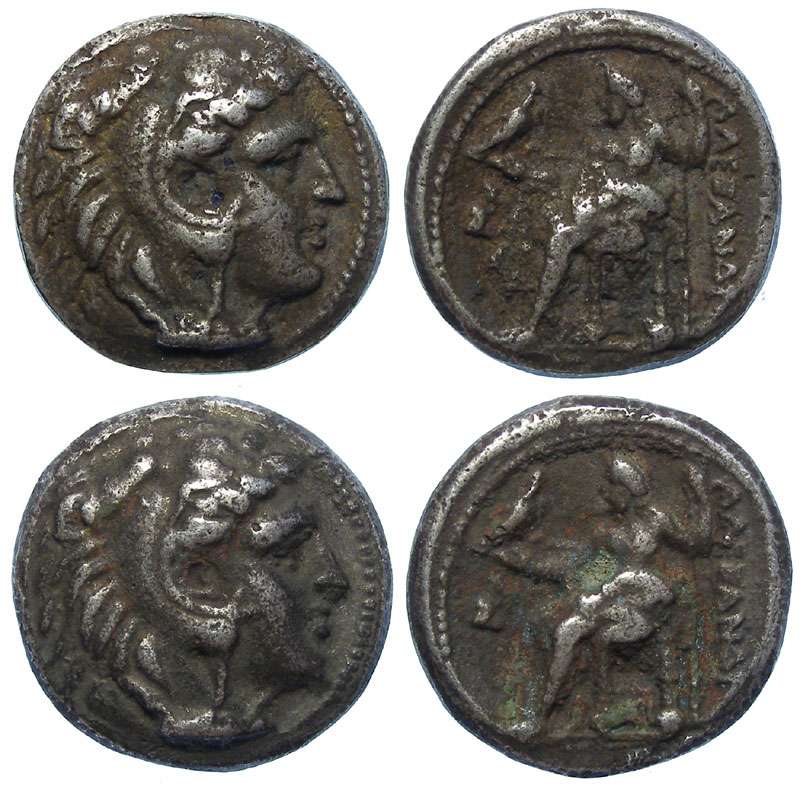
Enlargement of Obverse These are two examples of a modern fake of an Alexander the Great tetradrachm. They are from a group of 5 given to me at a coin show in Toronto so that I could document them here. The party that gave them to me said he bought them in Egypt in 1960, where they were called "Ben Hurs" having been made by the thousands to fill the money chest Sheik Ilderim was bringing with him to Judea to wager on the Chariot race in the 1959 movie Ben Hur. This would be typical Hollywood, as the that event would have occurred between AD 27 and 34, which the original coins of this type would have circulated later than about 75 BC. Recently I was able to watch Ben Hur on a high definition TV and can confirm that these are what was in that chest as they are just visible as Sheik Ilderim stirs them up. WEIGHT:average 12.88 grams (16.8 is normal) SIZE: average 25 mm (about the same as originals) STYLE: similar to originals and probably cast from a genuine coin. MANUFACTURE: Probably sand or clay mold casting, and test positive for silver. FIRST IMPRESSION: Fair to poor CHARACTERISTICS: This fake, when held in the hands, is not dangerous for several reasons. First is that at 12.88 grams they are far to low of weight for this type. Secondly, while about the right diameter they are thinner than one would expect, and anyone familiar with these will know immediately something is wrong. Third, there are many tiny casting bubbles and the edges are filed to remove a casting seam with no attempt to hide the file marks. Forth, they have been artificially patinated. RELATIVE DANGERDEALERVery low EXPERIENCED COLLECTOR Very Low NOVICE COLLECTOR Low to moderate On an internet auction with only an image these could be slightly more dangerous if a poor quality image is intentionally created. 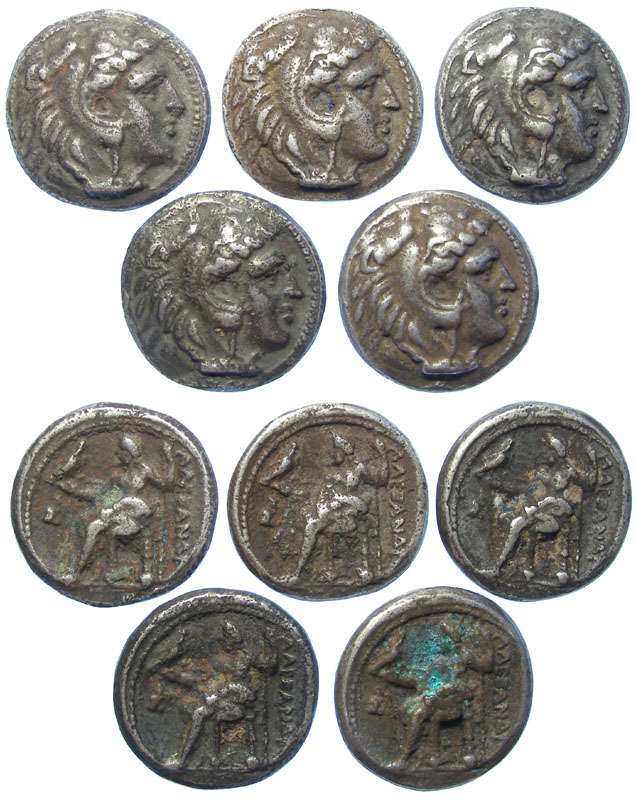
This image of five together clearly shows how all five are identical enough to be certain they cast from the same master, yet many of the finer details are different due how the mold picks up slightly different details each time the master is impressed. Back to examples of fakes. Top of Page
|


 |
 |
 |