 |
 |

|
Celtic Ring Money, or Not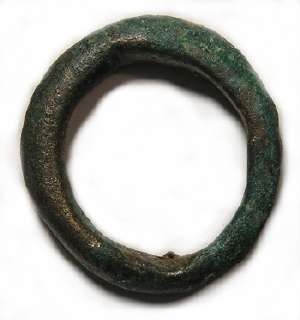 28.4 mm and 10.65 grams In recent years thousands of simple bronze rings similar to this have been sold as Celtic ring money. While there is evidence for Celts using metal rings as money, all types that can be documented as likely money have more complex shapes, and none are of bronze. Most are lead or possibly tin. The confusion comes when they are found in small groups, similar to small coin hoards, and people seeing this similarity assume these are also coin hoards. The have not considered another possibility that makes more sense once you understand how they were used and see my grouping below. 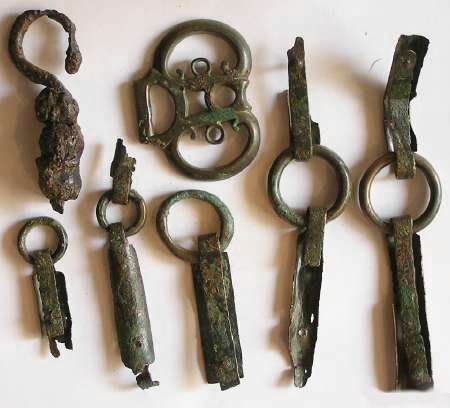
These bronze objects were found together and there can be no confusion as to what they are. I purchased them in 2003 from a well-known American ebay seller. The complex object at top center is an eastern Romano-Celtic bronze strap end and round hole to the left through which a metal rod could pass means it is likely one side of a horse bit. It is 2nd to 3rd century Roman, probably of Celtic workmanship or at least inspired by Celtic design. The hook end object at the upper left is also part bit and based on the size likely for a horse. The other objects are all strap junction rings, in this case with extra bronze clasps so one end can be attached with rivets to leather straps, which the other end can have cords wrapped through them. Together these are is part of a more elaborate horse harness. Most ancient harnesses were simpler harnesses with only the rings but not the extra attachments for leather. 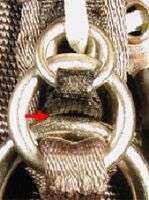
Today some modern harnesses are still made with metal rings, such as this skydiving harness with steel rings through which cords are wrapped. Many modern horse harnesses are also made this way, as were most medieval and ancient Greek and Roman harnesses. When only cord straps were used with simple rings, on burial the organic straps decay within a relatively sort period, and all that remains to be found is a clump of metal rings that looks very much like a coin hoard. A complex harness can have 20 or more rings and it is not difficult to see how such a group would be miss-understood as a monetary hoard. Considering the role horses played in the ancient and medieval world, there are likely millions of harness rings buried, waiting to be found. As harnesses have been made this way for at least 3000 years, a cluster of simple rings with nothing unusual about them, or other context which can be dated, could be from any period. The common assumption to date them to ancient Celtic is not correct. Some has been said that the fancy rings, often with multiple lugs, must be the true ring money. 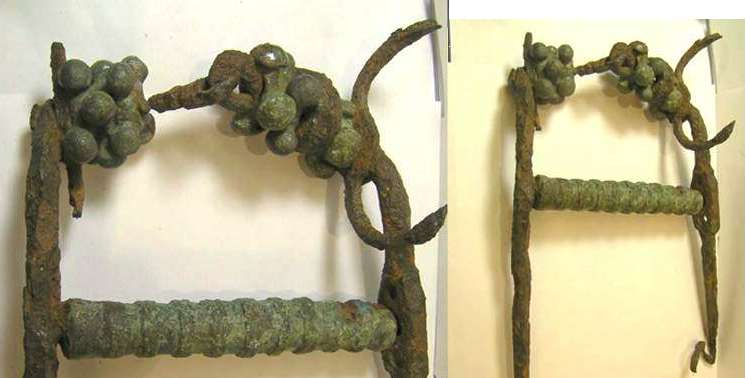
Image used by permission of Windsor Antiques in New York. Here is a group of larger rings, each with four knobs, still on the large oxen bit and were designed to make the bit uncomfortable in the animals mouth, resulting in them less likely to fight the bit. Many other similar rings commonly sold as Celtic ring money also have similar explanations. Spindle whorls are weighs used in weaving and spinning yarn. They are common called Les fusaioles in France, and are another type of object often mistakenly described as Celtic ring money in spite of being post medieval, more than 500 years after the Celtic era. 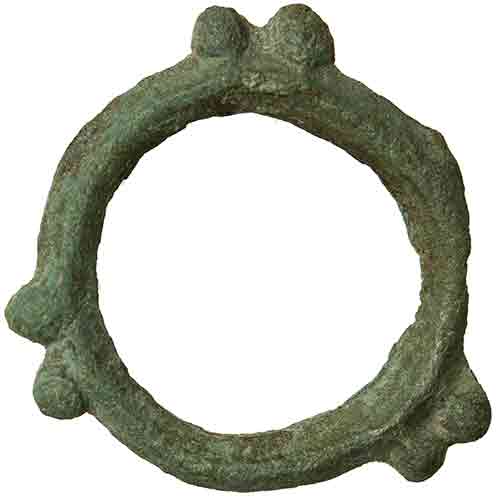
This ring has six evenly spaced knobs in groups of two. Often offered as Celtic Ring Money with the knobs described as decorations and sometimes denomination marks, these are another type of harness ring used to joined multiple (in this case three) straps. The knobs keep the straps separated so the harness does not tangling. Again not monetary items and nothing suggest a specific Celtic origin. These particular ones are likely Roman period, but that is by no means certain and without further context could be anywhere in about the past 3000 years. The earliest likely true ring money, commonly from Celtic sites in Great Britain although similar examples are found as far away as Persia, were gold rings which can be either fancy or fairly plain. 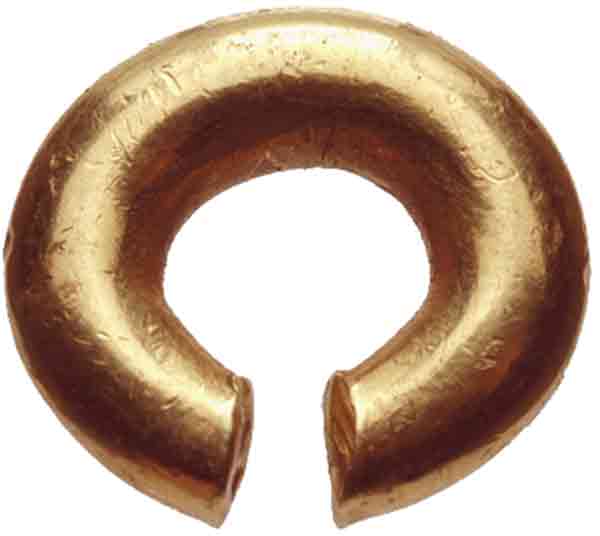 Plain ring money image by Classical Numismatic Group, fixed price list 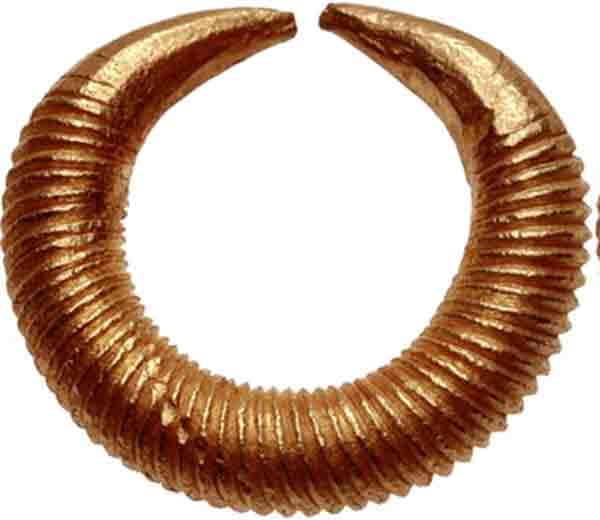 Fancy gold ring money image by Classical Numismatic Group, auction 85, lot 139 I am not aware of any silver or bronze ring money that can be confirmed as a type money, but during the Celtic period in parts of France and Switzerland we see tin and potin (a tin alloy) rings with spokes like a wheel, which are too soft or fragile for use as harness rings, and since the tin was a semi-precious metal at the time, they were likely used as currency. 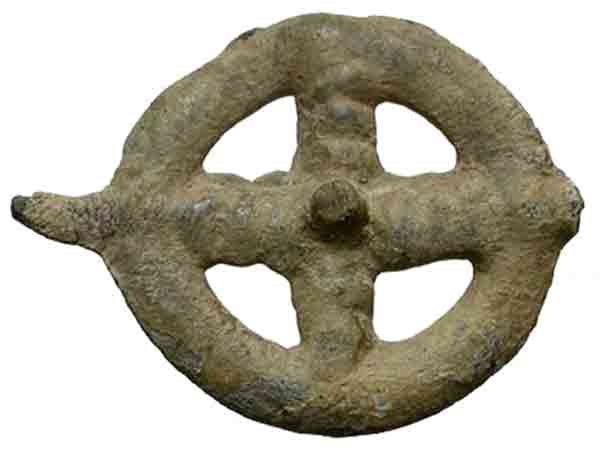 Tin or Potin Celtic Wheel Money Image by Marc Breitsprecher Hundreds of variations on this wheel money are known, and it seem likely they were made by local authorities, not any central authority. They may have been used more as a trade item for trading tin rather than a monetary item like a coin, but that still qualifies them in the category of primitive money. © 2016-2021 R & T Enterprises Ltd. |
 |
 |